
Internal communications employees actually absorb — Egypt & the Gulf
GoldinKollar is an internal communications consultancy for enterprise employers in Egypt, Saudi Arabia, the UAE, Qatar and Oman. We audit, design and run bilingual employee communication systems built around what people actually absorb rather than what was sent, then measure whether the message changed anything.
- Compliance
- Performance
- Engagement
- Advocacy

 Written and reviewed by Islam Yousry, Head of Research and Strategy ·
 What is internal communication? A working definition
Internal communication is the discipline of designing how information, decisions and expectations move through an organisation so that employees understand them, remember them and act on them. It covers channels, content, cascade through managers, and leadership voice. It is measured by comprehension and behaviour change, not by how much was sent.
One reading of internal communication treats it as a publishing function: a newsletter, an intranet, a quarterly town hall, an announcement when something large happens. That is distribution. Distribution is the cheap half of the job. The expensive half is retention: whether a shift supervisor in a warehouse can explain the new policy a fortnight later, and whether they follow it.
It is also not internal PR. Communication that only carries good news loses the audience it most needs during restructuring, integration or a difficult quarter. The discipline sits closer to organisational behaviour than to marketing. Its working parts are audience segmentation, message architecture, manager cascade, upward feedback loops, and measurement against comprehension and action.
Signs your internal communication has stopped landing
These are the sentences that come up first when the system has stopped working. If two or more sound like your organisation, the problem is systemic rather than editorial.
- We send the announcement, the open rate looks fine, and three weeks later nobody can tell you what changed.
- Our site and frontline teams have no company email, so everything reaches them second-hand through a WhatsApp group nobody controls.
- Leadership is convinced communication is clear. The engagement survey says the opposite, every year.
- Managers are supposed to cascade, but each one edits the message differently and some skip it entirely.
- We bought an employee app or intranet, launched it, and adoption collapsed inside two months.
- Everything is written in English first and translated into Arabic late, so the Arabic version reads like a legal notice.
- We are going through a merger, a restructure or a transformation programme, and rumour is travelling faster than we are.
What it looks like when it runs.
Real programs with real people. Tap one to see how we run it.
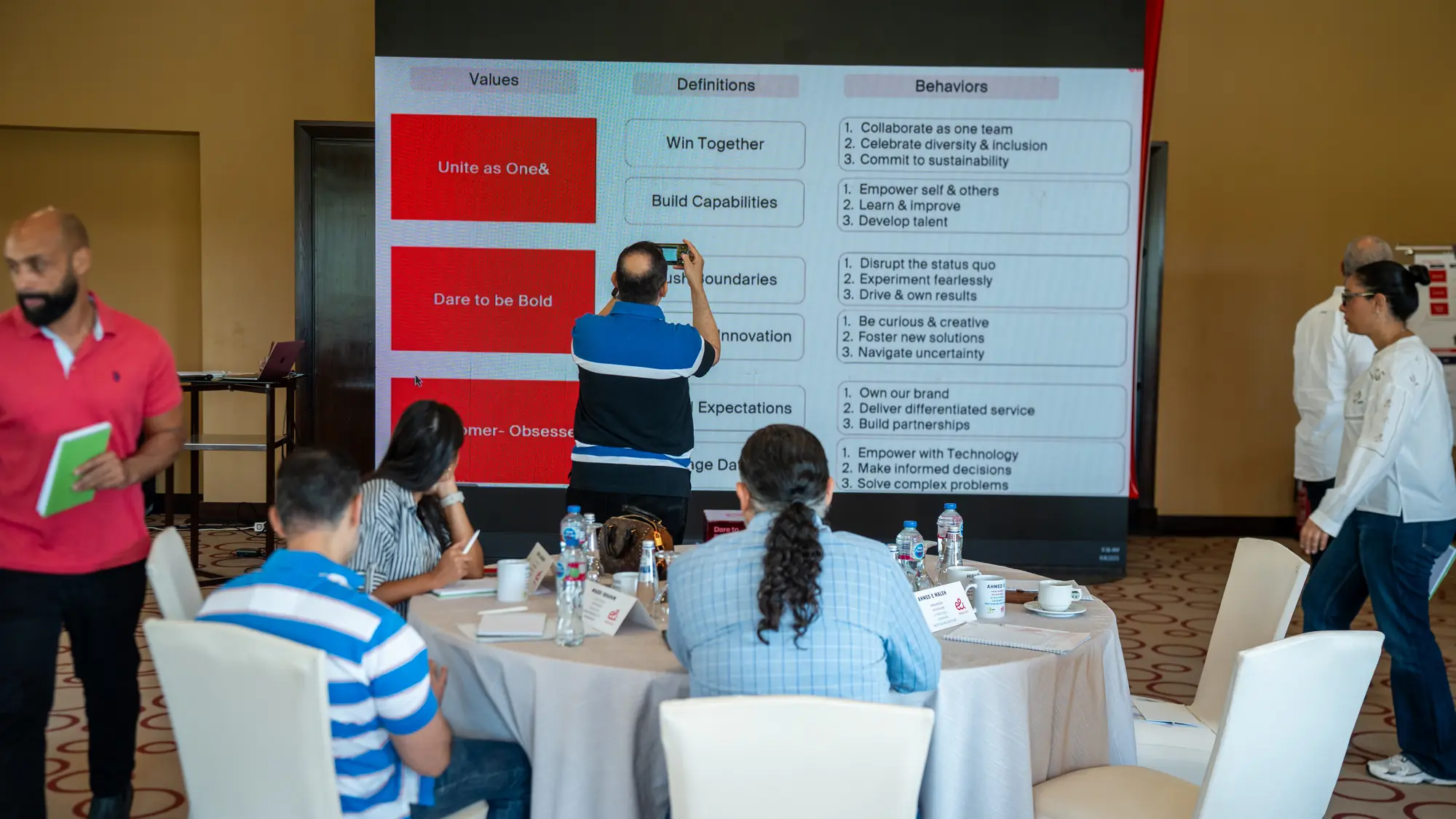


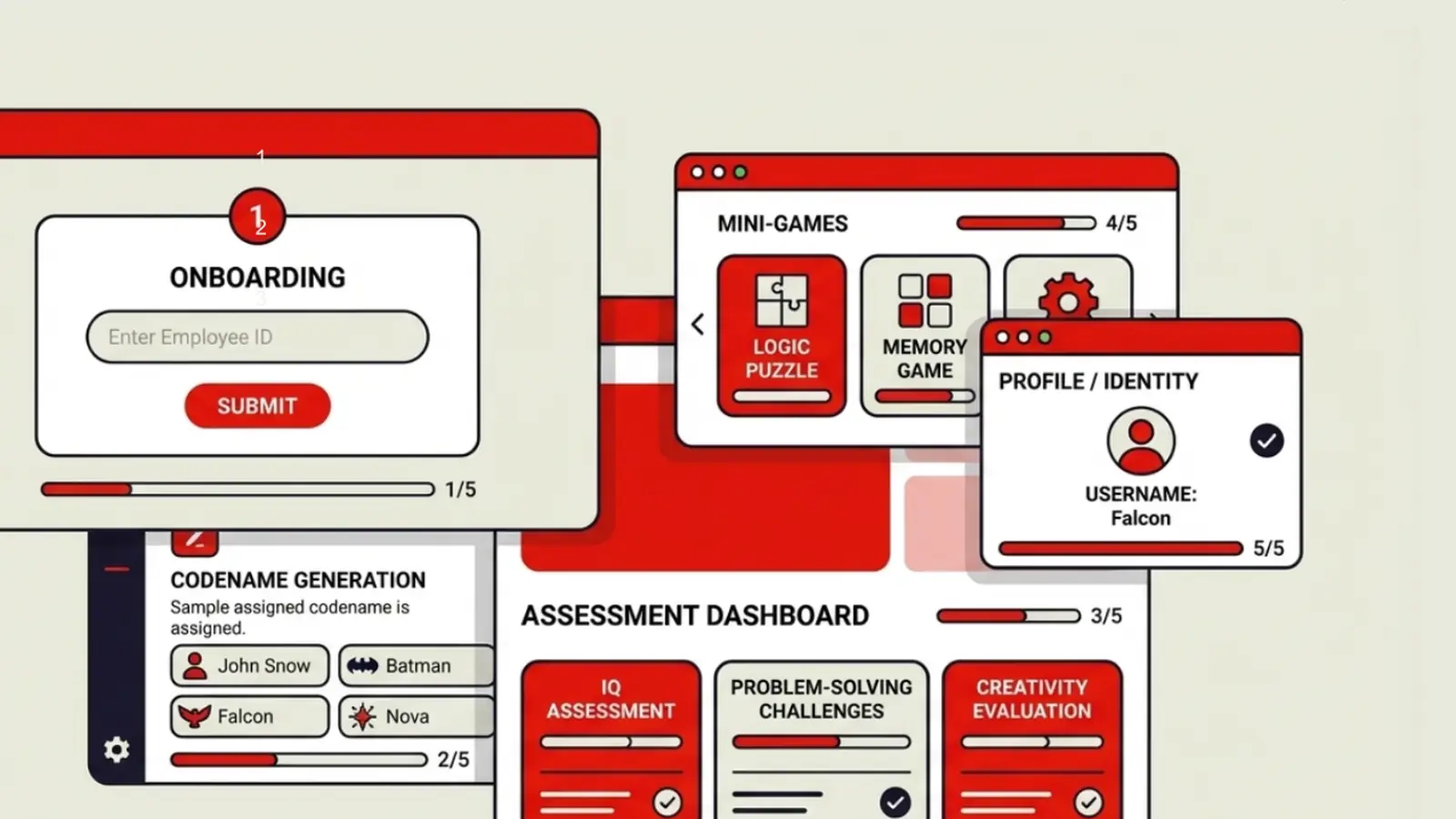


Internal communication in Egypt, Saudi Arabia and the UAE
Bilingual is the baseline, and translation is not the same as communication. Arabic drafted late from an English original arrives in a stiff Modern Standard register that employees skim and discard, while the same message written natively in the register people actually use at work lands. That register is not one thing: an Egyptian factory floor, a Riyadh head office and a Dubai service team each read differently, and a policy notice needs a different voice from a leadership message. Practising this discipline in the region means writing in Arabic and English in parallel, not sequentially.
Workforce structure changes the channel problem. Manufacturing, retail, hospitality, logistics and construction employers across the region carry large deskless populations with no corporate email address, working shifts, often across several nationalities and languages on one site. Head office communicates through systems those employees cannot open. Nationalisation programmes then change who is listening, and they do it through a mechanism worth understanding. Saudisation under Nitaqat bands an employer according to how many Saudi nationals it employs, and the band it sits in governs its access to ministry services, including work visas and permits. Emiratisation targets are set for private-sector employers and monitored, with financial consequences for shortfall, while the Nafis programme sits alongside them to support Emirati employment. Omanisation works to similar effect. The practical consequence is the same in each market: national hiring is measured, and so is national retention, which turns the onboarding narrative for national joiners into a governance obligation rather than an HR nicety. An employer that recruits well and communicates badly loses the people it is being counted on. Vision 2030-scale transformation in Saudi Arabia adds a volume of internal change that a communication function staffed for business-as-usual cannot absorb. High power-distance dynamics compound all of it. Announcements are received rather than questioned, so silence in the room is not agreement and the absence of complaints is not comprehension.
Two practical constraints follow. WhatsApp is already carrying internal messages informally across workplaces in the region, so the real decision is whether the organisation runs a governed mobile channel or cedes the ground to an ungoverned one. And employee data is regulated, though not uniformly, which matters more than it sounds. Saudi Arabia's PDPL and Egypt's Personal Data Protection Law 151/2020 both now sit on issued implementing rules, so hosting, lawful basis, consent, retention and who may process employee survey data are live questions rather than future ones. The UAE has a federal personal data protection law in force with its executive regulations still pending, which is a reason to design conservatively rather than to wait: fix your anonymity thresholds, minimum reporting-group sizes and data residency now, and you will not be rebuilding a pulse programme mid-cycle when the detail arrives. Anonymity thresholds are a design decision, not a footnote, because the moment a reporting group is small enough for people to identify each other, the honest answers stop.
Large single-country headcounts across manufacturing, retail, banking and outsourcing. Egyptian colloquial register carries internal messages far better than Modern Standard Arabic, and a Cairo head office and governorate sites need genuinely different channel mixes. Law 151/2020 is the operative instrument for employee data, and with its executive regulations now issued the alignment period is running rather than pending, which puts a date on decisions about where survey data sits and who is permitted to process it.
Riyadh and Jeddah employers are running transformation programmes and rapid Saudisation at the same time. National joiners arriving at pace need an onboarding narrative and a working manager cascade rather than more announcements, because Nitaqat banding makes their retention a governance matter and not only an HR one. PDPL, with implementing regulations in force, shapes where pulse data sits, how consent is handled and how small a reporting group can be before anonymity stops being real.
UAE workforces bring several nationalities and working languages onto a single site. Dubai and Abu Dhabi head offices operate in English while site and service teams operate in Arabic, Hindi, Urdu, Malayalam and Tagalog, so a single translated announcement will not reach everyone it names. Emiratisation creates a distinct national-talent audience with its own communication needs, and the federal data protection law is in force while its executive regulations are still pending, which argues for conservative survey design now.
Project-driven employers run mobilisation and demobilisation cycles rather than a steady headcount, so the communication calendar restarts with each phase instead of running to an annual rhythm. Where the workforce on a Doha site is engaged through a contractor rather than employed directly, your message reaches those people through someone else's supervisor, on someone else's channel. That is a governance problem before it is an editorial one, and it needs settling in the contract rather than in the newsletter.
Omanisation ties national employment to progression, development commitments and in-country value expectations, which makes career-path communication a standing agenda item rather than a campaign that runs once. Talent pools in Muscat are small and closely connected. What a leaver says about how a decision was communicated travels further, and faster, than it would in a larger market, so the quality of a difficult internal message has an external half-life.
Our internal communications services: audit, strategy, channels, campaigns and measurement
Five service lines. The diagnostic comes first unless you can already say, segment by segment, who has a verified working route to your messages. Every later decision on channels, language and cadence is priced and designed against that map.
IC Diagnostic and IC Quality Index
01Channel inventory and real reach by segment, content sampling, message-tracing interviews from the executive team down to the frontline, a manager cascade test, and a short bilingual pulse. We trace three actual recent messages end to end rather than asking people how communication feels in general. The IC Quality Index scores four things: channel architecture, message clarity, leadership communication capability, and governance.
Communication Strategy and Channel Architecture
02Audience segmentation by site, shift, language and access. Message architecture tied to the year's business priorities. A channel matrix that states what each channel is for and, more usefully, what it is not for. Governance, ownership and editorial rhythm, including who may publish without approval and who may not.
Change and Transformation Communication
03Restructuring, merger and acquisition integration, ERP and policy rollouts, nationalisation programmes and transformation-scale change. Stakeholder mapping, sequencing, leadership scripting, manager question-and-answer packs, and active rumour management, because in a close-knit workforce silence is read as bad news and travels quickly.
Campaign Design and IC Modules
04Single-behaviour campaigns on safety, ethics and speak-up, policy adoption, wellbeing or values in practice, built as spaced sequences rather than one launch. Three modules carry the delivery, each scoped to a different failure. Trivia Clans turns mandatory knowledge into team-based competitive retrieval, for content people are required to know and routinely forget. Spot the Problem places employees inside a realistic scene and asks them to find the safety, security or conduct failure, building pattern recognition instead of clause recall. The white-label IC Mobile App earns its place when the channel itself is the constraint, giving role-based feeds and push notifications to people with no corporate email address.
Embedded IC Capability
05For organisations without a full internal communications function. We run the calendar, write and produce in Arabic and English, and build the in-house capability in parallel. Retained, with a defined exit.
How we work: measure, strategize, implement, transfer, document
The five stages are the same in every GoldinKollar domain. What is specific here is the baseline. It is not a survey score. It is three of your own messages, traced from the executive team to the frontline, and the record of where each one stopped.
 01
01Measure
An IC Quality Index baseline: a maturity score across channel architecture, message clarity, leadership communication capability and governance, a friction map of where signal is lost, the segments that are dark, and how much of three traced announcements survived the cascade.
 02
02Strategize
The internal communications strategy and channel matrix: what each audience needs, on which channel, in which language, at which moment, and who owns it.
 03
03Implement
Bilingual content, manager cascade kits, spaced campaign sequences and platform or module configuration, run live against the editorial calendar.
 04
04Transfer
Capability inside your team: cascade coaching for people managers, briefing and writing standards in Arabic and English, and platform ownership moved in-house.
 05
05Document
An internal communications playbook your team can run without us: templates, tone-of-voice standards, channel rules, escalation paths and the dashboard definitions behind every metric.
How we measure internal communication effectiveness
What gets measured gets improved. These are the metrics we build into every engagement, defined honestly, including where each one is weak.
The proportion of the intended audience with a verified working route to the message, broken down by segment. Distinct from what was sent. Dark segments, meaning populations with no working route at all, only become visible when reach is measured segment by segment rather than in aggregate.
Channel-level engagement proxies. Useful for comparing a channel against itself over time. Inflated by preview panes and distorted by image blocking, so unfit as a standalone board metric.
The proportion of an audience who can correctly answer a small number of questions about the message after a deliberate delay, tested through a pulse item or an in-app quiz rather than immediately after reading.
The proportion who completed the specific behaviour the communication asked for: enrolled, reported, updated, attended, complied. The only metric that maps cleanly to a business outcome.
The proportion of people managers who ran the briefing inside the agreed window, plus the variance in what their teams then report understanding. Variance is usually the more revealing figure, because it shows which parts of the organisation are running on a different version of the message.
GoldinKollar's maturity score for an internal communication function, assessed across channel architecture, message clarity, leadership communication capability and governance, and reported with a friction map of where signal is lost. Re-scored to show movement rather than to produce a single number for a slide.
Behavioural science and gamified delivery: designed for retention, not distribution
Internal communication is easy to optimise for distribution rather than for effect. The plan is judged on whether the message went out, on time, in both languages, through the approved channels. We optimise for retention: what an employee still knows and does a fortnight later. That changes design decisions. One ask per message rather than five. Framing built around the decision the employee actually faces, not the decision the executive committee made. Timing placed at the moment of action rather than at the moment of approval. Spaced repetition and retrieval instead of a single launch event, because spaced exposure produces better long-term retention than a single massed event (Cepeda et al., 2006), which is why the sequence matters more than the announcement. The nudge literature from Thaler and Sunstein (2008) is useful here for a narrow reason: defaults, framing and friction move behaviour more reliably than exhortation does.
Gamification only appears when it has a job, and each module is scoped to a different failure. We are against forced fun. Trivia Clans is a team-based knowledge contest built for the content people are required to know and routinely forget: policy, cyber security, product detail, the corporate narrative. It works because retrieval practice produces better long-term retention than re-reading, as Roediger and Karpicke (2006) demonstrated. Spot the Problem puts employees inside a realistic scene and asks them to find the safety, security or conduct failure in it, which builds pattern recognition rather than recall of a clause number, and shows you where the mental model is wrong rather than where the wording was unclear. The white-label IC Mobile App earns its place when the channel is the constraint rather than the content: role-based feeds, push notifications and campaign modules for people who have no corporate email address to write to. In all three, comprehension and participation data is generated as a by-product of use, so you stop running a separate survey to find out whether anything landed.
AI is used where it earns its place and nowhere else. Drafting Arabic and English variants at the right register for each audience, segmenting distribution by shift, site and language, clustering free-text pulse comments so nobody reads four thousand rows by hand, and flagging the specific points in the cascade where comprehension drops. Editorial judgement stays human, and leadership voice is written by people. A synthesised CEO message is the fastest way to lose the trust the channel exists to carry.
See 3 pieces of internal communication work in practiceInternal communication vs engagement, experience, culture and employer branding
Internal communication, employee engagement, employee experience, culture and employer branding are routinely used as synonyms in briefs, which is why budgets end up funding the wrong work. Internal communication is the mechanism. The other four are the conditions it operates in, or the outcomes it contributes to.
| Term | What it actually means |
|---|---|
| Employee engagement | The outcome state: discretionary effort and commitment. Communication is one input into it. Improving communication can lift engagement, but a well-run channel cannot compensate for a broken manager relationship or an uncompetitive offer. |
| Employee experience | The full sequence of moments an employee moves through, from offer to exit. Internal communication carries and frames those moments, but does not design the process, the system or the policy underneath them. |
| Culture | The behavioural norms people actually follow when nobody is enforcing them. Communication can make norms explicit and repeat them, which matters. It cannot install a norm that leadership behaviour contradicts. |
| Employer branding | The promise made to an external audience of candidates. Internal communication is where that promise is either kept or exposed. Where the promise and the lived reality diverge, the gap tends to show up first in early attrition, because the new joiner is the person best placed to notice it. |
Internal Communication modules we deploy
Start with one module, prove value, then connect it into the broader system.
IC Quality Index
A metric-based audit that assesses channel architecture, message clarity, leadership communication capability, and governance—then produces a prioritized plan to fix signal loss.
Trivia Clans
A “territory conquest” knowledge war game. Teams win by answering questions about policies, products, values, cybersecurity, and key business narratives—making mandatory knowledge social and memorable.
Spot the Problem
Employees identify security, safety, and compliance issues in realistic scenes. This builds pattern recognition and safer behavior under real conditions.
IC Mobile App (White‑Label)
A centralized, role-based internal comms hub that reduces noise and improves reach and clarity—integrating campaigns, learning, and analytics into your ecosystem.
What an internal communications engagement looks like: scope, timeline and what drives cost
Engagements are quote-based, so instead of a rate card, here is the shape of the work and the variables that genuinely move the number. The diagnostic is the smallest sensible unit of work and can be commissioned on its own, which is usually the right way to start, because everything after it is scoped against the baseline it produces.
- Diagnostic
Typically three to five weeks. Channel inventory, content sampling, tracing of three recent messages, manager cascade test, short bilingual pulse, executive interviews. Ends with an IC Quality Index maturity score, a friction map and a ranked list of failure points.
- Strategy and architecture
Typically three to four weeks after the diagnostic. Segmentation, message architecture, channel matrix, governance model, editorial calendar and the measurement framework with named owners.
- Build and run
Three to twelve months depending on scope. Bilingual content production, cascade kits, spaced campaign sequences, module and platform configuration, and live measurement reported at the close of each campaign.
- Transfer and document
Runs alongside the final phase rather than after it. Manager cascade coaching, IC team capability building, and the playbook that lets your team keep the system running once we step out.
- Headcount, and the number of sites and countries in scope
- The proportion of the workforce that is deskless, and therefore harder and costlier to reach
- How many languages are required, and whether Arabic is written natively or translated
- How many channels are being redesigned, and whether platform or module configuration is included
- Whether we run the communication calendar or coach an in-house team to run it
- Depth of measurement, and whether a change event such as merger integration adds legal and leadership review cycles
Engagements are scoped and quoted individually. Book a diagnosis and we will size it against your context.
Internal Communication questions, answered
What does an internal communications agency actually do?+
What is an internal communications audit, and how often should we run one?+
How do you measure internal communication effectiveness?+
How do you reach frontline and deskless employees who have no company email?+
Do you deliver internal communications in Arabic as well as English?+
How much does an internal communications engagement cost in Egypt or the Gulf?+
Should we hire an internal communications agency or build an in-house team?+
We already have Staffbase, Workvivo or SharePoint and nobody uses it. Do we need an agency or better content?+
Trace three of your own messages before you write another one
Every engagement starts the same way: a bounded diagnostic that follows three real messages from the executive team to the frontline and returns a scored baseline with a friction map. You get a clear read on where communication is breaking before anyone writes a word of new content. Available across Egypt, Saudi Arabia, the UAE, Qatar and Oman, in Arabic and English.