
Psychological safety at work: what it is, what it is not, and how leaders build it

The weekly operations meeting ends the way it always does. The general manager presents the plan and asks, "Any questions?" Nobody speaks. A planning engineer three levels down saw the flaw in the delivery schedule on Sunday. She says nothing, because the last person who challenged the plan in that room was corrected in front of everyone. The schedule slips in week three, and the post-mortem asks why nobody raised it earlier.
That silence has a name. It is the absence of psychological safety, and it is one of the most expensive things a team can lack, because you never see the cost in the room. You see it later.
The short answer: psychological safety at work is a shared belief in a team that it is safe to take interpersonal risks: to ask a question, admit a mistake, disagree with a senior person or offer an unfinished idea without being embarrassed, rejected or punished. Amy Edmondson defined it in 1999 and linked it to how teams learn. Google's Project Aristotle later ranked it first of five dynamics of effective teams. It is not comfort, niceness or low standards. Leaders build it through what they do when someone speaks up, and in hierarchical workplaces that matters more, not less.
What the research actually found
The term is used loosely, so it helps to go back to the two sources most people cite.
Edmondson (1999). In a study of 51 work teams in a manufacturing company, published in Administrative Science Quarterly, Amy Edmondson defined team psychological safety as "a shared belief held by members of a team that the team is safe for interpersonal risk taking". Three findings matter for managers:
- Psychological safety was associated with learning behaviour, which she described as seeking feedback, sharing information, asking for help, talking about errors and experimenting.
- Learning behaviour, in turn, sat between psychological safety and team performance. Safety helped performance through learning, not by making people feel good.
- Team efficacy, a team's confidence that it can do the job, was not associated with learning once psychological safety was taken into account. Confidence alone did not make teams learn.
She also found that the support teams got from the organisation and the coaching they got from their leader were positively related to psychological safety. Context support was statistically significant; leader coaching was close to significant.
Google's Project Aristotle (re:Work, originally published 2015). Google's researchers studied 180 teams: 115 project teams in engineering and 65 pods in sales, a mix of high and low performers. They measured effectiveness four ways: executives' ratings, team leaders' ratings, team members' ratings and sales against quarterly quota. Their conclusion was that what mattered was "less about who is on the team" and more about how the team worked together. They listed five dynamics in order of importance:
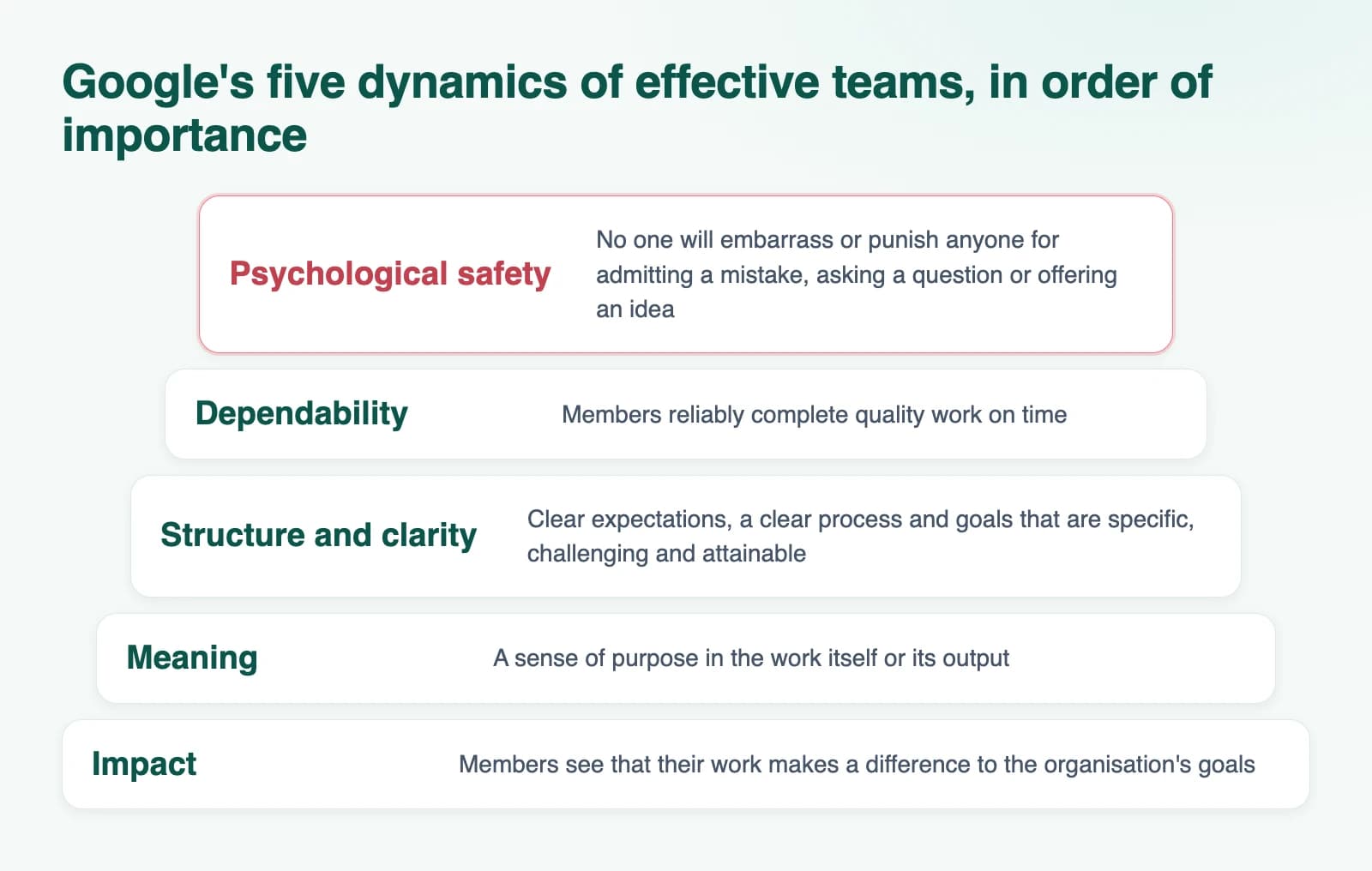
1. Psychological safety 2. Dependability 3. Structure and clarity 4. Meaning 5. Impact
Factors that did not significantly relate to effectiveness at Google included sitting in the same office, consensus-driven decision making, extroversion, individual performance, workload size, seniority, team size and tenure. The guide adds that these may still matter elsewhere.
Read it with its limits in mind. It is one company's internal study, published as a guide rather than a peer-reviewed paper. It says people on teams with a stronger team culture were less likely to leave, brought in more revenue and were rated effective twice as often by executives, but it gives no figures for the first two. The wider research base is larger: a 2017 meta-analysis in Personnel Psychology pooled 136 independent samples covering over 22,000 individuals and nearly 5,000 groups.
The obvious answer, and why it fails the test
The obvious reading is that psychological safety means being nice: a friendly team, no harsh words, everyone comfortable. Many workshops teach it that way.
Test that against the source. Edmondson wrote that psychological safety is not the same as group cohesiveness. Close-knit teams can be less willing to disagree, which is how groupthink happens. She also said the term means neither "a careless sense of permissiveness" nor unrelenting positive feeling. What it does mean is confidence that the team will not "embarrass, reject, or punish someone for speaking up".
So a polite team can be unsafe. If everyone smiles in the meeting and nobody says the plan is wrong, the politeness is part of the problem.
| What people think it is | What it actually is | Why it matters |
|---|---|---|
| Being nice to each other | Being able to disagree without paying a social price | Nice teams can still hide problems to keep the peace |
| Feeling comfortable | Taking a risk because the cost is bearable | Learning is often uncomfortable; the point is that it is safe |
| Lower standards | Honest talk about whether the standards are being met | Errors surface early, while they are cheap to fix |
| Trust in one person | A shared belief across the team | One trusted manager cannot make a team safe if peers punish dissent |
| The same as a good mood | Expectations about what happens after you speak | Mood surveys miss it; you need questions about consequences |
How to measure it
Edmondson measured psychological safety with seven survey items, answered on a seven-point scale from "very inaccurate" to "very accurate". Three were worded negatively, which helps catch people who agree with everything. In plain terms, the items ask whether:
- a mistake made on this team is often held against you (negative);
- members can bring up problems and tough issues;
- people on this team sometimes reject others for being different (negative);
- it is safe to take a risk on this team;
- it is difficult to ask other members for help (negative);
- no one would deliberately act to undermine your efforts;
- your unique skills and talents are valued and used.
Three rules make the results usable. Report by team, because the construct belongs to the team, not to the company average. Protect anonymity with a minimum group size, so the answers in a small team cannot be traced to one person; our guide on whether employee surveys are really anonymous explains what each kind of promise means. And read the score next to behaviour: how many errors are reported, how quickly bad news reaches the person who can act, how often juniors speak in meetings.
Psychological safety in hierarchical workplaces
In many companies in Egypt and the Gulf, titles, age and seniority carry real weight, and respect for seniors is a value, not a flaw. The question is not whether hierarchy exists. It is whether disagreeing upward carries a cost. Our guides to work culture in Egypt and Saudi Arabia describe how that plays out day to day.
The most useful study here comes from hospitals, where professional hierarchy is steep. Ingrid Nembhard and Amy Edmondson surveyed staff in 23 neonatal intensive care units. Staff with higher professional status reported more psychological safety than those lower in the hierarchy. But leader inclusiveness, which they defined as "words and deeds exhibited by leaders that invite and appreciate others' contributions", predicted psychological safety and weakened the link between status and safety. Psychological safety, in turn, predicted engagement in quality improvement work.
The lesson for a hierarchical workplace is practical. You do not need to flatten the structure. The person at the top needs to make it visibly safe for the people below to speak.

How leaders build it
In The Fearless Organization (2018), Edmondson organises the leader's tool kit into three parts: setting the stage, inviting participation and responding productively. Here is what each looks like in practice.
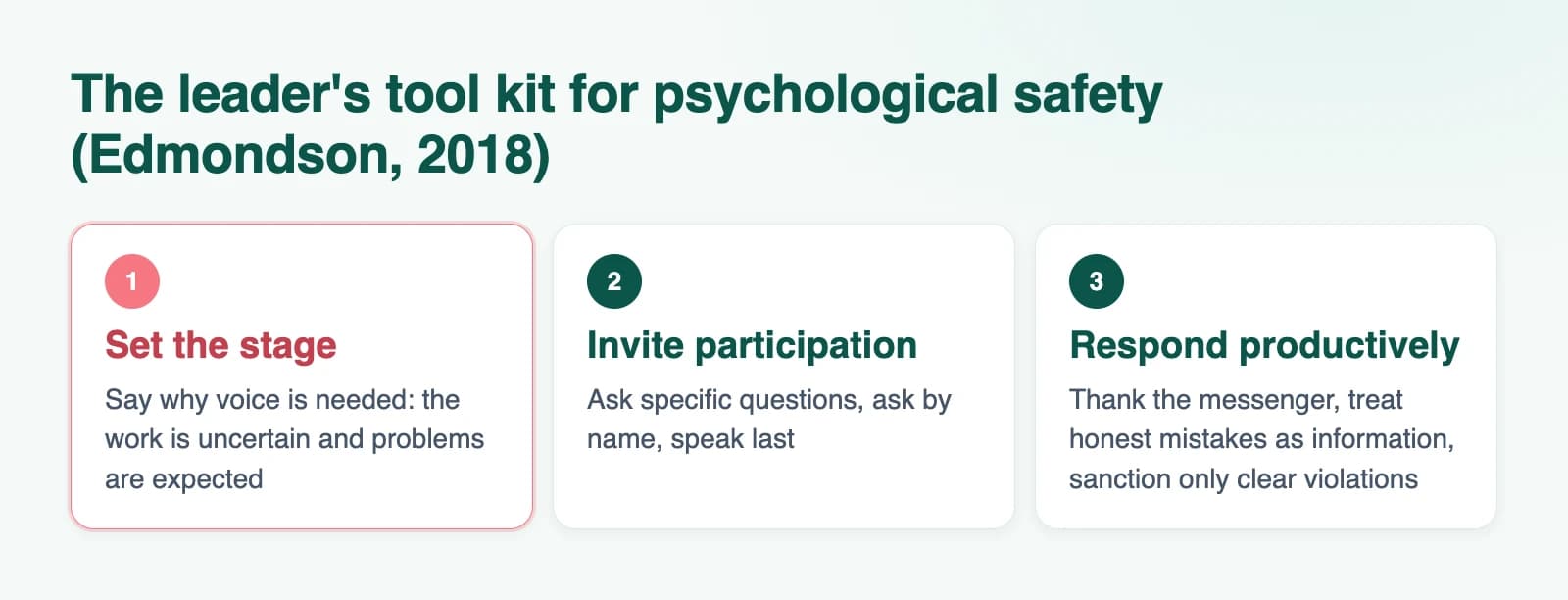
Set the stage. Say out loud why voice is needed: the work is uncertain, problems are expected, and you cannot see everything from where you sit. In a hierarchical team, the leader has to say this more than once, because the default assumption is that the boss does not want to be contradicted.
Invite participation. Ask specific questions rather than "any questions?" Ask by name, in private first if public disagreement is hard. Speak last on decisions, so your view does not close the discussion. Rotate who presents the risks in meetings, so raising problems becomes part of a role rather than a personal act of courage.
Respond productively. This is where safety is won or lost. Thank the person who brought the bad news before asking who caused it. Separate the quality of an idea from the rank of the person who said it. Treat honest mistakes as information, and reserve sanctions for clear violations such as cutting safety corners or hiding errors. One sharp reaction in front of the team undoes months of invitations.
| Leader behaviour | What the team learns | Why it matters |
|---|---|---|
| Asks "What am I missing?" and waits | The boss wants to hear it | Problems reach the leader while they can still be fixed |
| Thanks the messenger, then looks at the cause | Bad news is not punished | Errors are reported earlier, not hidden |
| Speaks last on decisions | Juniors' views count before the boss commits | Decisions use more of the team's knowledge |
| Disagrees with the idea, not the person | Challenge is about the work | People keep contributing after being overruled |
| Acts on what was raised, and says so | Speaking up changes things | Voice continues; otherwise it stops quietly |
Psychological safety also breaks down in ways that are not about one leader. Repeated small rudeness erodes it, as our article on workplace incivility explains. A leader who humiliates people destroys it entirely; see toxic leadership. And where it is missing across many teams, it is usually a symptom of a wider toxic work culture.
Where to start
Pick one team that matters to next year's plan. Run Edmondson's seven items anonymously, with a minimum group size, and add two behaviour measures you can count: errors reported last quarter and the time it takes bad news to reach the decision-maker. Share the results with the team, agree two leader behaviours from the table above, and measure again in three months. GoldinKollar measures culture before advising on it; if you want to read safety alongside the wider culture, see our organisational culture work.
Frequently asked questions
What is psychological safety in simple terms?
It is the shared belief in a team that you will not be embarrassed, rejected or punished for speaking up: asking a question, admitting a mistake, disagreeing or offering an idea. It describes the team, not one person's personality.
What did Google's Project Aristotle find?
Google studied 180 teams and found that how a team works together mattered more than who is on it. It listed five dynamics of effective teams in order of importance, with psychological safety first, followed by dependability, structure and clarity, meaning and impact.
Does psychological safety mean no one is held accountable?
No. Edmondson wrote that it is not a careless sense of permissiveness. A team can hold high standards and still make it safe to say the standards are not being met. Without that safety, people hide the shortfall instead.
How do you measure psychological safety?
The most cited measure is Edmondson's seven-item team survey, which asks, for example, whether mistakes are held against you and whether it is safe to take a risk. Report it by team, protect anonymity, and read it next to behaviour such as how many errors are reported.
Can you build psychological safety in a hierarchical culture?
Yes. Research in hospital teams found that leaders who invite and appreciate input reduce the effect of status on safety. The structure can stay; what changes is how the most senior person responds when someone below them speaks up.
References
- Edmondson, A. (1999), "Psychological safety and learning behavior in work teams", Administrative Science Quarterly 44(2), 350-383. doi.org/10.2307/2666999
- Google re:Work (originally published 2015), "Guide: Understand team effectiveness". rework.withgoogle.com
- Nembhard, I. M. and Edmondson, A. C. (2006), "Making it safe: the effects of leader inclusiveness and professional status on psychological safety and improvement efforts in health care teams", Journal of Organizational Behavior 27(7), 941-966. doi.org/10.1002/job.413
- Frazier, M. L., Fainshmidt, S., Klinger, R. L., Pezeshkan, A. and Vracheva, V. (2017), "Psychological safety: a meta-analytic review and extension", Personnel Psychology 70(1), 113-165. doi.org/10.1111/peps.12183
- Edmondson, A. C. (2018), The Fearless Organization: Creating Psychological Safety in the Workplace for Learning, Innovation, and Growth, Wiley. wiley.com