
How to fix a toxic work culture: a four-step plan for leaders and HR

The exit interviews from one branch say the same thing in different words. The leadership team discusses it and approves a respect workshop for every employee. Six months later the same branch manager is still in post, still hitting his numbers, and the workshop has become a joke inside the branch.
That is the most common way a toxic culture survives a fix. The company responded, but to the wrong problem, at the wrong level, with the cheapest tool.
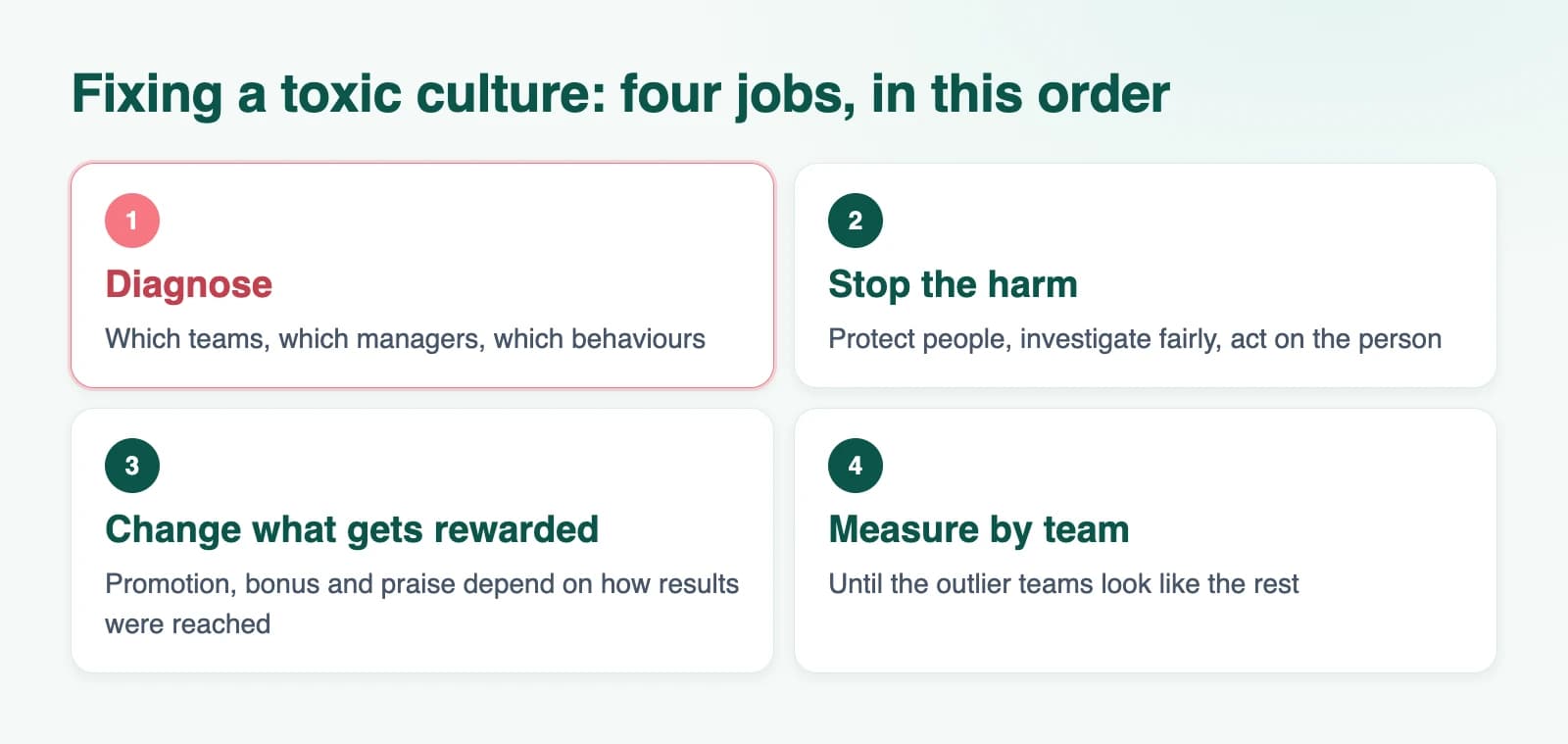
The short answer: to fix a toxic work culture, do four jobs in this order. Diagnose where the harm is: which teams, which managers, which behaviours. Stop the harm: protect the people affected, investigate fairly and act on the person causing it, whatever their results. Change what gets rewarded: promotions, bonuses and public praise must depend on how results were reached. Then measure team by team until the outlier teams look like the rest. Values campaigns and company-wide training come last, if at all.
This article is the plan. For what a toxic culture is, its signs and what it costs, read our guide to toxic work culture first.
The obvious answer, and why it fails
The obvious answer is a programme: new values, a respect campaign, training for all staff. It feels fair because everyone is included, and it is easy to approve.
Test it against how toxicity actually spreads. It is rarely spread evenly. In their review of the research, Donald Sull and Charles Sull of MIT Sloan Management Review concluded that a front-line supervisor or middle manager is often the most powerful influence on toxicity at team level. They also cite research on financial advisers which found that local leaders were twice as important as company-level policies in deciding whether an adviser with a misconduct record was promoted or fired.
So a company-wide programme treats a local problem as a general one. Worse, it sends a message to the teams that are suffering: leadership has seen the problem and chosen the response that asks nothing of the person causing it. People read decisions, not posters. Our article on why most values launches fail covers the same trap from the values side.
Step 1: diagnose where, who and which behaviours
You cannot fix an adjective. "Toxic" has to become a list of teams, people and behaviours you can name. Five questions do most of the work.
| Question | Where to look | Why it matters |
|---|---|---|
| Where is it? | Regretted leavers, unplanned absence and transfer requests by team and by manager, over 12 months | Company averages hide the pockets; the outlier teams are where to start |
| Who is involved? | Upward feedback by manager, skip-level conversations, exit interviews run by someone outside the line | One manager is often the source, and their own manager is often the last to know |
| Which behaviours? | Free-text comments, grievance records, specific incidents with dates | A named behaviour ("belittles people in meetings") can be investigated and changed; a label cannot |
| Who knew, and what happened? | How past complaints about the same people were handled | Tolerance by people with power is what turns one person's behaviour into a culture |
| Does the system pay for it? | The bonus, rating and promotion history of the people named | If they were rewarded, the system is teaching everyone else that the behaviour works |
Two cautions. First, check the label before you use it. Sull and Sull warn against calling a manager toxic when they are simply "outspoken, demanding, or gruff". Demanding is not the same as abusive. Second, collect evidence the way your workforce speaks. In many companies in Egypt and the Gulf, the people most exposed work in frontline or multi-site roles, in Arabic or another language, and rarely open a survey sent in English by email. Listening in person and in their language is part of the diagnosis, not an extra.

Step 2: stop the harm before you redesign anything
Redesigning reward systems takes months. The people inside a toxic team cannot wait that long. The first job is to stop the harm that is happening now.
| Situation | First move | What to avoid |
|---|---|---|
| A serious complaint against a manager | Separate the people involved while you investigate: change reporting lines, shifts or site | Moving the person who complained; it looks like punishment and teaches everyone else to stay silent |
| Several complaints about the same person | A formal investigation by someone outside their line, focused on behaviours, dates and witnesses | Asking the person's own manager, who may have tolerated it, to judge it |
| A high performer who mistreats people | The same process and the same standard as anyone else | A private word and nothing written, which tells the team the rules depend on results |
| A manager who is harsh but not abusive | Coaching with clear expectations and a review date | Treating them as toxic, which damages trust in the whole process |
| A team where rudeness has become normal | A team conversation about norms, led by its manager's manager | Waiting for one big incident before acting |
On separation, the guidance of Acas, the UK's workplace conciliation service, is a useful model even outside the UK. It says employers "should not use suspension automatically", and lists alternatives such as changing shifts or working from another site. It also says suspension "does not mean an employee has done anything wrong". Check your own country's labour law before you act; this is general guidance, not legal advice.
Speed matters for a second reason: toxic behaviour spreads. Michael Housman and Dylan Minor studied 58,542 hourly frontline service workers in 11 firms, defining toxic workers as those fired for serious breaches such as sexual harassment, workplace violence or fraud. A one standard deviation increase in a worker's exposure to toxic colleagues was linked to a 46% higher hazard of being fired for toxic behaviour themselves.
Then decide about the person. Sull and Sull treat dismissal as a last resort, after coaching. Last resort does not mean never. Set the expectations in writing, give a date, and act if nothing changes.
Finally, tell people something. Confidentiality limits the detail, but "a concern was raised, it was investigated and action was taken" is better than silence. Silence teaches the team that nothing happened. For the leadership side of this problem, see our article on toxic leadership.
Step 3: change what gets rewarded
Why do organisations tolerate toxic people? Often because their numbers are good. Housman and Minor found that the toxic workers in their data produced work faster than their peers, but at lower quality. Speed is visible on a dashboard; the cost is spread across everyone else.
Their estimate of that cost is the most useful number for a leadership team. Avoiding one toxic worker saved about $12,489 in turnover costs, from the colleagues who would otherwise have left. Hiring a superstar in the top 1% of performers added about $5,303. Removing the toxic worker was worth more than twice as much as hiring the star, and the authors call their cost estimate a likely lower bound. It excludes legal costs and lost morale. The data come from one kind of work, hourly frontline service jobs, so treat the ratio as a signal rather than a law.
The MIT research points the same way at company level. Sull, Sull and Zweig (2022) found that a toxic culture was 10.4 times more powerful than compensation in predicting a company's attrition rate compared with its industry. Pay ranked 16th. Failure to recognise performance was among the top predictors too. The lever is not how much you pay but what you visibly reward.
Five changes do most of the work:
- Put "how" into promotion decisions. Use upward feedback, reported only above a minimum group size, alongside results. No one moves into a people-manager role with an unresolved conduct finding.
- Make conduct a gate for bonuses. A documented conduct breach reduces or removes the bonus, whatever the number.
- Audit exemptions. List who broke a rule in the last 12 months without consequence. If the list is mostly top performers or people close to senior leaders, that is the culture.
- Choose who you praise in public. Recognition at town halls and in internal news teaches faster than any policy. Praise results that were reached the right way, and say how they were reached.
- Publish the criteria. Where personal relationships carry weight in decisions, published criteria and a panel instead of one decision-maker protect both the people and the managers.
Step 4: measure until the pockets close
A toxic culture is fixed when the outlier teams look like the rest of the company, not when the company average rises. Measure by team and by manager, with the same questions each time. The checkpoints below are a planning design, not research findings.
| Checkpoint | Question to answer | Evidence that it is working |
|---|---|---|
| 30 days | Has the harm stopped in the teams you named? | Investigations opened and closed; separations in place; people who raised concerns know the outcome |
| 90 days | Has the climate moved in the hot spots? | Respect and fairness items in those teams move toward the company norm; skip-level conversations sound different |
| 6 months | Has the reward system changed? | Promotion and bonus decisions in the period show conduct being applied, including to at least one high performer if the case arose |
| 12 months | Have the pockets closed? | Regretted attrition and absence in the outlier teams return to the company rate; a repeat culture assessment with the same instrument |
Expect the number of concerns raised to go up before it goes down. When people start to believe that speaking up is safe, more problems surface. Read that rise next to the other indicators, not as failure. Our article on psychological safety at work explains how to build that belief deliberately, and measuring culture without guesswork covers the measurement design.
Once the harm has stopped, the next question is direction: what culture do you want instead? That is where a culture diagnostic helps. GoldinKollar measures culture before advising, and Persona Quest applies the Organizational Culture Assessment Instrument (OCAI) to map current against preferred culture by unit. Be clear about its limits: it shows what kind of culture people experience and want, but it is not a tool for detecting abuse. Steps 1 and 2 do that job.
Your next step
This month, pull 12 months of regretted leavers, unplanned absence and grievances by manager, and find your three outlier teams. Do it before anyone approves a programme. If you want help with the diagnosis, see our organisational culture work.
Frequently asked questions
What should HR do first when a toxic manager is reported?
Protect the people affected, then investigate. Separate the people involved during the investigation by changing reporting lines, shifts or location, and avoid moving the person who complained. Use an investigator outside the manager's line, focus on specific behaviours and dates, and tell the person who raised it what happens next.
Should you fire a toxic high performer?
Hold them to the same standard as everyone else. Coach first, with written expectations and a review date. If the behaviour continues, act. Research on frontline workers found that avoiding one toxic worker was worth more than twice as much as hiring a top 1% performer, because colleagues leave around them.
Can training fix a toxic culture?
Not on its own. Training for everyone treats a local problem as a general one, and it does nothing about the manager causing the harm or the rewards that protect them. Training helps after the harm has stopped and the rewards have changed, as support for new norms.
Can HR fix a toxic culture without the CEO?
HR can diagnose, investigate and design new criteria. It cannot change who gets promoted or paid without the top team. If senior leaders will not act on a high performer who mistreats people, the culture will not change, whatever HR does.
How do you know a toxic culture is getting better?
Look at the outlier teams, not the average. The fix is working when attrition, absence and respect scores in those teams move toward the company norm, and when promotion and bonus decisions show conduct being applied. A short-term rise in concerns raised is often a good sign.
Sources
- Sull, D. and Sull, C. (2022), "How to fix a toxic culture", MIT Sloan Management Review, 28 September 2022. sloanreview.mit.edu
- Sull, D., Sull, C. and Zweig, B. (2022), "Toxic culture is driving the Great Resignation", MIT Sloan Management Review, 11 January 2022. sloanreview.mit.edu
- Housman, M. and Minor, D. (2015), "Toxic workers", Harvard Business School Working Paper 16-057. dash.harvard.edu
- Acas (2025), "Deciding to suspend: suspension during a work investigation". acas.org.uk