
Workplace incivility: the small behaviours that poison a culture, and what to do

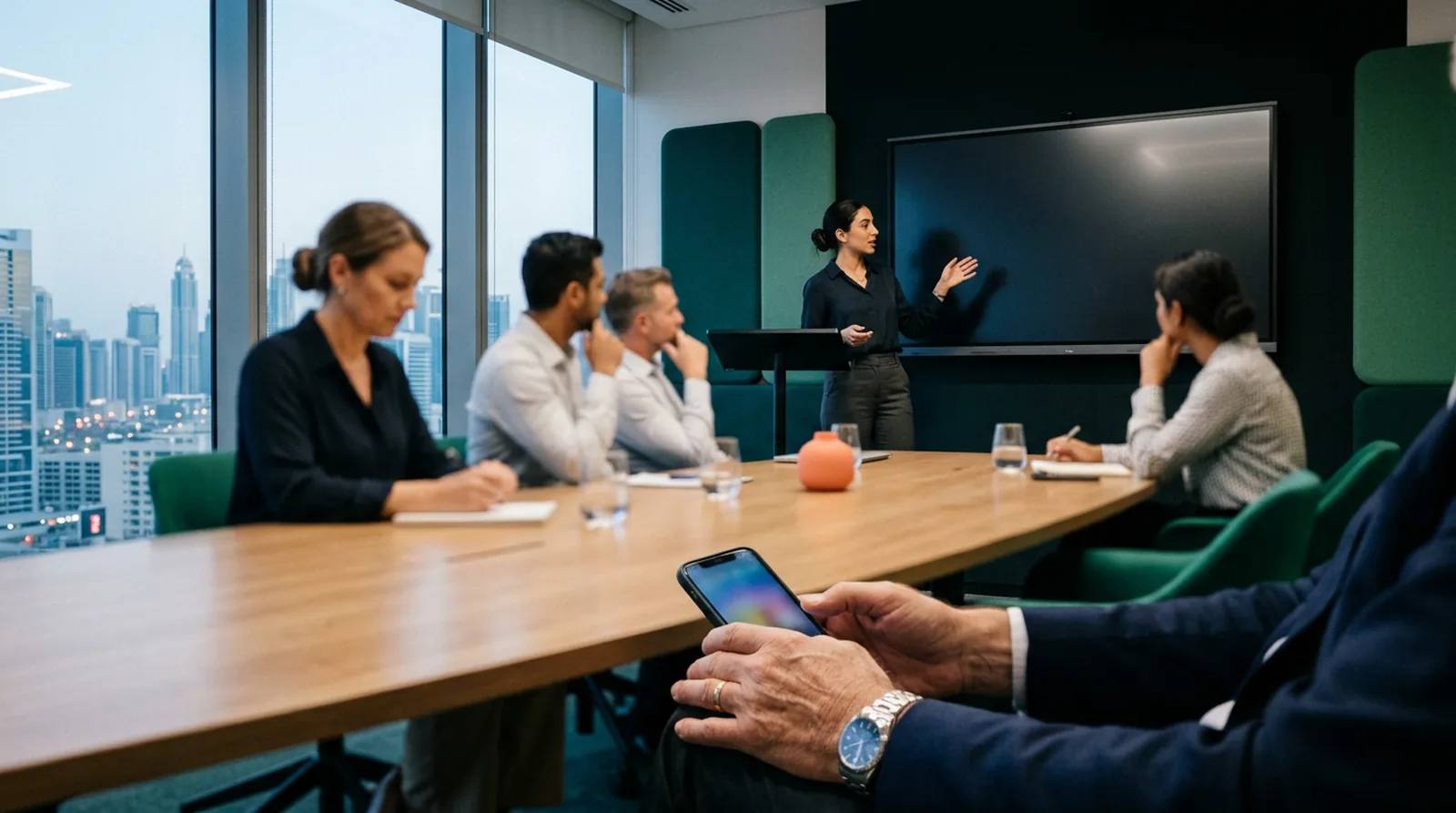
A junior analyst presents her first proposal. Her manager reads his phone through most of it, then interrupts to ask a question she answered two slides ago. Nobody says anything. Nothing in the meeting breaks a policy. The next month she stops volunteering ideas, and a colleague who watched starts checking his phone when the interns present.
That is workplace incivility. It is small, it is deniable, and it is how many cultures go bad without anyone deciding they should.
The short answer: workplace incivility is low-level rudeness at work: ignoring people, interrupting, belittling, taking credit, leaving people out. Researchers define it as behaviour that breaks norms of mutual respect, where the intent to harm is unclear. It is not bullying or harassment, but it is common, it spreads from person to person, and it costs effort, quality and people. In one widely cited poll of 800 managers and employees, 48% of those treated rudely deliberately cut their work effort. Leaders reduce it by modelling respect, correcting rudeness on the spot, letting teams agree their own norms and measuring it by team.
What counts as workplace incivility
The standard definition comes from Lynne Andersson and Christine Pearson, writing in the Academy of Management Review in 1999. They defined it as "low-intensity deviant behavior with ambiguous intent to harm the target", in violation of workplace norms for mutual respect.
Two parts of that definition matter in practice.
Low intensity. No single act is serious enough to fill in a complaint form. A sigh, an unanswered message, a joke at someone's expense.
Ambiguous intent. The person can always say they did not mean it, and sometimes they did not. That is exactly why incivility goes unchallenged. The target is left wondering whether they are being oversensitive.
Common examples:
- Checking a phone or laptop while someone is speaking
- Interrupting, or talking over people
- Not replying to messages or greetings
- Taking credit for someone else's work
- Belittling remarks, sarcasm or eye-rolling in meetings
- Leaving someone out of an email, a meeting or a decision they should be part of
- Blaming a colleague in front of others for a shared mistake
Incivility, bullying and harassment: where the lines are
Incivility sits at the low end of a range of mistreatment. Knowing where it sits tells you which response fits.
| Behaviour | What it looks like | Intent and pattern | Why it matters for your response |
|---|---|---|---|
| Incivility | Rudeness, disregard, exclusion from small things | Intent unclear; may be one-off or habitual | Best handled in the moment and through team norms, not formal process |
| Bullying | Persistent criticism, humiliation, a heavier workload than everyone else, spreading rumours | Acas describes it as offensive or intimidating behaviour, or "an abuse or misuse of power"; it can be a pattern or a one-off | Needs a formal route: a written concern, an investigation, protection for the target |
| Harassment and violence | Threats, sexual comments or contact, physical intimidation | Causes or is likely to cause harm; one serious incident can be enough | Needs immediate protection and a formal process; see our guide to whether a work environment is toxic |
The lines are not walls. Repeated incivility from someone with power over you can become bullying. That is one reason not to ignore it.
The obvious answer, and why to test it
The obvious answer is that incivility is a matter of manners. Adults should grow a thicker skin, and HR has bigger problems.
Test that against the research.
It is common. In a study of 1,180 public-sector employees, Lilia Cortina and colleagues (2001) found that 71% reported some experience of workplace incivility in the previous five years. Incivility was linked to lower job satisfaction, more job withdrawal and higher psychological distress, for both women and men, although women experienced it more often.
It is getting more common, at least in the US. Christine Porath and Christine Pearson reported in 2013 that, in their polling, half of workers said they were treated rudely at least once a week in 2011, up from a quarter in 1998.
It costs work, not just feelings. In a poll of 800 managers and employees in 17 industries, Porath and Pearson asked people who had been treated rudely how they responded. The figures, as reported by Thunderbird School of Global Management:
| Response among those treated rudely | Share | Why it matters |
|---|---|---|
| Intentionally decreased their work effort | 48% | Lost output you will never see in a complaint log |
| Intentionally decreased the quality of their work | 38% | Errors and rework |
| Lost work time worrying about the incident | 80% | Attention goes to the incident, not the job |
| Lost work time avoiding the offender | 63% | Collaboration routes around people |
| Said their commitment to the organisation declined | 78% | The first step toward leaving |
| Left their job because of it | 12% | Turnover that exit interviews often record as "better offer" |
| Took their frustration out on customers | 25% | The rudeness reaches the customer |
The same research programme found that people treated rudely in an experiment were 30% less creative, and that people who merely witnessed incivility were less willing to help others afterwards.
Read these numbers with care. They come from self-reported polls and experiments, mostly in the US. But the direction is consistent, and the costs are spread across many people, which is exactly why they are easy to dismiss. It also links to the wider picture of toxic work culture: in an MIT Sloan Management Review analysis of more than 1.3 million Glassdoor reviews by US employees (Sull and colleagues, 2022), feeling disrespected had the largest negative impact on culture ratings of any single topic.
How incivility spreads
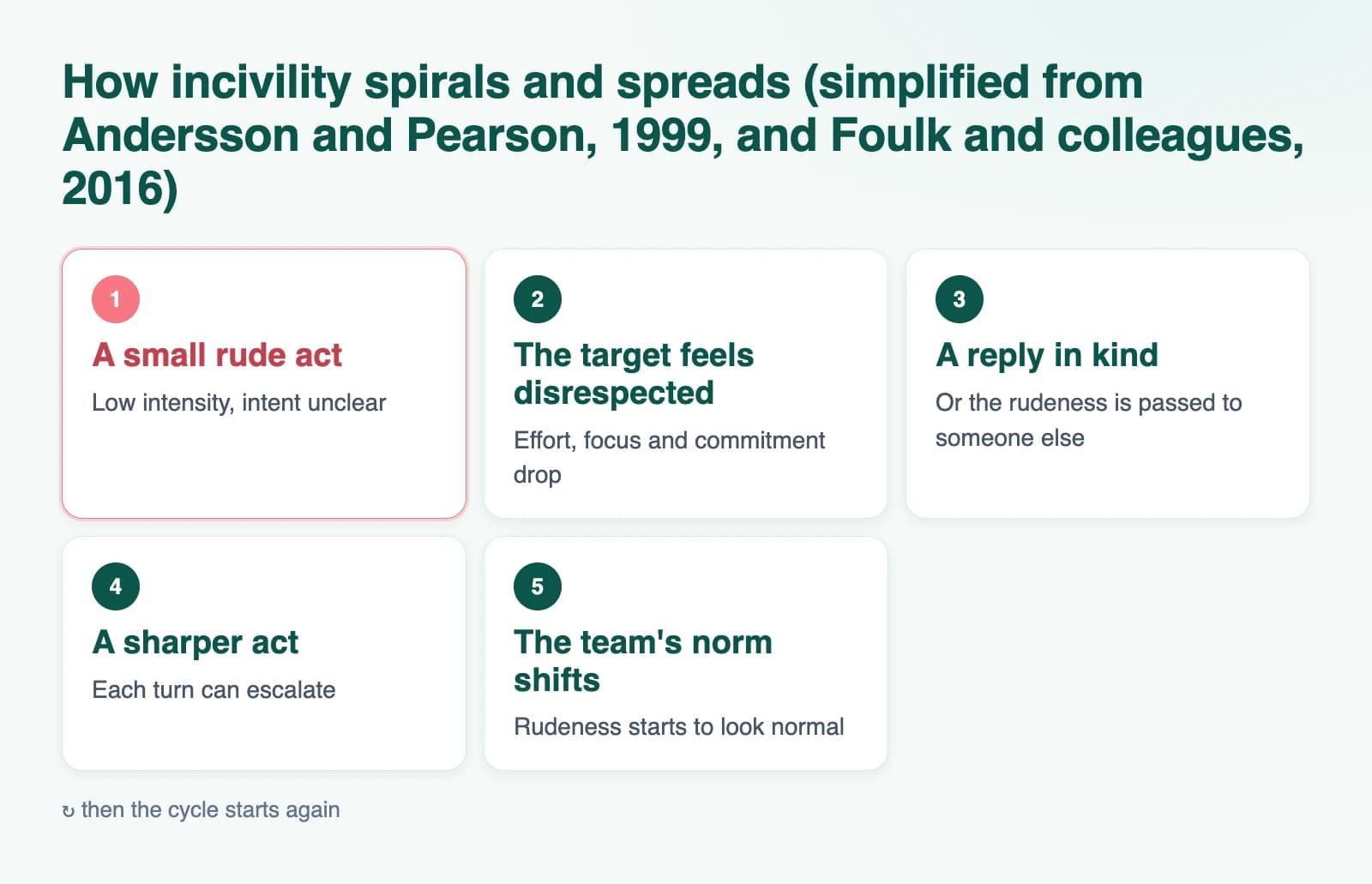
Andersson and Pearson's original paper was titled "Tit for tat?". Their argument was that incivility can spiral: one rude act invites a reply in kind, and each reply can be sharper than the last, until small slights become open conflict.
Later research showed that it also spreads sideways, to people who were not part of the first exchange. Trevor Foulk, Andrew Woolum and Amir Erez (2016) ran three studies on what they called the contagion of rudeness. They found that low-intensity negative behaviours like rudeness can be contagious, that a single episode is enough, and that "anybody can be a carrier". The effect also carried over to the next people they dealt with. The mechanism was cognitive: being treated rudely made hostile ideas more available in people's minds, and that shaped how they behaved next.
In practice, incivility tends to travel down and sideways. In hierarchical workplaces, common in Egypt and the Gulf, people rarely answer a senior manager back. The rudeness is absorbed, then passed on to a peer, a junior or a customer. A manager who is short with their team can set the tone for a whole floor without ever seeing the result.
What to do as a leader
You cannot write a policy against eye-rolling. Incivility is changed by what leaders do in the moment and by what teams agree is normal.
| Move | What it looks like | Why it matters |
|---|---|---|
| Model it | Phone face down in meetings; reply to messages; let people finish | Your team copies what you do, not what the values poster says |
| Correct in the moment | "Let her finish, then I want to hear your view" | A light, immediate correction resets the norm before it hardens; waiting turns it into a formal issue |
| Let the team set its norms | A team conversation: which behaviours make work harder here, and what do we agree to do instead | Norms that a team writes itself are easier to hold each other to |
| Hire and promote for it | Ask references how the candidate treats people who cannot help their career | Promoting a rude high performer tells everyone that rudeness has no cost |
| Measure it by team | Two or three respect items in a regular pulse survey, reported by team above a minimum group size | Incivility clusters; an average hides the teams where it has become normal |
There is evidence that the team-norms approach works. Michael Leiter and colleagues (2011) evaluated CREW (Civility, Respect, and Engagement at Work) with healthcare workers: 1,173 workers in 41 units were surveyed before and 907 after a six-month programme. Most measures improved significantly more in the 8 intervention units than in the 33 comparison units, including co-worker civility, supervisor incivility, respect, cynicism, job satisfaction, trust in management and absences.
If incivility in a team has crossed into persistent harm, or one manager is at the centre of it, team norms are not enough. That is a toxic pocket, and our plan for how to fix a toxic culture applies. Our article on toxic leadership covers the manager's side.
Civility is also the everyday ground of psychological safety at work. People do not take the risk of speaking up in a team where they are regularly talked over.
What to do as an employee
- Name it accurately. Is it rudeness, or is it harm? One sharp email is not a pattern. Repeated humiliation from someone with power over you is closer to bullying. The work environment check helps you look at the wider picture.
- Respond to the behaviour, not the person. "I had not finished. Can I complete the point?" is calm and hard to argue with.
- Do not pass it on. The contagion research suggests the person most likely to receive your bad mood is the next person you deal with. Notice it before you send it on.
- Keep a note if it repeats. Date, what was said or done, who was present. A pattern is easier to raise than a feeling.
- Raise it when it is a pattern or comes from power. Start with the person if you can, then their manager or HR. Our guide to what to do in a bad work environment sets out the options.
Your next step
At your next team meeting, ask one question: what is one small behaviour here that makes work harder for you? Agree one norm to replace it, write it down, and check in a month whether it held.
Frequently asked questions
What is workplace incivility?
Workplace incivility is low-level rude or disrespectful behaviour at work where the intent to harm is unclear, such as ignoring, interrupting, belittling or excluding people. Andersson and Pearson defined it in 1999 as low-intensity deviant behaviour that breaks workplace norms for mutual respect.
What are examples of incivility at work?
Checking your phone while someone speaks, interrupting, not answering messages or greetings, taking credit for others' work, sarcasm or eye-rolling in meetings, and leaving people out of emails or decisions they should be part of.
Is incivility the same as bullying?
No. Incivility is lower in intensity and its intent is unclear. Bullying is offensive or intimidating behaviour or an abuse of power that undermines or humiliates someone. Repeated incivility from someone with power over you can become bullying, so the line is worth watching.
How should I respond to a rude coworker?
Respond to the behaviour calmly and in the moment where you can, for example by asking to finish your point. Avoid replying in kind, because incivility tends to spiral. If it repeats, keep a note and raise it with the person, their manager or HR.
Can you report incivility to HR?
Yes, especially when it is repeated, comes from someone with power over you, or is affecting your work or health. A single rude remark is usually best handled directly. A pattern, with dates and examples, gives HR something it can act on.
Sources
- Andersson, L. M. and Pearson, C. M. (1999), "Tit for tat? The spiraling effect of incivility in the workplace", Academy of Management Review 24(3), 452-471. doi.org/10.2307/259136
- Cortina, L. M., Magley, V. J., Williams, J. H. and Langhout, R. D. (2001), "Incivility in the workplace: incidence and impact", Journal of Occupational Health Psychology 6(1), 64-80. pubmed.ncbi.nlm.nih.gov
- Porath, C. and Pearson, C. (2013), "The price of incivility", Harvard Business Review, January-February 2013, as summarised in Thunderbird School of Global Management, "Research shows rude behavior at work is increasing and affects the bottom line", 30 January 2013. newswise.com
- Foulk, T., Woolum, A. and Erez, A. (2016), "Catching rudeness is like catching a cold: the contagion effects of low-intensity negative behaviors", Journal of Applied Psychology 101(1), 50-67. doi.org/10.1037/apl0000037
- Leiter, M. P., Laschinger, H. K. S., Day, A. and Oore, D. G. (2011), "The impact of civility interventions on employee social behavior, distress, and attitudes", Journal of Applied Psychology 96(6), 1258-1274. doi.org/10.1037/a0024442
- Sull, D., Sull, C., Cipolli, W. and Brighenti, C. (2022), "Why every leader needs to worry about toxic culture", MIT Sloan Management Review, 16 March 2022. sloanreview.mit.edu
- Acas (2025), "What bullying is: bullying at work". acas.org.uk