
Toxic leadership: the signs of a toxic manager, and why organisations keep them

Most toxic managers are not a secret. For example, in a regional sales business, three exit interviews in one year name the same manager. His team's transfer requests are the highest in the company. HR knows, his director knows, and his peers know. His review is postponed again, because his numbers are the best in the region.
The hard part of toxic leadership is rarely spotting it. It is understanding why the organisation keeps it, and changing the conditions that let it stay.
The short answer: toxic leadership is leadership that does serious and lasting harm to people and to the organisation through destructive behaviour, not a boss who is merely demanding or difficult. Its best-researched form is abusive supervision: sustained hostile behaviour, verbal or non-verbal, short of physical contact, such as public put-downs, ridicule and blaming people to save face. The research finds little evidence that it improves results, and much evidence that it damages morale, health and retention. Organisations tolerate it because of what surrounds the leader: followers who comply or collude, and an environment with weak checks. HR's job is to change those conditions, not only the person.
What makes a leader toxic
Two definitions are worth knowing, because they answer different questions.
Jean Lipman-Blumen (2005) wrote the broad one. In the Ivey Business Journal, she defined toxic leaders as people whose destructive behaviours and dysfunctional personal qualities "inflict serious and enduring harm" on the people, groups and organisations they lead. She was explicit that she did not mean the ordinary difficult boss people complain about. She also warned that the label is hard to apply: one person's toxic leader can be another's hero, and a toxic leader is not toxic in every situation or all the time.
Bennett Tepper (2000) wrote the narrow, measurable one. He defined abusive supervision as subordinates' perceptions of how far supervisors engage in "the sustained display of hostile verbal and nonverbal behaviors", excluding physical contact. Employees report how often their own manager does specific things, such as telling them their thoughts or feelings are stupid, putting them down in front of others, or blaming them to save the manager embarrassment.
| Definition | What it focuses on | Why it matters for HR |
|---|---|---|
| Lipman-Blumen: toxic leaders | Harm that is serious and lasting, from behaviour and character together | Sets the threshold: harm, not style. A blunt manager is not automatically toxic |
| Tepper: abusive supervision | Sustained hostile behaviour, as experienced by the people who report to the manager | Gives you something to measure, manager by manager |
| Padilla, Hogan and Kaiser: the toxic triangle | The leader plus the followers and the environment around them | Explains why the problem survives, and where HR can act |
Two words in these definitions carry the weight. Sustained: one bad day is not abusive supervision. And perceptions: Tepper and colleagues are clear that these are employees' reports, not an objective record. That is not a weakness to explain away. It is the experience that drives people's behaviour, and it tells you where to look more closely.
"Tough, but they deliver": testing the obvious answer
The most common defence of a toxic manager is that the harshness is the price of performance. Tepper and colleagues called this a pervasive lay belief.
Test it against the research. In 2017, Tepper, Simon and Park reviewed more than 15 years of studies, including three meta-analyses. They concluded that abusive supervision is linked with lower morale for individuals and groups, poorer psychological health and weaker executive functioning, and with more counterproductive work behaviour and higher quit rates. They found little empirical evidence that outcomes improve as abuse increases. In the paper that introduced the concept, Tepper found that abusive supervision predicted employees' self-reported decisions to quit.
How common is it? The review puts the share of employees exposed at about 10%, and gives reasons to doubt the figure in both directions: some people may read abuse into behaviour that is not abusive, and others may under-report because they are afraid, even in anonymous surveys. For example, in a workforce of 2,000, that would be around 200 people.
So the honest version of "tough, but they deliver" is this: the results may be real, but they are being bought with costs that appear elsewhere, in other teams' numbers, in resignations and in problems nobody reports.
Signs of a toxic manager
Look for patterns of behaviour over months, not one incident. The first three signs below come straight from the kinds of behaviour Tepper's measure asks about.
| Sign | What you will see | Why it matters |
|---|---|---|
| Public put-downs | People corrected, mocked or belittled in front of colleagues | The humiliation teaches the whole team, not only the target, to keep quiet |
| Blame that always points down | Mistakes are someone else's, especially when seniors are watching | People learn to hide errors, so problems surface late |
| Contempt for ideas and feelings | Suggestions dismissed as stupid; concerns treated as weakness | Ideas and early warnings stop coming |
| Loyalty demanded, dissent punished | Threats about jobs, bonuses or shifts for those who disagree | Fear replaces judgement; people follow instructions they know are wrong |
| Promises nobody can keep | Grand targets and visions that justify any means | Lipman-Blumen calls these grand illusions; followers trade autonomy for them |
| Traces in HR data | Transfers, exits and sick leave clustering under one manager | The pattern is visible before anyone files a complaint |
If you are an employee trying to decide whether your own situation is harmful, our guide on whether your work environment is toxic or just bad gives you a self-check. For the culture-wide signs, see toxic work culture.
Why organisations tolerate toxic leaders
Art Padilla, Robert Hogan and Robert Kaiser described destructive leadership as a toxic triangle: destructive leaders, susceptible followers and conducive environments. Remove one side and the problem is much harder to sustain.
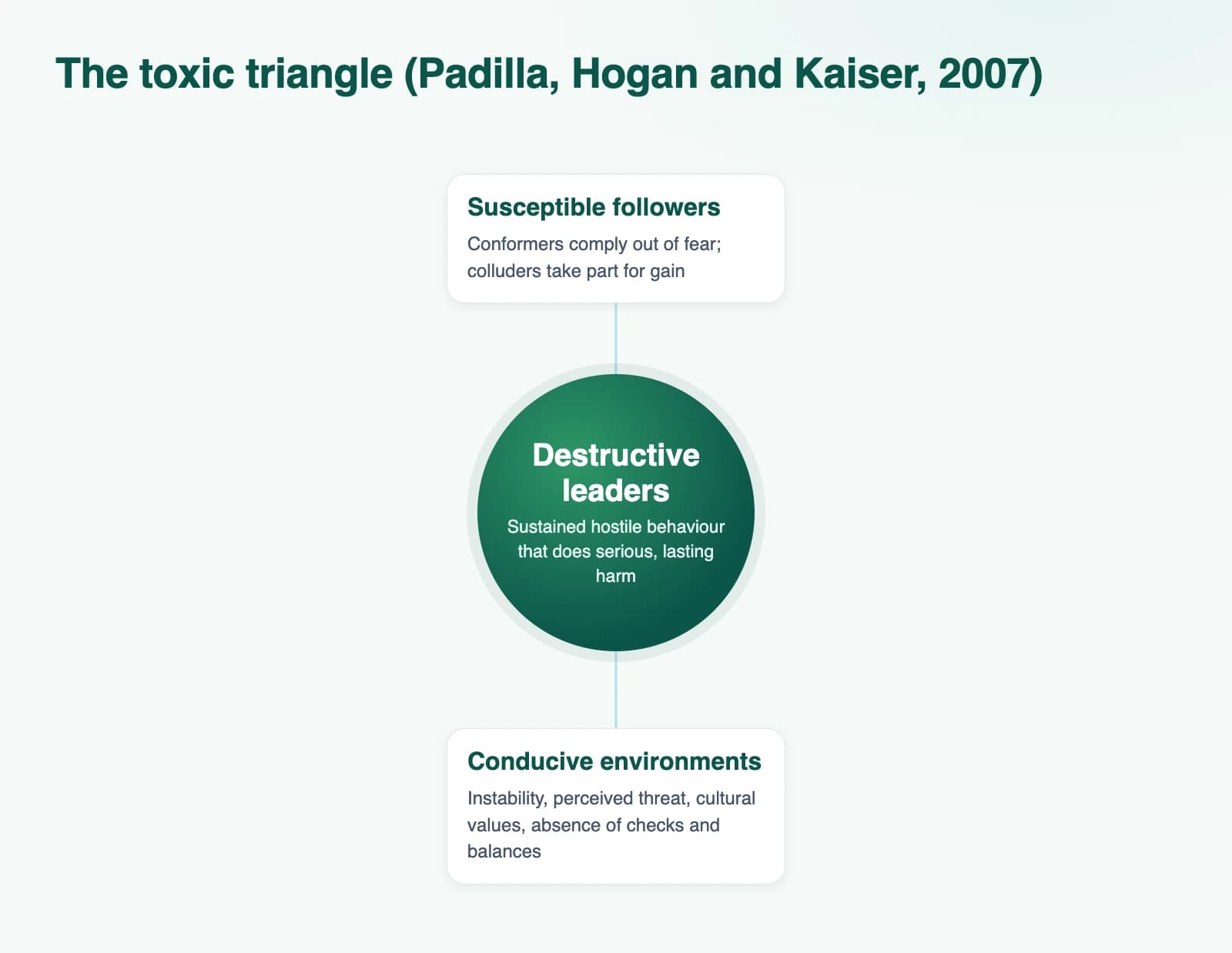
Susceptible followers. A summary of the model published by Hogan Assessments describes two kinds of followers. Conformers comply out of fear. Colluders take part actively, because they gain from being close to the leader. Lipman-Blumen describes the same trap from the inside: followers tell themselves they are not strong enough to resist, that nobody else sees the problem, or that their careers are at risk. Over time these rationalisations harden into what she calls control myths, beliefs that resisting is pointless or dangerous.
Conducive environments. The same summary lists four conditions: instability, perceived threat, cultural values such as high power distance and the avoidance of uncertainty, and the absence of checks and balances. Rapid change, a restructuring, a founder or senior leader who answers to nobody: each gives a destructive leader more room.
Copying from above. Tepper's review reports evidence that abuse trickles down from higher to lower levels of management. One study it cites found that middle managers were more likely to copy abusive behaviour from senior managers when they believed it was meant to improve performance. If the top team tolerates a bully because of results, it is teaching the next layer what results require.
Pressure and exhaustion. Not every abusive manager is a bad character. The review's model of causes includes workload and pressure to perform, difficult employees and fatigue, and one study it cites found that a supervisor's poor sleep quality predicted their abusive behaviour day to day. Some toxic behaviour is produced by how the job is designed.
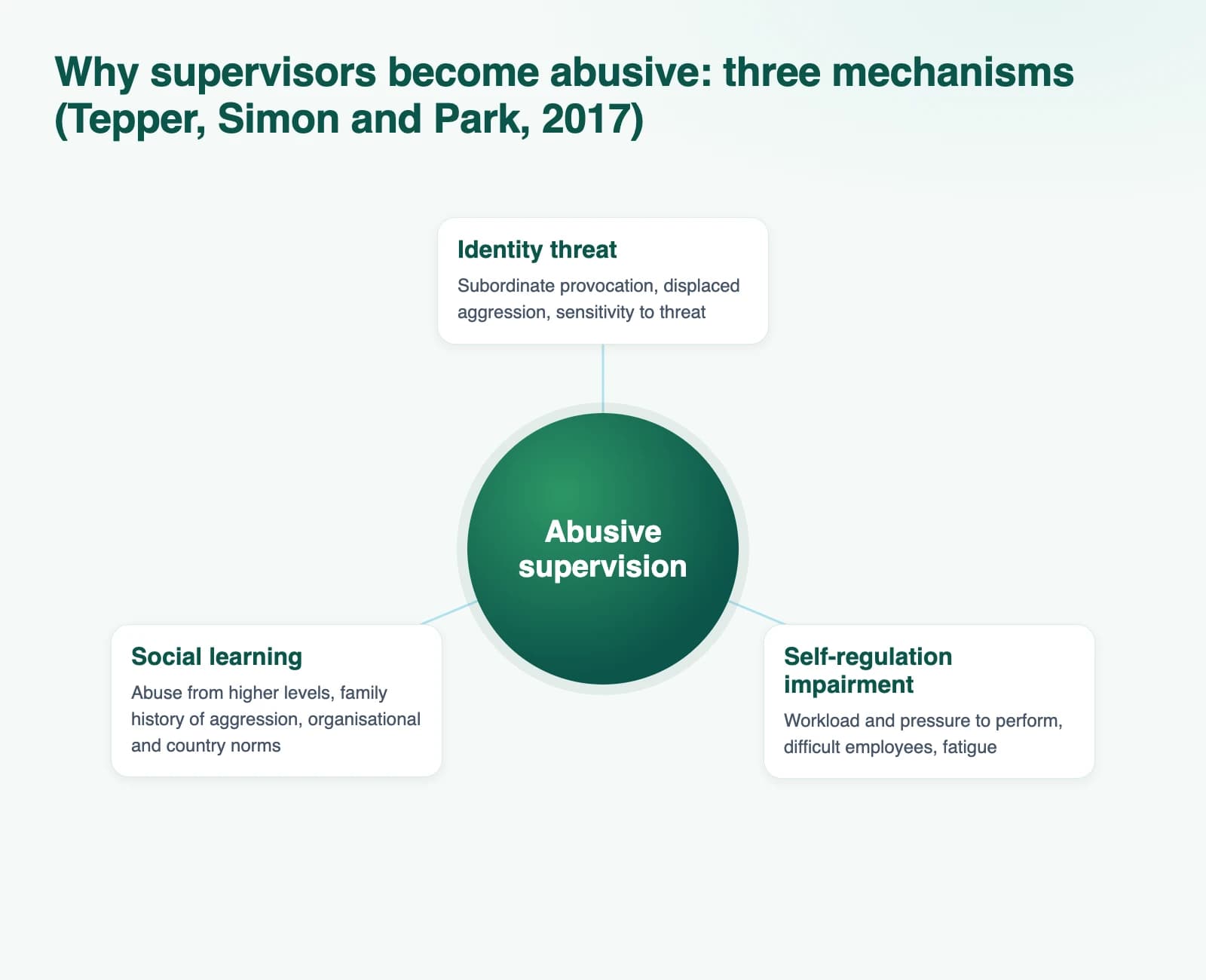
Culture and hierarchy. The review notes there is little cross-country research. One study it cites, comparing Anglo and Confucian countries, found that abuse hurt employees' sense of fair treatment less where power distance is higher, which the authors explain by greater acceptance of supervisors' behaviour. Do not read that as harmlessness. It means people may complain less, so HR has to look harder.
What HR can do
Start with the conditions, then the person.
1. Find the pattern before the complaint. Collect upward feedback on each manager, reported only above a minimum group size; our direct manager survey template is a starting point. Put it next to exits, transfers and absence by manager. Because people under-report out of fear, treat clusters in the data as a reason to look, not as proof. 2. Make it safe to tell you. Offer a route that bypasses the line manager, and keep investigations separate from the reporting line. Lipman-Blumen argues that when organisations ask for feedback on leaders, people need safeguards so they can be candid without endangering themselves. What leaders do when someone speaks up decides whether anyone does again; see psychological safety at work. 3. Fix the pressure that feeds it. Look at workload, targets and staffing in the teams where abuse clusters. Coaching a manager who is running a team at twice its capacity treats the symptom. 4. Change what gets rewarded. Add how results were achieved to promotion and bonus decisions, and stop exempting high performers. Promotion is the strongest message an organisation sends about behaviour. 5. Build checks into the structure. Lipman-Blumen proposed periodic 360-degree reviews of leaders, open selection processes that consult people inside the organisation, limits on how long one person holds a powerful role, and respectable ways for leaders to step down. 6. Act, and be seen to act. Coach first where the behaviour is new or pressure-driven, with clear expectations and a date. Where it does not change, move the person out of people leadership. Our guide on how to fix a toxic culture covers the wider sequence.

If the toxic manager is yours
This is general guidance, not legal advice. Lipman-Blumen's advice to followers is practical: keep a dated log of what happens, check whether others see the same pattern, avoid confronting the leader alone, and raise concerns with others in terms of their effect on the organisation. She also writes that leaving is an honourable choice when staying would cost your health or integrity. Our guide to what to do in a bad work environment takes you through the steps.
Where to start
Pull twelve months of exits, transfer requests and sick leave by manager, and list the five managers whose teams are furthest above the company rate. Run anonymous upward feedback in those five teams within the next quarter. Then decide, manager by manager, whether the cause is the person, the pressure on the team, or both. GoldinKollar measures culture before advising on it; our organisational culture work starts with this kind of evidence.
Frequently asked questions
What is toxic leadership?
Toxic leadership is leadership that causes serious and lasting harm to people and the organisation through destructive behaviour. Jean Lipman-Blumen's definition centres on that harm. It is different from a demanding or blunt manager whose standards are high but who treats people with respect.
What are the signs of a toxic manager?
Repeated public put-downs, blaming others to save face, dismissing people's ideas and feelings as stupid, punishing disagreement, and demanding loyalty through threats. In the data, look for exits, transfers and sick leave that cluster under one manager.
What is abusive supervision?
It is Bennett Tepper's research term, defined in 2000 as employees' perceptions of a supervisor's sustained hostile verbal and non-verbal behaviour, excluding physical contact. It is measured by asking employees how often their own manager does specific hostile things.
Why do companies keep toxic leaders?
Because they often deliver short-term results, because followers comply or collude, and because the environment lacks checks. The toxic triangle model names these three sides: destructive leaders, susceptible followers and conducive environments.
Can a toxic leader change?
Sometimes. Some abusive behaviour is driven by workload, pressure and fatigue, and changes when those change. Coach with clear expectations and a deadline, but if the behaviour continues, remove the person from managing people.
References
- Lipman-Blumen, J. (2005), "The allure of toxic leaders: why followers rarely escape their clutches", Ivey Business Journal, January/February 2005. connectiveleadership.com
- Tepper, B. J. (2000), "Consequences of abusive supervision", Academy of Management Journal 43(2), 178-190. doi.org/10.2307/1556375
- Tepper, B. J., Simon, L. and Park, H. M. (2017), "Abusive supervision", Annual Review of Organizational Psychology and Organizational Behavior 4, 123-152. doi.org/10.1146/annurev-orgpsych-041015-062539
- Padilla, A., Hogan, R. and Kaiser, R. B. (2007), "The toxic triangle: destructive leaders, susceptible followers, and conducive environments", The Leadership Quarterly 18(3), 176-194. doi.org/10.1016/j.leaqua.2007.03.001
- Joyce, J. and Tracy, N., "Tiger Mike and the toxic triangle", Hogan Assessments (summary of the toxic triangle model). hoganassessments.com