
Culture change models compared: Lewin, Kotter, ADKAR and the influence model

Almost every culture change deck has the same slide. Three blocks of ice: unfreeze, change, refreeze. It is credited to Kurt Lewin and treated as the foundation of change management. Lewin never wrote the word "refreezing". The idea the slide is built on takes up a short passage near the end of a 37-page article, published in 1947, shortly after his death.
That does not make the slide useless. It shows how change models travel: simplified, repeated and trusted far beyond what their authors claimed. Before you choose one for a culture change, know what it says, what evidence sits behind it, and which question it answers.
The short answer: the four models most used for culture change answer different questions. Lewin's three steps describe what a group must go through: loosening old habits, moving, and settling at a new level. Kotter's eight steps describe what leaders must do, in order, to drive a large transformation. Prosci's ADKAR describes where an individual is stuck: awareness, desire, knowledge, ability or reinforcement. McKinsey's influence model names four levers that change behaviour: role modelling, understanding and conviction, talent and skills, and formal mechanisms. None has been proven best. Choose by the question you need answered, and expect to combine them.
The obvious answer, and why to test it
The obvious answer is to pick the best-known model, usually Kotter's, and follow the steps in order.
Test it against the evidence. In 2012, Steven Appelbaum and colleagues published what they described as the first formal review of Kotter's model, 15 years after his book Leading Change (1996). They found support in the literature for most of the eight steps, but no formal study of the model as a whole. Their conclusion was that its popularity comes more from its "direct and usable format" than from scientific consensus on its results. They found no evidence against it either, and called it most useful as a planning tool.
The other number that drives model shopping does not survive testing. The claim that 70% of change programmes fail is widely repeated. Mark Hughes reviewed the published sources for it in 2011 and found "no valid and reliable empirical evidence" for that figure. Our article on whether organisational culture can be changed covers what does move culture.
So no model has been shown to beat the others. The useful question is not which is best, but which fits the problem in front of you.
Lewin's three steps: unfreeze, move, freeze
What it says. Lewin offered three steps as a way that planned social change "may be thought of": unfreezing the present level, moving to a new one, and freezing the group at the new level. The point of the last step is that a change which is not held in place does not last.
What Lewin actually wrote. Stephen Cummings, Todd Bridgman and Kenneth Brown traced the model's history in Human Relations in 2016. They found the idea sits in the 24th of 25 sub-sections of Lewin's 1947 article "Frontiers in group dynamics", with no data and no diagram. In the 1951 collection Field Theory in Social Science, it fills two short paragraphs (131 words) of a 338-page book. Lewin wrote "freezing", not "refreezing". According to the authors, "refreezing" first appeared in a 1950 conference paper by his former student Leon Festinger, and Edgar Schein brought it into management writing in 1961. Their conclusion: Lewin never developed the three-step model; it "took form after his death".
When it helps. As a way to think, not a plan. It reminds you that people must let go of the old way before they adopt a new one. It works for a single team changing one practice.
Watch out for. The ice metaphor suggests an organisation is frozen until someone acts on it, while Lewin's wider work described groups as always adjusting.
Kotter's eight steps
What it says. In a 1995 Harvard Business Review article, John Kotter described watching "more than 100 companies" try to remake themselves. He set out his eight steps in the book Leading Change (1996). Kotter Inc. lists them today as:
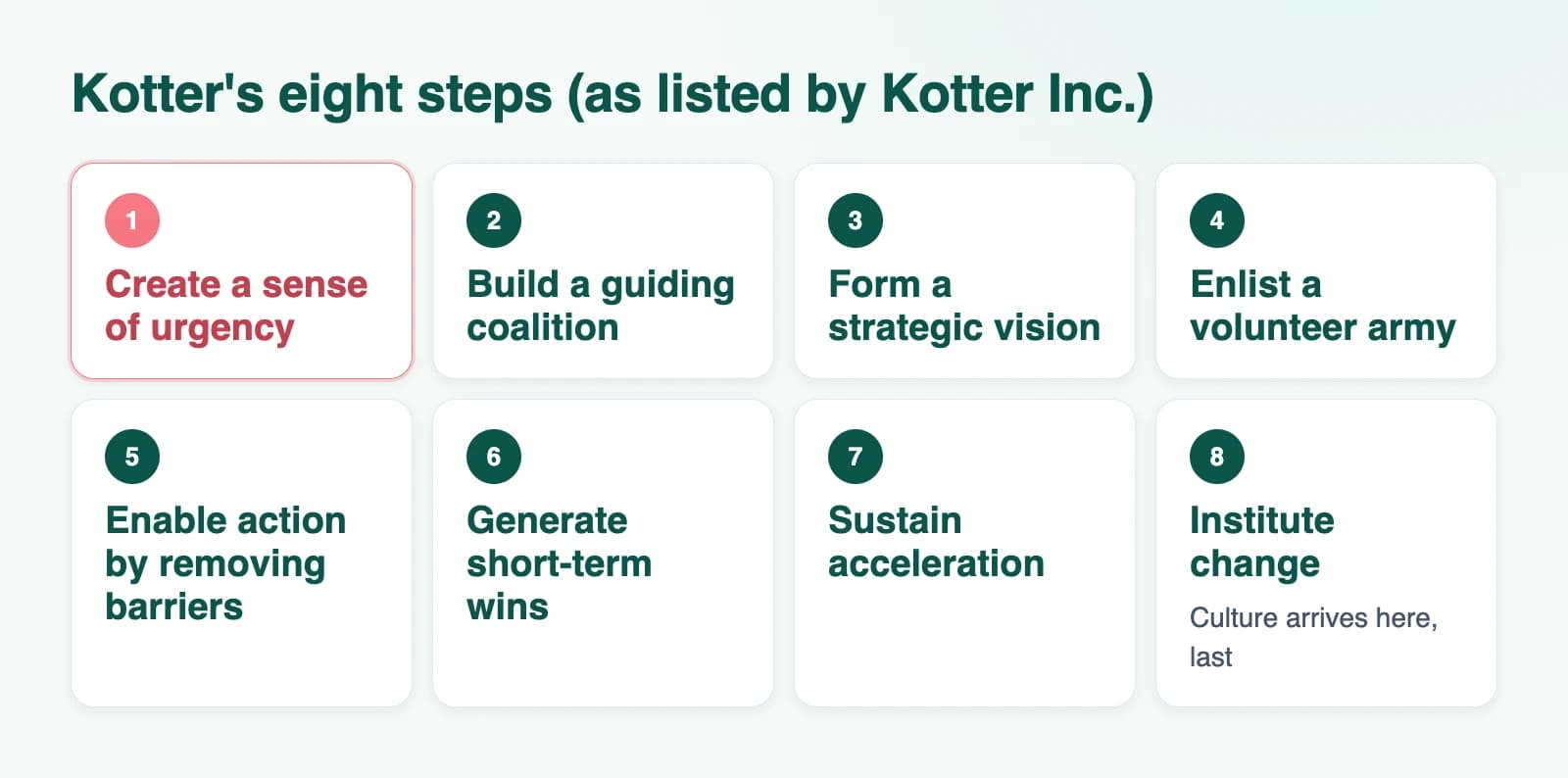
1. Create a sense of urgency 2. Build a guiding coalition 3. Form a strategic vision 4. Enlist a volunteer army 5. Enable action by removing barriers 6. Generate short-term wins 7. Sustain acceleration 8. Institute change
When it helps. Large, top-led transformations: a merger, a new strategy, a restructuring. It is strong on the political work at the start (urgency, coalition, vision) that many plans skip.
Watch out for. It is written from the leader's seat, and culture arrives at the end, as the last step. Kotter himself moved on from a strictly linear version: his firm says he evolved the eight steps into eight "accelerators" in his 2014 book Accelerate. If you use the original, do not wait until step eight to think about culture.
Prosci ADKAR
What it says. ADKAR was developed by Jeff Hiatt in 1996, first published in a white paper in 1999 and set out in a book in 2006, according to Prosci. It describes five outcomes a person must reach for a change to stick:
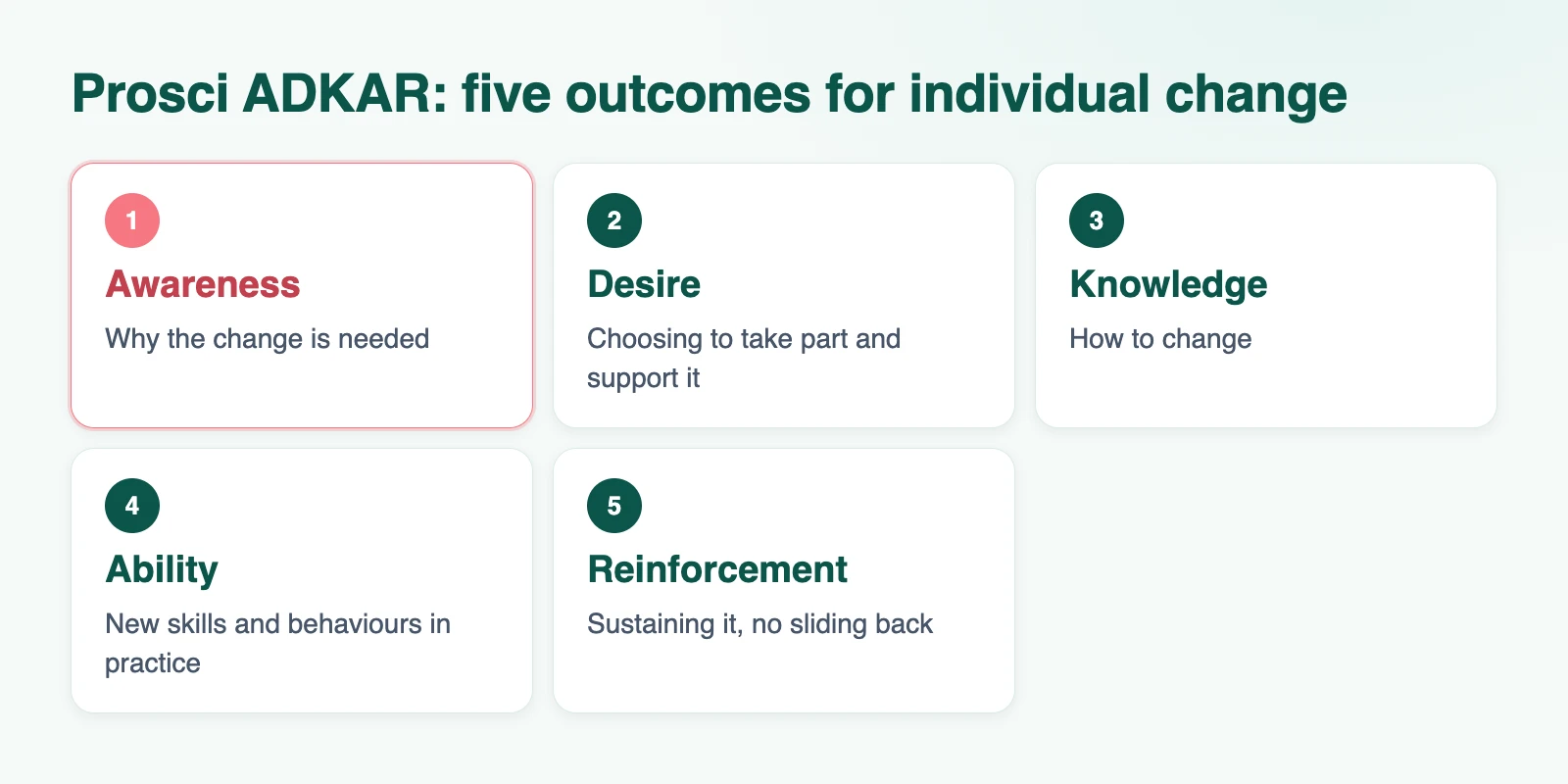
- Awareness of why the change is needed
- Desire to take part in and support it
- Knowledge of how to change
- Ability to put new skills and behaviours into practice
- Reinforcement to sustain the change and prevent sliding back
Prosci describes the elements as "sequential but not linear" and advises focusing on the earliest one that is not yet in place, which it calls the barrier point.
When it helps. Diagnosing why a specific change is stuck with specific people. If a team knows the new process but does not want it, more training will not help; the gap is desire, not knowledge.
Watch out for. Prosci itself calls ADKAR "a model for individual change, not a complete change management methodology". Most of what is published about it comes from Prosci. It tells you where a person is stuck, not how to shift the shared assumptions of a whole organisation.
McKinsey's influence model
What it says. First described by Emily Lawson and Colin Price in McKinsey Quarterly in 2003, the model names four actions that change how people think and behave:
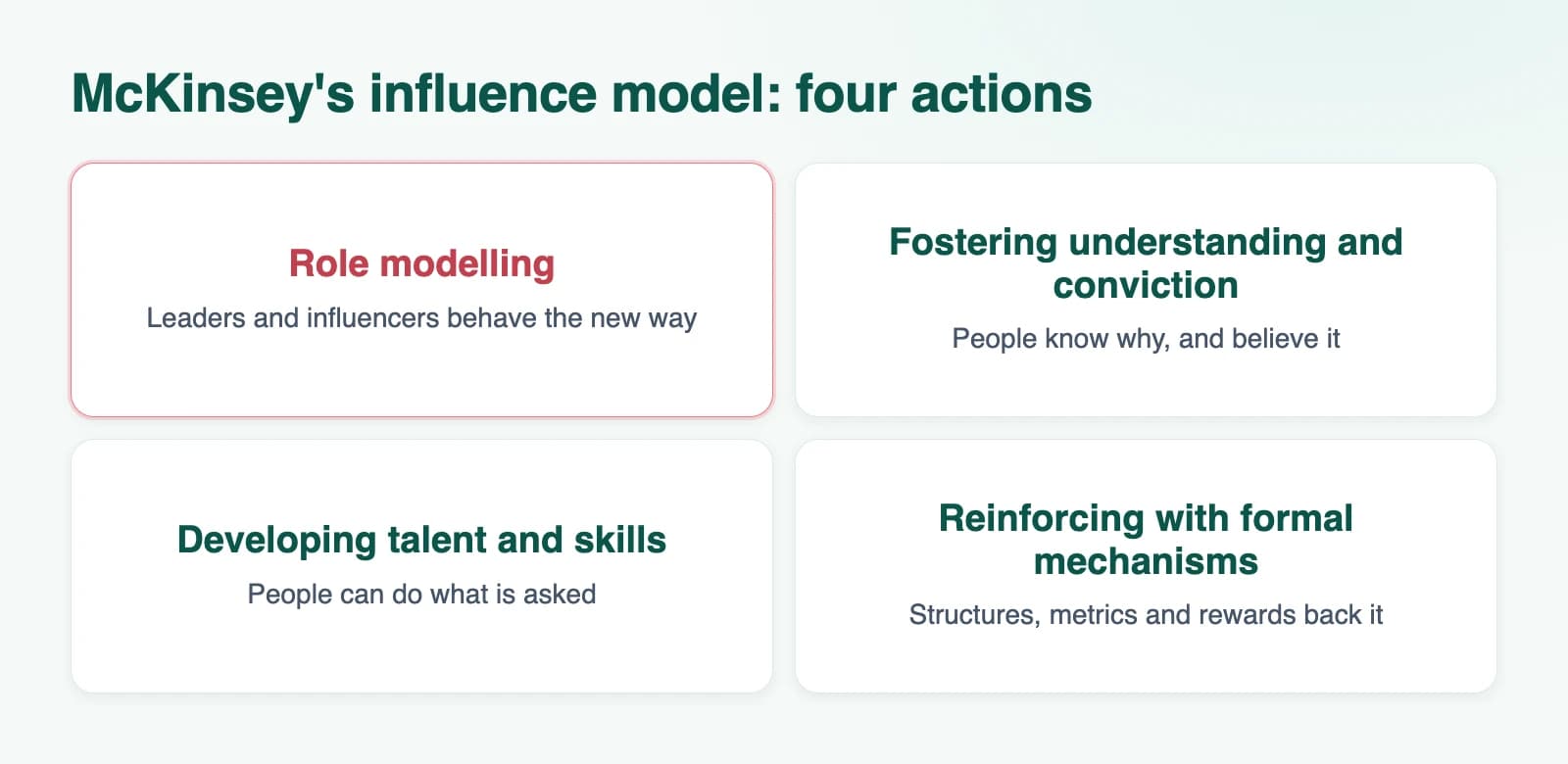
- Role modelling: leaders and influential colleagues behave in the new way
- Fostering understanding and conviction: people understand the change and believe in it
- Developing talent and skills: people have the skills the new behaviour needs
- Reinforcing with formal mechanisms: structures, processes, metrics and rewards support the change
The evidence. A McKinsey Global Survey in February 2015 (n = 1,662 executives, of whom 1,477 had been part of a transformation in the past five years) found that transformations rated successful were nearly eight times more likely to have used all four actions than just one. Respondents also said role modelling was the action their companies used least often. This is a self-reported survey by the firm that owns the model, so treat it as a strong pattern, not proof.
When it helps. Culture change. It is the only one of the four built around behaviour and mindset rather than project stages.
Watch out for. It tells you what to pull, not in what order. It needs a plan around it.
The four models side by side
| Model | The question it answers | Unit of change | Best fit | Why it matters for culture |
|---|---|---|---|---|
| Lewin's three steps | What must a group let go of, and how is the new way held in place? | The group | One team changing one practice | Reminds you that change fades without a "freeze" |
| Kotter's eight steps | What must leaders do, in what order? | The organisation | A large, top-led transformation | Strong on urgency and coalition; puts culture last |
| Prosci ADKAR | Where is this person stuck? | The individual | Process, system or role changes with a clear "new way" | Finds the gap, but does not address shared assumptions |
| McKinsey influence model | Is the system around people pushing the new behaviour? | Behaviour and mindset | Culture and behaviour change | Checks whether leaders, skills and rewards say the same thing |
Which model fits which situation
Some examples, each one generic:
- For example, a bank merging two head offices. Use Kotter for the arc: urgency, coalition, vision. Use the influence model to check the behaviours you want are being role-modelled and rewarded in both legacy teams.
- For example, a hospital moving to a new patient record system. ADKAR fits. Survey staff by element, find the barrier point by department, and act on that.
- For example, a retailer trying to stop a culture of blame. Start with the influence model. Then ask Lewin's question: what will hold the new behaviour in place when attention moves on? If behaviour has become harmful, see our guide to fixing a toxic culture.
- For example, one team adopting weekly retrospectives. Lewin's three steps are enough.

Why culture change fails, whichever model you use
Most change models were built for change in general, and culture is the hardest kind. Three reasons recur.
The model treats culture as the last step. Culture is not a stage you reach. It is the set of assumptions that decides whether the earlier steps work at all. Gerry Johnson's cultural web shows how those assumptions are held in place by stories, routines, symbols, controls and power. A model that does not touch those will meet them as resistance.
The words change and the experience does not. A new values statement while promotion criteria, budgets and leaders' behaviour stay the same teaches people that culture is a communications exercise. Our article on why most values launches fail looks at this pattern.
Leaders do not model the change. In the McKinsey survey above, role modelling was the action companies used least. People believe what leaders do, not what they announce.

A fourth reason is quieter: nobody measured the starting point, so nobody can show movement. That is why we measure culture before advising on it. A baseline of the behaviours you want, repeated about a year later, shows whether any model is working; our measurement services start there.
A bounded next step
Before you choose a model, write down the two or three behaviours that must change. For each one, check the four influence levers: who is role-modelling it, do people understand why, do they have the skill, and do the metrics and rewards support it. The gaps you find tell you which model to reach for. If you want help mapping them, our culture practice can run the baseline.
Frequently asked questions
What are the main change management models?
The most widely used are Lewin's three steps (unfreeze, move, freeze), Kotter's eight steps, Prosci's ADKAR model and McKinsey's influence model. Together they cover what a group goes through, what leaders do, where people get stuck, and which levers change behaviour.
What is the difference between Kotter and ADKAR?
Kotter's model describes what leaders do, in sequence, to drive a large organisational change. ADKAR describes the five outcomes an individual must reach for a change to stick. Many organisations use Kotter for the overall plan and ADKAR to diagnose where specific groups are stuck.
Is Lewin's change model still relevant?
As a way of thinking, yes: change needs letting go, moving and holding in place. As a plan, it is too thin. Historians of the model have shown that Lewin wrote only a short passage about it and never used the word "refreezing".
Which change model is best for culture change?
No model has been proven best. For culture, McKinsey's influence model is the most directly useful because it focuses on behaviour and on whether leaders, skills and rewards support it. Pair it with a sequencing model and a measured baseline.
What is the McKinsey influence model?
A framework, first published in McKinsey Quarterly in 2003, that names four actions for changing mindsets and behaviour: role modelling, fostering understanding and conviction, developing talent and skills, and reinforcing with formal mechanisms.
References
- Cummings, S., Bridgman, T. and Brown, K.G. (2016), "Unfreezing change as three steps: rethinking Kurt Lewin's legacy for change management", Human Relations 69(1), 33-60. doi.org/10.1177/0018726715577707
- Kotter, J.P. (1995), "Leading change: why transformation efforts fail", Harvard Business Review, March-April 1995. hbr.org
- Kotter Inc., "The 8 steps for leading change". kotterinc.com
- Appelbaum, S.H., Habashy, S., Malo, J.-L. and Shafiq, H. (2012), "Back to the future: revisiting Kotter's 1996 change model", Journal of Management Development 31(8), 764-782. doi.org/10.1108/02621711211253231
- Prosci, "The Prosci ADKAR Model". prosci.com
- Prosci, "ADKAR: core to the people side of change". prosci.com
- Basford, T. and Schaninger, B. (2016), "The four building blocks of change", McKinsey Quarterly. mckinsey.com
- McKinsey & Company (2015), "The science of organizational transformations", McKinsey Global Survey results. mckinsey.com
- Hughes, M. (2011), "Do 70 per cent of all organizational change initiatives really fail?", Journal of Change Management 11(4), 451-464. doi.org/10.1080/14697017.2011.630506