
The cultural web: how to map the culture that is holding your strategy back

A menswear retailer decided to become fashionable. Its managers did what they had always done: they copied styles from boutiques, had them made more cheaply in the Far East and pushed them through their low-cost shops. Nothing changed for the customer. What finally moved the staff was not a plan or a speech. It was a rule that they wear the clothes sold in their own shops. One executive said that was when "they began to wear the new strategy".
The story comes from Gerry Johnson's 1992 paper on managing strategic change, and it holds the whole idea of the cultural web. Strategy is decided in a meeting room. Culture decides which parts of it survive the walk back to the desk.
The short answer: the cultural web is a tool for mapping an organisation's culture, developed by Gerry Johnson and usually credited to Johnson and Kevan Scholes. At its centre is the paradigm: the shared, taken-for-granted assumptions about how the business works. Around it sit six elements that protect the paradigm: stories, rituals and routines, symbols, organisational structure, control systems and power structures. Teams use it in a workshop to map the culture they have, then the culture their strategy needs, and then to choose what to change.
What the cultural web is, and where it came from
Johnson set out the web in "Managing strategic change: strategy, culture and action", published in Long Range Planning in 1992, when he was at Cranfield School of Management. The model is usually called Johnson and Scholes' cultural web, after the textbook he wrote with Kevan Scholes, Exploring Corporate Strategy, which the 1992 paper recommends for further reading.
The core idea is the paradigm. Johnson borrows Edgar Schein's definition of culture's deepest level: basic assumptions that are shared, unconscious and "taken for granted". He then calls the paradigm both "a device for interpretation and a formula for action". In plain terms, it is the lens managers use to make sense of what happens, and the set of moves they reach for in response.
That paradigm does not float free. Johnson writes that it is "hedged about and protected by a web of cultural artefacts". The routines, the stories, the symbols, the controls and the people with power all hold it in place. That is why a new strategy can be accepted in every meeting and still not happen.
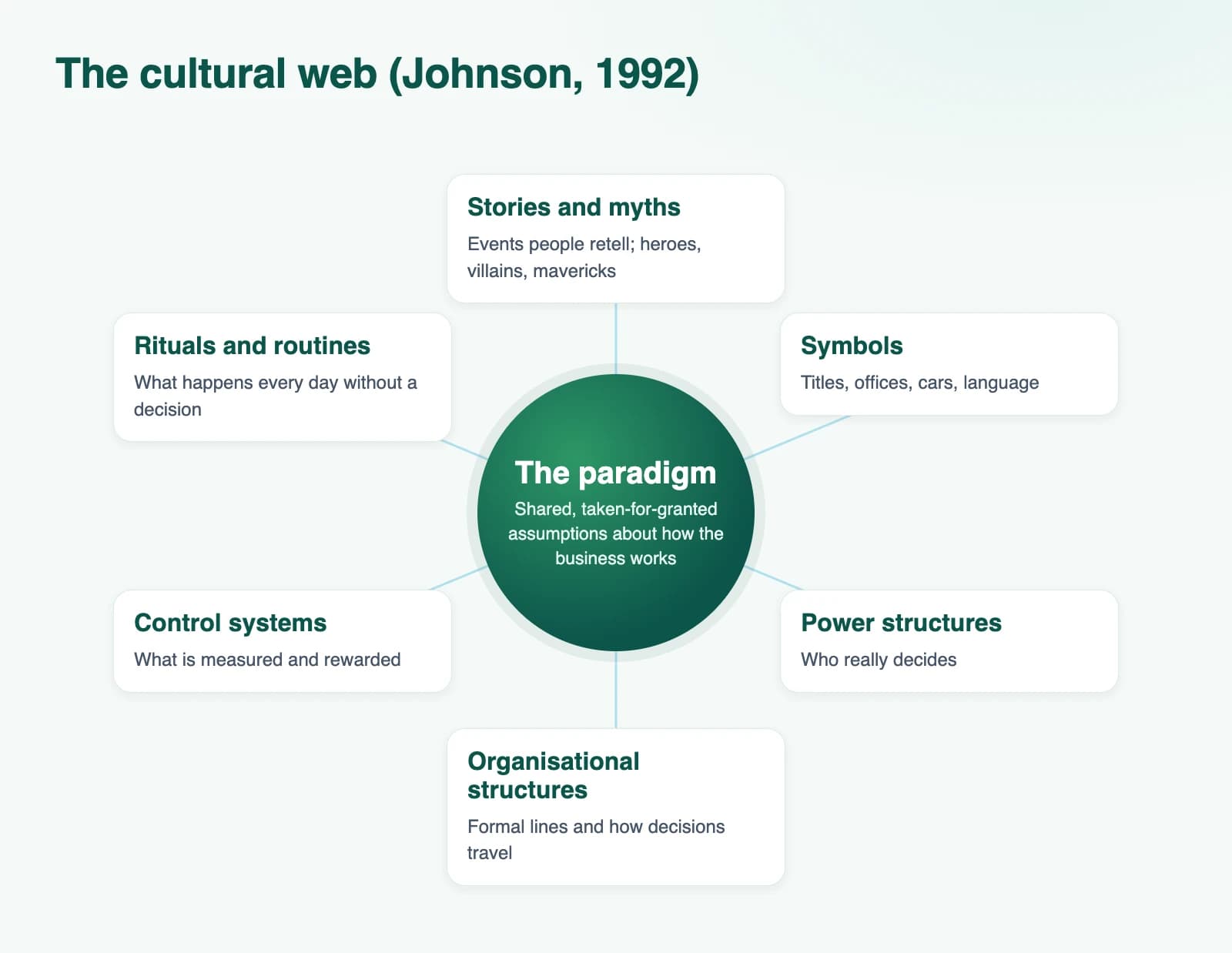
The six elements of the cultural web
Johnson used the web by asking managers to audit their own organisations. His paper reports three of these audits: a menswear retailer, a consultancy partnership linked to an accountancy firm, and a regional newspaper. The examples below come from those three audits.
| Element | What to look for | Example from Johnson's audits | Why it matters |
|---|---|---|---|
| Stories (and myths) | The events people retell, and who the heroes, villains and mavericks are | "Big buying deals of the past" at the retailer | Stories tell newcomers what gets admired and what gets punished |
| Rituals and routines | What happens every day without anyone deciding it | "Partners signatures on anything that goes to clients" at the consultancy | Routines carry the culture when no one is watching |
| Symbols | Titles, offices, cars, language, who eats where | "Named and numbered car parking spaces rigidly adhered to" at the retailer | Symbols are a shorthand for who matters here |
| Organisational structure | Formal lines, and how decisions really travel | "Vertical, hierarchical system with little lateral communication" at the newspaper | Structure decides which ideas meet and which never do |
| Control systems | What is measured, checked and rewarded | "Emphasis on time control and utilization of consultants" at the consultancy | People work towards what is measured, whatever the values say |
| Power structures | Who really decides, and whose assumptions they guard | "Insiders with experience traditionally powerful" at the retailer | The most powerful people are usually closest to the paradigm |
The newspaper's paradigm, as its managers wrote it down, began with "We are in the newspaper business" and "Our paid-for daily will always be there". Younger managers who argued that the real business was advertising were set aside. The presses, the production jargon and the stories of scoops all said otherwise.
The obvious answer, and why it fails the test
When a strategy stalls, the obvious answer is better communication. Explain the strategy again, show more data, run a roadshow. If people understood, they would change.
Johnson's paper tests this directly, and it fails. He found that managers facing poor results first try to do the familiar thing harder, such as tightening controls. If that fails, they change strategy, but only in ways that fit the existing paradigm. The retailer's "fashion" strategy was still a buying strategy. And analysis that challenges the paradigm tends to get a political response, not an intellectual one, because the people with power are the ones most tied to the old assumptions.
Over time this produces what Johnson calls strategic drift: the strategy moves gradually, perhaps without anyone noticing, out of line with the market. Each small change looks like progress, and some even improve results for a while, which makes the drift harder to see.
So more communication is not wrong, but it is aimed at the wrong level. The web shows where the resistance actually lives: in the parking spaces, the sign-off routines, the metrics and the stories that nobody in the strategy meeting thought to mention.
How the cultural web compares with other culture models
The web is not a survey. It produces a picture, not a score. That makes it a different tool from the ones most HR teams already know.
| Model | What it gives you | Best used for |
|---|---|---|
| Cultural web | A qualitative map of what holds the current culture in place | Finding the barriers to a specific strategy or change |
| Schein's three levels | A way to separate artifacts, stated values and basic assumptions | Understanding why visible change does not reach deep beliefs |
| Competing Values Framework and OCAI | A numerical profile of current and preferred culture across four types | Comparing units, setting a baseline and measuring change over time |
The paradigm sits close to Schein's basic assumptions; Johnson cites Schein's definition himself. What the web adds is the six places where those assumptions show up in daily life, which gives a team something concrete to change. For a wider comparison of instruments, see our guide to culture assessment tools.
How to run a cultural web workshop
Johnson used the web as a "culture audit" run by managers themselves, so that they could surface what they took for granted. Practice guides such as Mind Tools describe four stages: map the culture as it is, map it as you want it to be, compare the two, and plan the changes. Here is a practical way to run it in one working day.
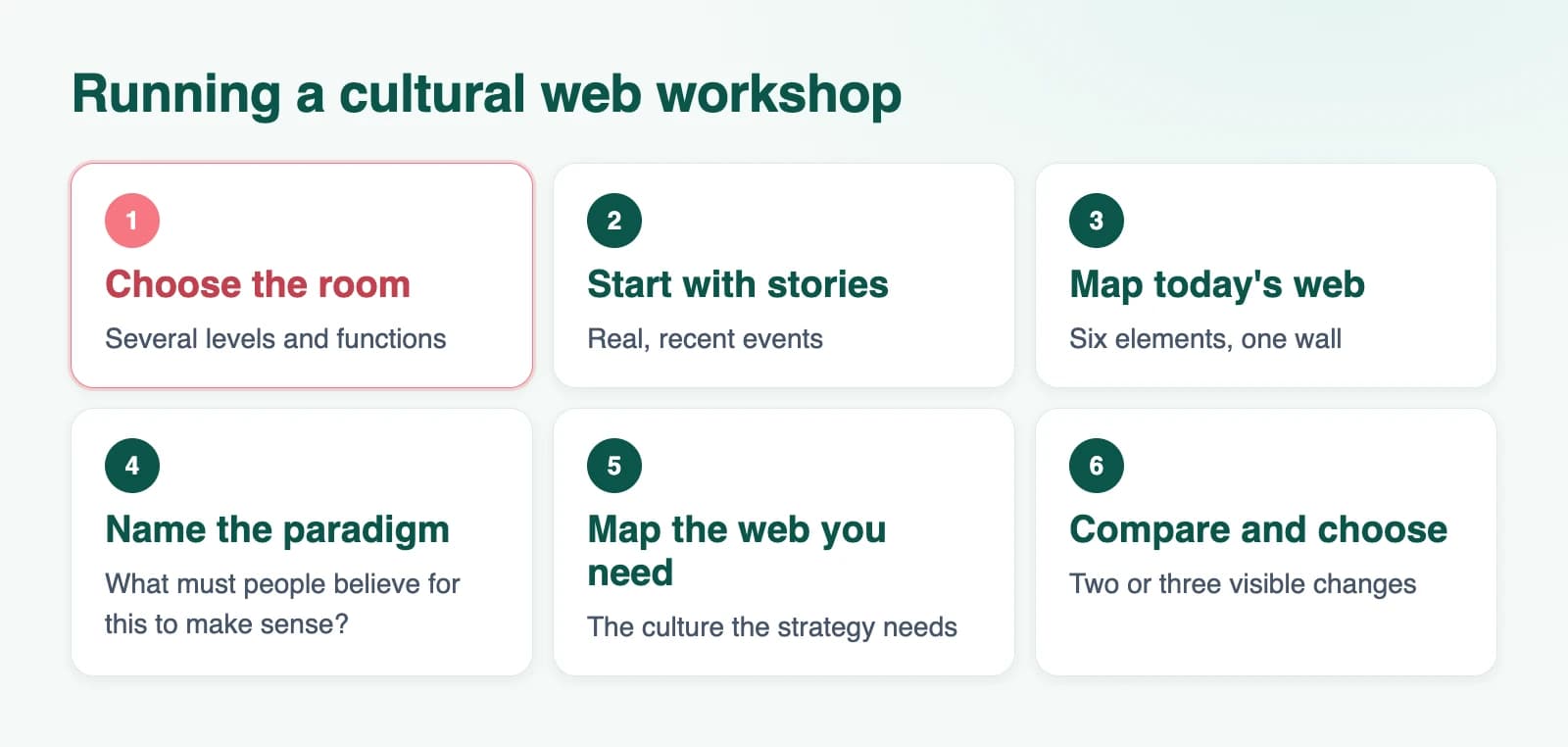
1. Choose the room. Johnson's audits were done by managers. Add people from more than one level and more than one function, because the paradigm is hardest to see for those who benefit from it. His paper notes it may be "more easily perceived by outsiders". 2. Start with stories, not values. Ask for real recent events: what happened to the last person who challenged a decision, missed a target or broke a rule. Stories are the easiest way into the other five elements. 3. Map the six elements of today's web. One wall, six circles, sticky notes. For each note, ask: what does this tell people about what matters here? 4. Name the paradigm last. Ask: what would people have to believe for all of this to make sense? Write it in their words, as the newspaper's managers did. 5. Map the web your strategy needs. Same six circles. What stories would you want people to tell in two years? What would a new joiner notice on day one? 6. Compare and choose. Mark what blocks the change and what already supports it. Pick two or three changes to routines, symbols or controls that people will see in daily work.

A short example shows how the comparison reads. For example, a logistics company moving from "deliver at any cost" to "deliver safely":
| Element | Current web | Web the strategy needs | First visible move |
|---|---|---|---|
| Stories | The driver who made the impossible delivery | The supervisor who stopped a load and was thanked | Leaders retell one such story at every site meeting |
| Control systems | On-time delivery is the only number on the screen | Near-miss reports sit next to on-time delivery | Add the safety measure to the same dashboard |
| Symbols | Bonus boards ranking the fastest routes | Recognition for safe practice | Retire the speed ranking board |
| Power structures | Operations managers overrule safety officers | Safety officers can stop work without approval | Write the stop-work right into role descriptions |
Why symbols and controls are the levers that move
Johnson's paper makes a point that many change plans miss. Executives tend to see control systems and structure as ways of monitoring change. He argues they are also signals. A shift from controlling costs to monitoring customer service is not only a new metric; it tells everyone the culture has changed.
The same goes for symbols. His examples of change signals range from new logos and new forms of address to closing executive dining rooms. The retailer's clothing rule worked because it changed something staff did every day, not something they were told.

This is where the web connects to the wider question of how culture change models work. The web shows you what to change. Change models help you sequence it.
What the cultural web is good for, and its limits
Good for: surfacing assumptions a survey cannot reach; explaining why a sound strategy is stalling; giving a leadership team a shared language for culture; turning a vague "culture problem" into specific routines, symbols and controls.
Limits worth knowing:
- It depends on who is in the room. A web drawn by senior managers describes the culture as senior managers see it.
- It has no numbers. You cannot compare two units or track change over time without a separate measure.
- It can turn into caricature. A workshop that runs on complaints produces a list of grievances, not a map. Ask for evidence: a specific story, a specific report, a specific decision.
- People may map the stated culture. Push past values statements to what actually happened.
The usual answer is to pair the web with a measure. A survey-based instrument such as our Persona Quest OCAI diagnostic, which applies Cameron and Quinn's OCAI, gives the numbers; the web explains them. Our article on measuring culture without guesswork shows how the two kinds of evidence fit together.
A bounded next step
Do not start with a full culture programme. Take one strategic priority that is not moving. Run a two-hour session with eight to ten people from different levels, map only stories and control systems, and ask what the paradigm behind them must be. If what you find surprises you, that is your case for a proper culture diagnostic.
Frequently asked questions
What is the cultural web?
A model for mapping organisational culture, developed by Gerry Johnson and usually credited to Johnson and Kevan Scholes. It places the paradigm, the shared taken-for-granted assumptions, at the centre, surrounded by six elements that hold it in place: stories, rituals and routines, symbols, organisational structure, control systems and power structures.
Who created the cultural web, and when?
Gerry Johnson set it out in "Managing strategic change: strategy, culture and action", Long Range Planning, 1992. It is widely known as Johnson and Scholes' cultural web because of the strategy textbook the two wrote together.
What is the paradigm in the cultural web?
The core set of beliefs and assumptions that managers share and no longer question. Johnson describes it as both a way of interpreting events and a formula for action. It filters what managers notice, which is why it can make an organisation drift away from its market.
How do you use the cultural web for change?
Map the current web in a workshop, starting with real stories. Name the paradigm. Then map the web your strategy needs, compare the two, and change a few visible routines, symbols and controls first.
What is the difference between the cultural web and Schein's model?
Schein describes three levels of culture: artifacts, espoused values and basic assumptions. The cultural web's paradigm is close to Schein's basic assumptions; Johnson uses Schein's definition. The web adds six practical places where those assumptions show up, which makes it easier to plan change.
References
- Johnson, G. (1992), "Managing strategic change: strategy, culture and action", Long Range Planning 25(1), 28-36. Includes Figure 2, "The cultural web of an organization", and Table 1, three managers' culture audits. doi.org/10.1016/0024-6301(92)90307-N90307-N)
- Mind Tools, "The cultural web", four stages for using the model and question prompts for each element. mindtools.com