
Measure what matters—before you invest in change
Employee surveys and assessments for Egypt and the Gulf, in English and Arabic, so the number you take to the board comes with a reason and a next step.

What we measure with
Ready-made instruments you can launch this month, and the conversations that explain the numbers.
What we measure with
Ready-made instruments you can launch this month, and the conversations that explain the numbers.
You already have data. What you do not have is a number you can defend.
Most HR leaders we meet are not short of surveys. They are short of answers they can take into a leadership meeting without flinching. If one of these sounds like your last quarter, this page is for you.
- “The engagement score came back fine. The resignations did not slow down.”
- “The CEO asked how we got the number, and I could not explain it in one sentence.”
- “We translated the questionnaire. Most of the comments were about the questions.”
- “The report arrived finished. I still do not know what to do on Monday.”
- “Every department says its problem is communication. I cannot tell whose is real.”
- “Our job adverts make promises. I am not sure our new joiners would recognise them.”
Measurement is not a score. It is the reason your next decision holds.
A rating scale records how someone felt on the morning they answered. A translated questionnaire records how well they understood the translation. A report that arrives finished records what it was built to find. None of them tells you what to do next, and none of them survives a sceptical question from the board.
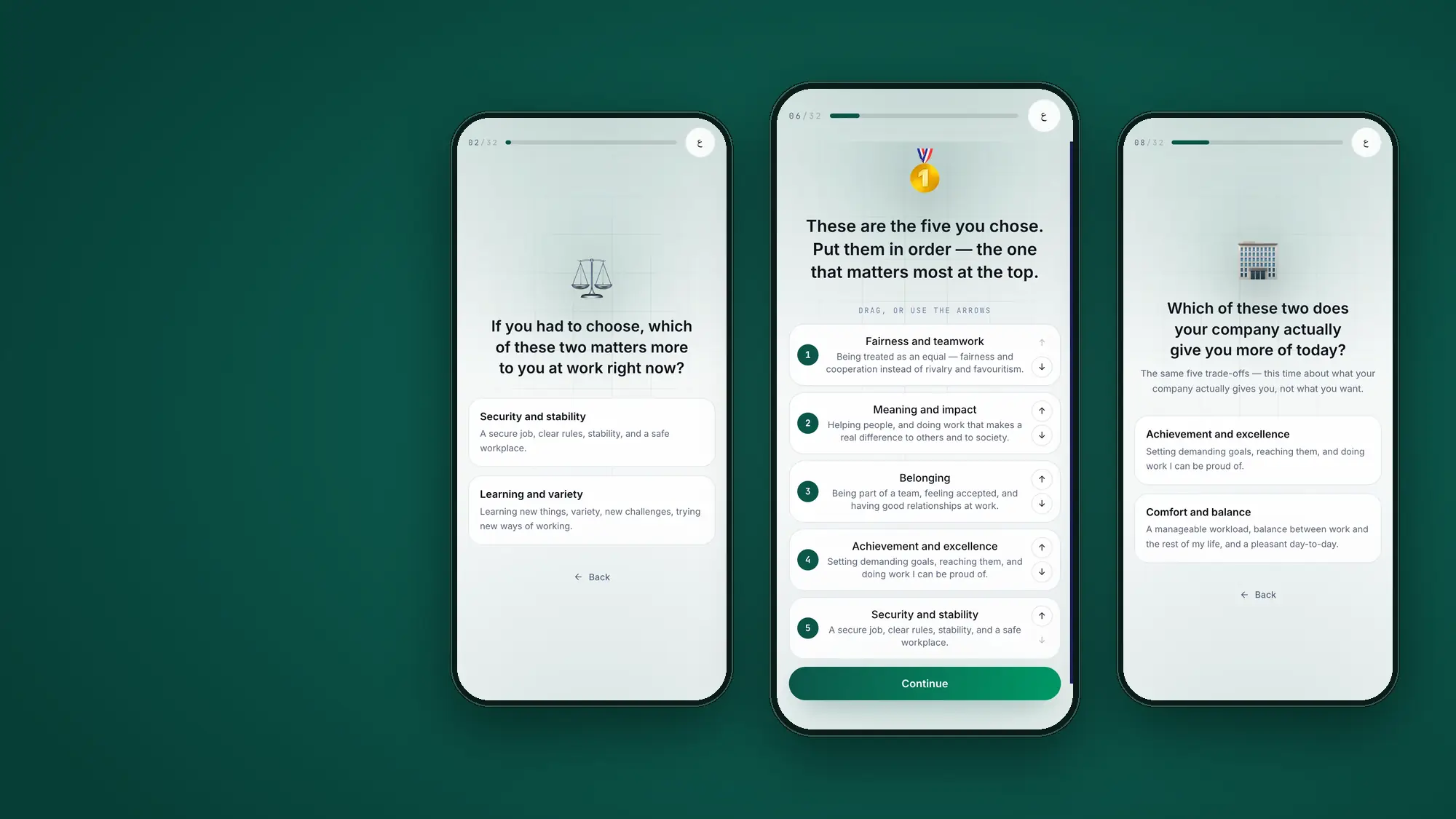
We work the other way round. We start from the decision the number has to support, and work back to the questions. We write those questions for how your people actually speak, in English or Arabic, instead of translating an English template. Where a rating scale invites the polite answer, we use scenarios and trade-offs that people cannot answer on autopilot.
Then we tie every finding to something a named team can do. You leave with a real baseline, including the uncomfortable parts, and an order of work that starts on Monday — not a deck that waits for the next offsite.
Book a DiagnosisWhat lands on your desk
Every measurement engagement ends in the same three things: a baseline, the reasons behind it, and an order of work. Depending on the area we measure, they take this form.
A baseline, with the uncomfortable parts left in
An internal communication maturity scorecard, a journey map with its touchpoint inventory, a culture heatmap and gap report, or an EVP truth gap report. Nothing smoothed over to make the first meeting easier.
Where it breaks, and why
Friction hotspots and their root causes, by cohort, department or journey stage, so you spend first where it hurts most rather than where it is loudest.
An order of work
A prioritised roadmap with quick wins, or a 12-week improvement plan for internal communication. Something your team can start, not something you have to translate.
A summary your leadership will read
A leadership summary and debrief, and an action model that turns each finding into a step for a named team.
A way to see it move
Dashboards and trend views, so the next pulse is compared with this one, not with somebody’s memory of it.
Modules that fit Measure
Filtered from our products and suites. Some delivery types also include tailored services.
GK Engagement Survey
Whatever engagement survey you run, the numbers come back below reality — not because your work is bad, but because people answer based on how the last few days felt, not the whole year. The GK Engagement Survey asks them to choose instead. One survey covering engagement, culture, EVP, experience and retention.
IC Quality Index
A metric-based audit that assesses channel architecture, message clarity, leadership communication capability, and governance—then produces a prioritized plan to fix signal loss.
Employee Journey Assessment Tool
A structured assessment that maps touchpoints, identifies friction, and measures signals across the lifecycle—creating a baseline to prioritize EX investments.
Satisfaction Pulse Suite
A pulse system that tracks engagement drivers and translates results into an action model leaders can execute.
Persona Quest (OCAI)
Employees respond to scenarios that reveal cultural preferences and tensions. Results map to OCAI to show current vs desired culture and gap zones.
EVP Reality Audit
We identify the truth gap between what you communicate externally and what employees experience internally—then provide a prioritized plan to close it.
Tell us your objective and your scale. We will recommend the cleanest starting point, including when that is a smaller first step.
Measure, area by area
- Internal Communication
Measure IC effectiveness
Assess channel architecture, clarity, leadership comms, and governance—then identify signal loss.
- Employee Experience
Measure experience friction
Map moments that matter and quantify where experience drifts—by cohort and journey stage.
- Employee Engagement
Measure engagement drivers
Run pulses that measure drivers and translate insights into leader actions.
- Culture
Measure culture truth
Low-resistance diagnostics that reveal current vs desired culture and where gaps live.
- Employer Branding
Measure EVP truth gap
Compare market perception and employee reality—then identify the gap that drives early churn.
How a measurement engagement runs
- 1
Agree what the number is for
Which decision it has to support, who will read it, and which areas it covers: internal communication, employee experience, engagement, culture or employer brand.
- 2
Collect the evidence
Surveys and pulses, interviews, a desk review of your channels and documents, and scenario-based diagnostics, in English, Arabic or both.
- 3
Validate before we score
We test early findings with your stakeholders, so the final report is argued with evidence, not received as a surprise.
- 4
Hand over the baseline and the plan
The scoring, the reasons behind it and the order of work — and a date to measure again, so the next number means something.
PRISM, Viton and IRIS
The same idea, built into three instruments: PRISM measures a person, Viton measures a voice, IRIS measures a room.
Before you call
We already run an annual engagement survey. Why would we need this?+
Can our people answer in Arabic?+
Will you compare us with other companies?+
What does it cost, and how long does it take?+
Walk into the next board meeting with a number you can defend.
Tell us the decision you have to make and who has to agree to it. We will tell you what is worth measuring first, in which language, and what it would realistically cost.