
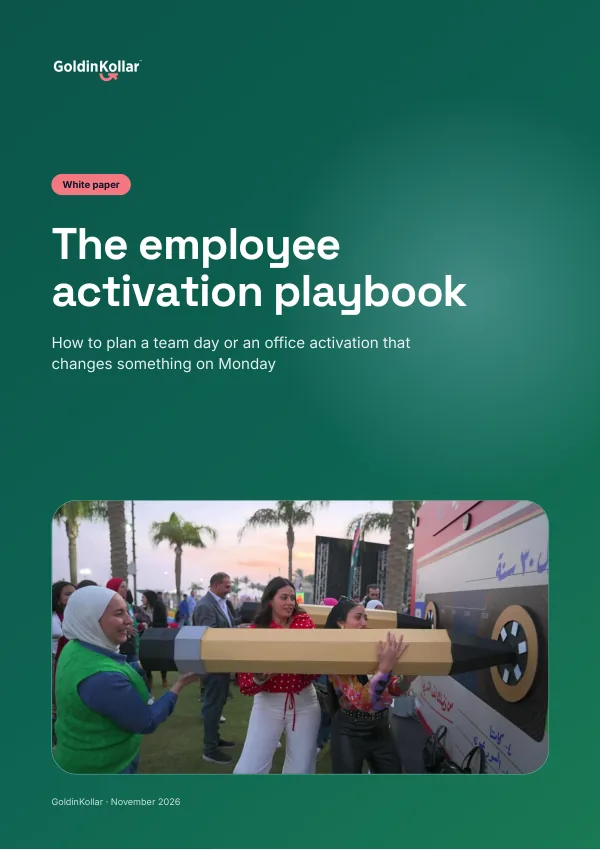
The employee activation playbook
How to plan a team day or an office activation that changes something on Monday: the brief, the idea, the format, the day itself, and what happens after the last game.
What is inside
- A one-page brief that starts from what should change
- Three tests for an idea, and five formats to choose from
- A week-by-week plan, from eight weeks before to four weeks after
- How to run the day from one page, and who can stop a round
- The debrief, the five questions and the recap
- Where the money goes, without a single price
From the work
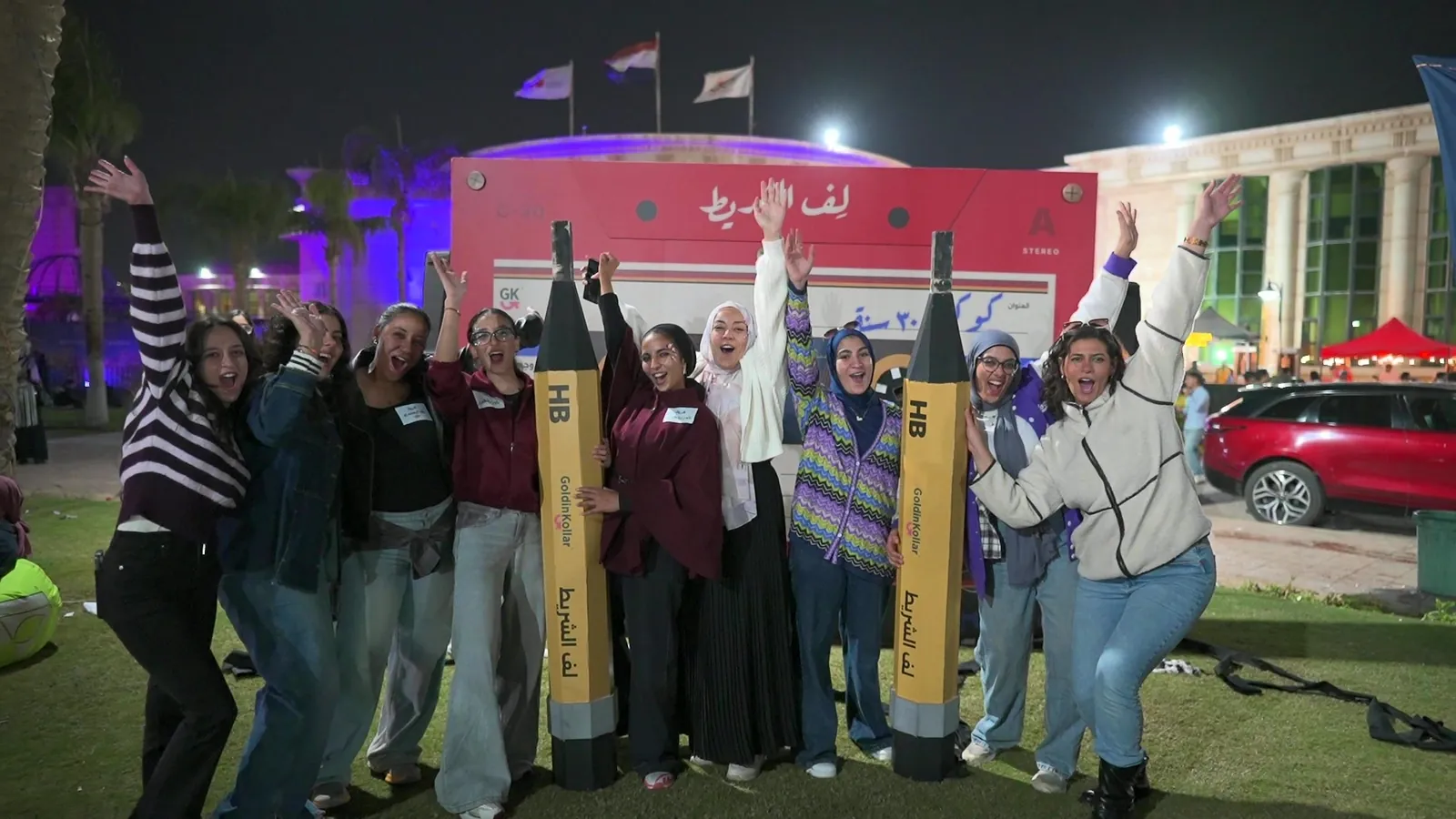
MSA University’s 30th anniversary team day: “Rewind”, thirty years played as five games from the 90s. 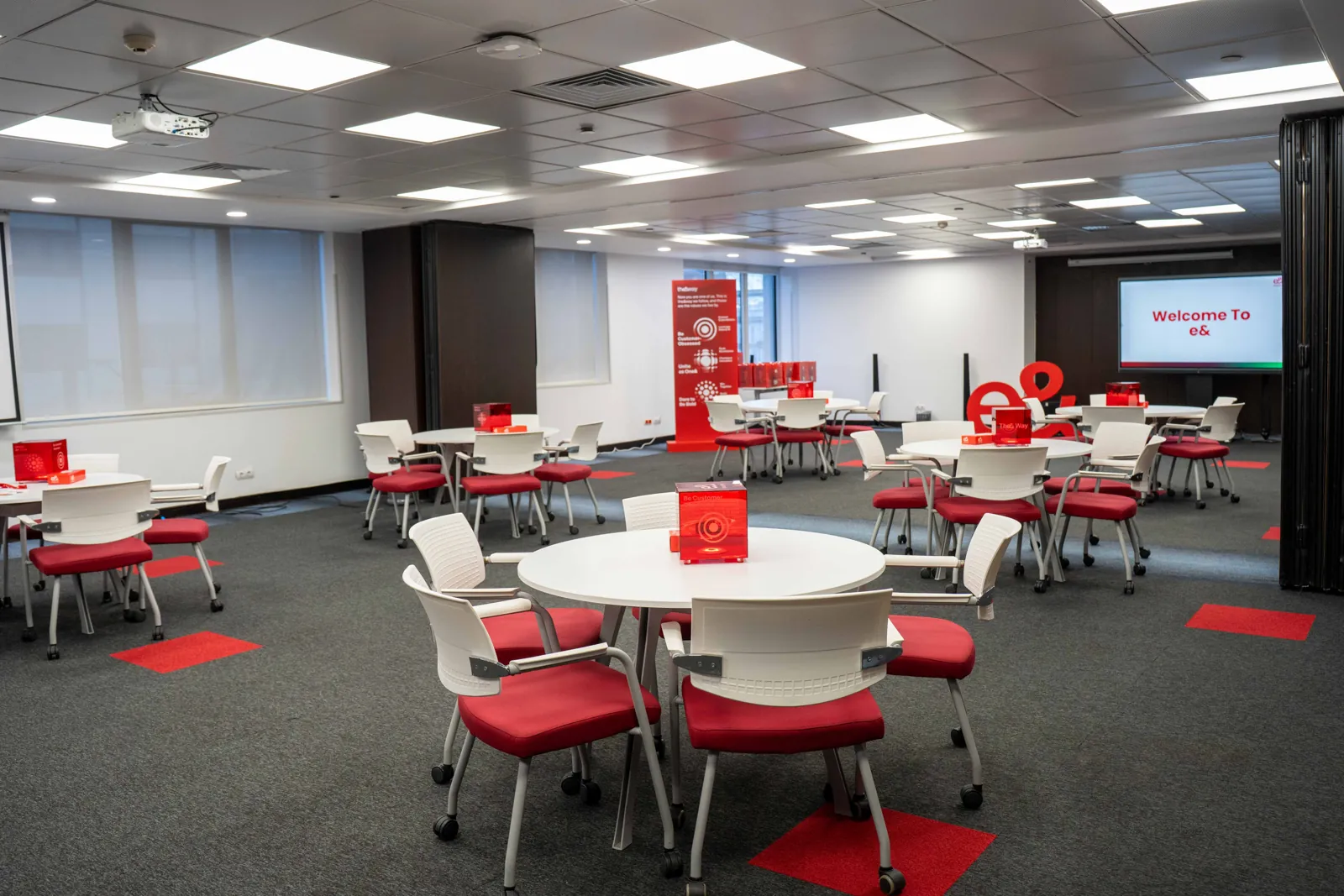
An induction room set before the doors open, with a welcome kit at every place. 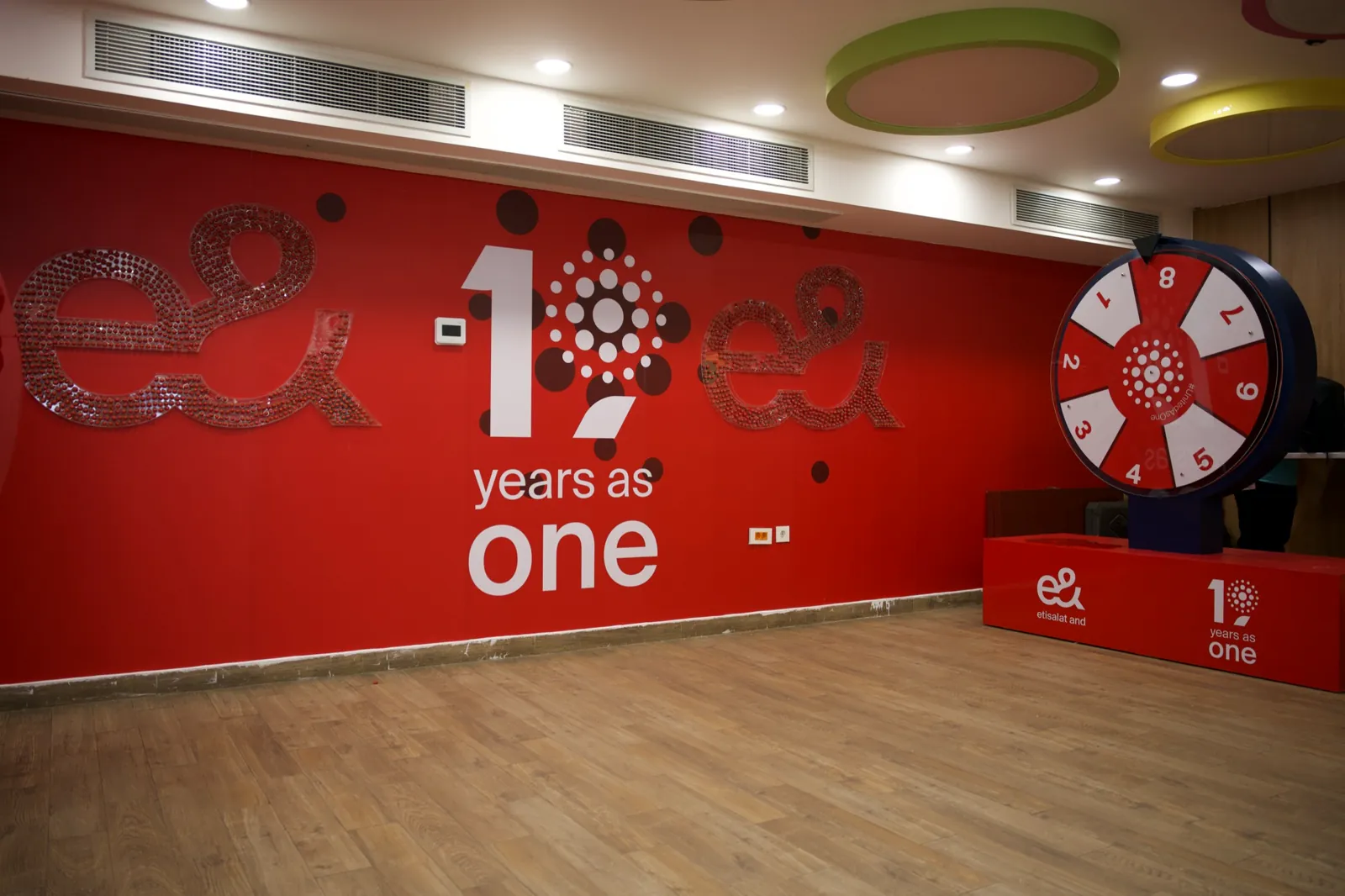
An anniversary set built for photographs on the office floor.
Most company days are planned backwards. Someone books a venue, someone orders the T-shirts, and the question of what the day is for arrives last, if it arrives at all. The photos look good. On Monday, nothing has moved.
This playbook is how we plan a team day or an office activation so that something does move. It is our own method, not a study. Two findings in it come from published research, and both are cited at the end.
The short version
- Start from Monday. Write the one thing people should do differently afterwards before anyone has an idea.
- One idea, with a name. A day people can describe in a sentence is a day they remember.
- Design moments people take part in. A moment only counts if the whole team is needed to finish it.
- Run it from one page. One clock, one owner for each line, one person who can stop any round.
- Debrief the same day, report within a week, come back in four. After that it is only a memory.
What is an employee activation?
An employee activation is a planned moment that employees take part in, built to move one behaviour or one belief.
It is easier to see beside its neighbours:
| People | Built for | You know it worked when | |
|---|---|---|---|
| A campaign | read and watch | attention and understanding | people can say the message back |
| An event | attend | a shared moment | people came, and stayed |
| An activation | take part | one behaviour or belief | people do something differently afterwards |
A team day is an activation that lasts a day. A booth on the office floor for a product launch is an activation that lasts ten minutes. The planning is the same; only the scale changes.
Why do most activations change nothing?
Because they are designed for the day, not for the day after.
The research on team building says the same thing in numbers. A meta-analysis of team-building studies found a moderate positive effect overall, and of the four components it compared, goal setting and role clarification had the largest effects (Klein and colleagues, 2009). The activity itself matters less than what it is aimed at.
So the first document is not a mood board. It is one page with six lines: the occasion, the change, the people, how you will know, the limits, and who approves. If you cannot write the second line, you are not ready to choose an activity.
A good change line names a behaviour someone could see at work:
- "Dispatch and customer care call each other before a delivery is late, not after."
- "New joiners can name their manager, their buddy and their first task by the end of day one."
- "Every team can say our three values in its own words."
"Bond", "have fun" and "feel appreciated" are not change lines. They are what people feel when the day is well made. They are not what it is for.
How do you find the idea?
Look for something true about this company, then give it a name.
MSA University turned thirty. The true thing was the year it was founded: the nineties. So the day became "Rewind": thirty years, played as five games from that decade. A giant cassette that a team winds back with a giant pencil. Two televisions and a rooftop antenna. Two real 128s pushed round a cone course. Nobody had to explain why these games, at this university, in this year.
Three tests for an idea:
- It has a name. Two to four words that people will repeat in a corridor.
- It could not belong to another company. If you can swap the logo and nothing breaks, it is decoration.
- Every moment trains something. In "Rewind", each game was built around one way of working together: rhythm, communication, role clarity, shared effort and trust.
Which format fits the occasion?
Choose by what people need to do, not by what you ran last year.
| Format | Use it when | What it needs | From our work |
|---|---|---|---|
| Team day with stations | teams need to work across their usual lines | open space, one facilitator for each station, a rotation plan | MSA University’s 30th anniversary |
| Activation on the office floor | everyone should take part without leaving work | a set people walk into, ten minutes of play, no sign-up | the World Cup inside the office |
| Launch day | a programme or a set of values needs a first day | a room, an identity, one moment everybody shares | a women’s programme launch |
| Games for awareness | people must remember rules or values | a game that makes them use the rule, not read it | values played on the office floor |
| A digital layer | people are in different sites, or the day needs a score | phones, a big screen, a game that takes teams | Trivia Clans |
Most good days combine two: stations for the afternoon, a digital game that keeps the score, a film that carries the day to the people who were not there.
How do you plan it, week by week?
Eight weeks is comfortable. Four is possible if the idea is simple and the site is your own.
| When | What is done |
|---|---|
| 8 weeks before | The brief is signed by the person who approves |
| 7 weeks | The idea is chosen and named |
| 6 weeks | Site visit and the first safety walk |
| 5 weeks | Station sheets written and tested with five people |
| 4 weeks | Production brief sent, three quotes for each item, budget approved |
| 3 weeks | Managers briefed, then the teaser goes up |
| 2 weeks | Invitation sent, teams drawn so that every team is mixed, crew confirmed |
| 2 days | Reminder with team colour and meeting point |
| The day before | Everything built and tested on site; the crew plays every game |
| The day | Second safety walk, crew briefing, doors open |
| The next morning | Five questions to everyone who took part |
| One week after | Film, photos and the recap page |
| Four weeks after | Team commitments reviewed in a meeting that already exists |
Two lines in that table are skipped more than any others: testing each game with five people, and briefing managers before their teams. A game that has never been played will fail in round one. A manager who hears about the day from the invitation cannot answer the first question their team asks.
What makes the day itself run?
Three rules, and they are all about one page.
- One page, one clock. The run of show lists every change of activity with a time, a place, a named owner and the cue that starts it. If two people hold different versions, the day runs late.
- One voice at each station. A lead facilitator briefs the team and calls the result. A marshal keeps the rules and the safety, and resets the station for the next team.
- One person can stop any round. The safety lead does not ask permission. They have walked the site twice: once to plan, and once that morning.
For a day with stations, play for fifteen minutes and move for five. Two teams meet at each station, every team visits every station once, and with an odd number of stations no two teams meet twice. A round that runs long takes its minutes from every round after it.
Plan for the people who are easy to leave out. In Egypt and the Gulf that means prayer times inside the plan, shorter and cooler hours in Ramadan and in summer, games that do not depend on strength or speed alone, and transport for the colleagues who do not work at head office. An activity that excludes part of the team works against the reason for doing it.
What happens after the last game?
The part that decides whether the day was worth it.
A meta-analysis of 46 samples found that properly run debriefs improved individual and team performance by about 20 to 25 percent (Tannenbaum and Cerasoli, 2013). A debrief is not a speech. It is ten minutes in teams, before the results, on three questions:
- What happened in the games?
- Why did it happen?
- What is one thing we will do differently?
The next morning, send five questions. Three are answered from 1 to 5: I worked with people I do not usually work with; I understand what the day was for; the day will change something in how my team works. Two are open: what should we keep, and what should we change.
Within a week, send one page to management: what you set out to change, how many were invited, took part and answered, what people said in their own words, and the date of the follow-up. Show the number who answered beside every score. An average from ninety-seven people and an average from nine are not the same claim.
Four weeks later, read each team’s commitment aloud in a meeting that already exists. That is the whole follow-up, and it is the step that turns a day into a change.
Where does the money go?
Into six headings, and one of them is the one to watch.
| Heading | What sits under it |
|---|---|
| Built or bought once | sets, props, printed kits |
| Rented for each day | sound, screens, shade, vehicles |
| Crew | facilitators, marshals, technicians, safety |
| Venue and site | space, power, permissions |
| Food and drink | for participants and crew |
| Photo and film | the day, and the clips for those who were not there |
What you build once is the cost of the first day. A second day, for another site or another shift, reuses it and pays only the daily headings. So a programme for a thousand people over three days costs less for each person than three separate days would. Ask for the two totals separately, add a contingency as a line of its own, and divide the total by the number of participants before you compare quotes.
This playbook gives no prices. They change by city, season and supplier, and a number printed here would be wrong for most readers.
A checklist to keep
- The change is a behaviour someone could see at work
- One idea, with a name, that could not belong to another company
- Every moment needs the whole team
- Every game tested with five people before it is built
- Managers briefed before their teams
- One page, one clock, one owner for each line
- A safety lead who can stop any round, and two walks of the site
- Prayer time, heat and access inside the plan
- Ten minutes of debrief before the results
- Five questions the next morning, one page within a week, a follow-up in four
Templates for every step
Every document named in this playbook is free to download, in English and Arabic: the brief, the idea sheet, the station sheet, the rotation plan, the run of show, the crew list, the production brief, the budget, the safety walk, the communication plan and the recap. There is also a planner workbook that sets the countdown dates and builds the rotation by itself. Get them from the team day and activation templates.
To see the method at work, browse the work, or read does team building actually work? for the evidence in more detail.
Sources
Know someone who should read this?
Share it on LinkedIn with a post that is already written. You can change it before you publish.
Follow GoldinKollar on LinkedInPlanning something for your people?
Get two or three ideas for your occasion
Three taps, then send. We reply within one business day with ideas that fit your people and your date.
The occasion
How many people
When
Opens WhatsApp with your answers already written. Nothing is sent until you press send there.
Take this to your leadership with a plan, not an article.
Tell us what you are facing. In a 30-minute diagnosis call we tell you what we would measure first, which program fits and what it would take. We reply within one business day.
Messages and calls reach Islam Yousry, our Head of Research and Strategy, directly.