
Hofstede's cultural dimensions at work: Egypt, Saudi Arabia and the UAE

The slide says: "Saudi Arabia: high power distance. Don't ask employees for ideas; they expect to be told." It was put together for a regional leadership offsite, and nobody in the room questions it. It misuses Geert Hofstede's research twice. It applies a national average to individual people, and it treats national culture as if it were the culture of one company. Hofstede warned against both.
The short answer: Hofstede's cultural dimensions are six scales for comparing national cultures: power distance, individualism versus collectivism, motivation towards achievement and success (formerly masculinity versus femininity), uncertainty avoidance, long-term versus short-term orientation, and indulgence versus restraint. Each country gets a score on each scale, relative to other countries. At work they are useful as hypotheses about how people may expect authority, feedback, rules and rewards to work. They are not descriptions of any individual, and they are not your organisation's culture. Your own employees' answers beat any country score.
Where the dimensions come from
In the 1970s Hofstede gained access to a values survey run inside IBM's subsidiaries in more than 50 countries. The database held more than 100,000 questionnaires. His breakthrough, as he describes it, came when he stopped analysing individuals and compared the average answers of whole countries. Patterns appeared at country level that were not visible at individual level.
Four dimensions came from that data. A fifth, long-term orientation, came later, and a sixth, indulgence versus restraint, was added in 2010 from World Values Survey data analysed by Michael Minkov. Hofstede defined culture as the "collective programming of the mind" that distinguishes one group from another. The word that matters is collective.
The six dimensions at work
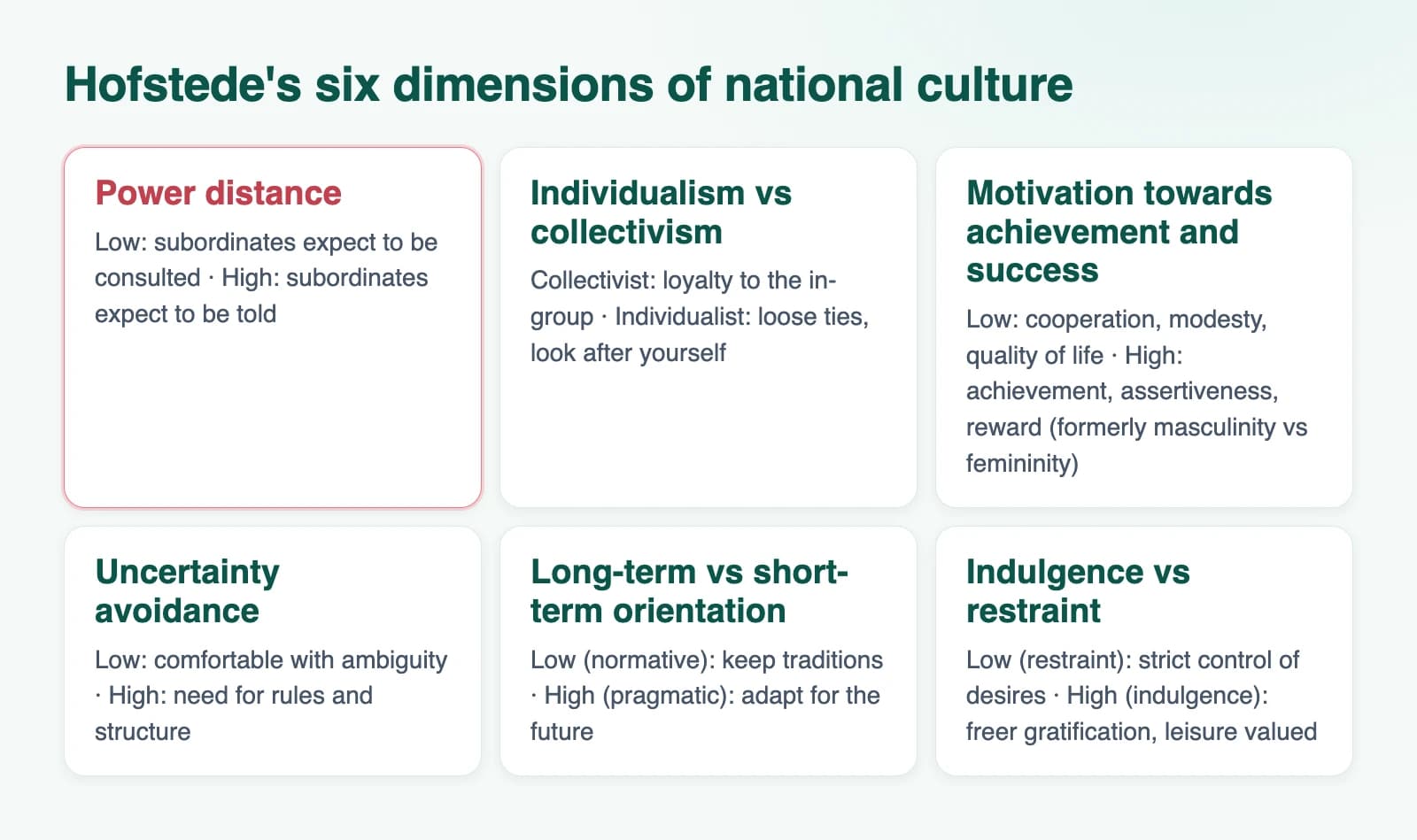
| Dimension | What it is about | How it can show up at work | Why it matters for HR |
|---|---|---|---|
| Power distance | How far less powerful people expect and accept that power is distributed unequally | Whether people expect to be consulted or told; how much they defer to the boss | Shapes how upward feedback, open-door policies and delegation are received |
| Individualism vs collectivism | How tightly people are integrated into groups | Loyalty to the in-group; whether reward and blame land on individuals or teams | Affects individual bonuses, forced ranking and how criticism in public is felt |
| Motivation towards achievement and success | A preference for achievement, assertiveness and material reward, against cooperation, modesty and quality of life | How openly people compete and celebrate winning | Shapes recognition programmes, sales incentives and leadership style |
| Uncertainty avoidance | How threatened people feel by ambiguous or unknown situations | Appetite for clear rules, procedures and detailed instructions | Affects how change, agile ways of working and vague job roles land |
| Long-term vs short-term orientation | Whether a society prefers tradition (normative) or adapts it pragmatically for the future | Respect for established ways; patience for long payback | Shapes how long-horizon development and change programmes are sold |
| Indulgence vs restraint | How far people control their desires and impulses | Attitudes to leisure, fun at work and social norms | Affects which wellbeing and employee experience ideas feel natural |
The dimension once called masculinity versus femininity now appears on The Culture Factor's country comparison tool as "Motivation towards Achievement and Success". The content is the same: competition and achievement at one end, cooperation and caring at the other.
How Egypt, Saudi Arabia and the UAE compare
The newest country figures come from a study by Shihanah Almutairi, Michael Heller and Dorothy Yen (2021), and The Culture Factor Group (formerly Hofstede Insights) shows them on its country comparison tool. In broad strokes: all three countries score high on power distance and low on long-term orientation and indulgence, Egypt most of all on indulgence. Egypt is markedly more collectivist than Saudi Arabia and the UAE, and the two Gulf states show a stronger wish to avoid uncertainty than Egypt. The tool's terms limit its scores to non-commercial use, so we describe the pattern here and link to the tool for the numbers.
Read those figures with their history. Hofstede's original IBM data covered seven Arab countries with 141 respondents in total, surveyed in 1969 and 1972, and, according to Almutairi and colleagues, the raw data was later destroyed. Only regional figures survived. The data file on Hofstede's own website still lists one row for "Arab countries" on the first four dimensions, with no separate scores on those four dimensions for Egypt or Saudi Arabia, and no row at all for the UAE.
The newer scores un-cluster them. Almutairi and colleagues gave Hofstede's Values Survey Module 2013 in Arabic to university students without work experience, a matched sample Hofstede's method recommends. The final sample included 130 Egyptian, 98 Saudi and 90 Emirati students. The country differences are useful: Egypt is far more collectivist than Saudi Arabia on these figures, and the Gulf scores lower on power distance than the old regional score.
The two sources do not always agree. Hofstede's own file, which draws its last two dimensions from World Values Survey data, places Saudi Arabia far higher on indulgence than the newer student study does. Same country, same dimension, different sample, very different answer. That alone is a reason to hold any single score lightly.
How to read the scores without misusing them
They are relative. A score places a country against other countries. Egypt's 0 on indulgence does not mean Egyptians never enjoy themselves; it means Egypt sits at the restrained end of the countries measured.
They describe students, not your workforce. The Arab scores come from students with no work experience: a sound choice for comparing countries, and silent about a 45-year-old plant manager in Alexandria.
In the UAE, ask whose culture it is. The Emirati figures come from 90 Emirati students. The Culture Factor's own text describes the UAE as an expatriate-majority society. In a Dubai office with a dozen nationalities, the UAE score may describe a minority of the room.
They are averages, and the spread is wide. Hofstede wrote that national culture scores "should not be used for stereotyping individuals". Inside every country there is a full range of personalities, regions, generations and sectors.
The obvious answer, and why to test it
The obvious answer: "Use the country scores to design HR practices for each country." It sounds culturally intelligent. Test it against four findings.
- Organisations differ in practices, nations in values. Hofstede's own organisational study of 20 units in Denmark and the Netherlands found large differences between units in perceptions of daily practices but only modest differences in values. Organisational culture lives mostly in practices, which leaders can change. National culture lives in values learned in childhood.
- The level of analysis matters. Hofstede stressed that patterns found between countries can differ strikingly from patterns found between individuals. A country score is a property of a country.
- Wealth explains a lot. Hofstede notes that individualism and low power distance both correlate with national wealth, and that once wealth is controlled for, correlations with culture "usually disappear". Some of what looks cultural may be economic.
- The model has serious critics. Brendan McSweeney (2002) challenged the assumptions behind the claim to have measured whole national cultures, and questioned whether national culture systematically causes behaviour. Hofstede replied in the same journal. You do not have to settle the debate to see the lesson: treat the scores as a starting point.
So the obvious answer fails as a rule. It works as a source of questions. A high power-distance score for Egypt is a reason to ask whether your upward feedback process feels safe to use, not a reason to drop it.

What Hofstede is good for at work, and what it is not
| Use it for | Avoid using it for | Why it matters |
|---|---|---|
| Preparing managers who move between countries | Predicting how one employee will behave | Scores are country averages; individuals vary widely |
| Spotting where a global HR policy may meet friction | Deciding a policy cannot work in a country | Friction is a design problem, often solved by how a practice is introduced |
| Starting a conversation in a multinational team about working styles | Explaining a company's culture problem | Organisational culture sits mainly in practices, which leaders shape |
| Forming hypotheses before a culture survey | Replacing your own survey data | Your employees' answers are about your organisation; the scores are not |
For example, a logistics company rolling out upward feedback in Cairo and Riyadh might expect, from the power distance scores, that people will hesitate to rate their managers openly. That is a hypothesis. The useful response is to design for it, with anonymity, a clear explanation of how answers are used, and a visible first action from leadership, and then measure whether people used it. Our article on psychological safety at work covers why people stay silent in hierarchical teams, and what leaders can change.
National culture and organisational culture
Hofstede worked at two levels. The six national dimensions compare societies. His organisational research produced six different dimensions of everyday practice, covered in our comparison of culture assessment tools. National scores describe the society your employees grew up in, not what your organisation rewards, tolerates or punishes.
For that, start with what organisational culture is and the main types of organisational culture. For practical country context beyond the scores, our guides to work culture in Egypt, Saudi Arabia and the UAE cover working hours, Ramadan, hierarchy and what employees value.
What to do next
Pick one people practice you run across several countries, such as performance reviews or upward feedback. Write down the one hypothesis the Hofstede scores suggest about it, then test it with your own data: response rates, comments and differences between units. If the data confirms the hypothesis, adjust the design; if it does not, drop the assumption. When you are ready to measure your organisation's culture rather than its countries', our measurement work starts there.
Frequently asked questions
What are Hofstede's six cultural dimensions?
Power distance; individualism versus collectivism; motivation towards achievement and success (formerly masculinity versus femininity); uncertainty avoidance; long-term versus short-term orientation; and indulgence versus restraint. Each country receives a score on each dimension relative to other countries.
What are Hofstede's scores for Egypt, Saudi Arabia and the UAE?
All three score high on power distance and low on long-term orientation and indulgence. Egypt is markedly more collectivist than Saudi Arabia and the UAE, and the Gulf states score higher on uncertainty avoidance. The current figures come from a study of university students in Arab states (Almutairi, Heller and Yen, 2021) and are shown on The Culture Factor's country comparison tool, linked in the references.
Can Hofstede's dimensions be used for organisational culture?
Not directly. The six national dimensions compare countries' values. Hofstede's organisational research found that organisations differ mainly in practices, and produced six different dimensions for them. Use national scores for context and measure your organisation separately.
Is Hofstede's model still valid?
It is widely used, and Hofstede lists six major replications between 1990 and 2002. It is also criticised, notably by McSweeney (2002), who challenged its claim to capture whole national cultures. The Arab scores were re-measured with students, and sources disagree. Use the scores as hypotheses, never as facts about a person.
What does high power distance mean at work?
That people in the society, on average, accept unequal power more readily and are more likely to expect direction from the boss. In an organisation it suggests upward feedback and open disagreement need deliberate design. It does not mean employees have no ideas or do not want to be asked.
What this article does not settle
The country scores come from one study of students; we have not tested them against working adults in Egypt or the Gulf.
Epistemic status: built on Hofstede's own 2011 overview, the Arab-states re-measurement, The Culture Factor's country comparison tool and Hofstede's own data file, all read at source; the critique is cited from its published abstract.
References
- Hofstede, G. (2011), "Dimensionalizing cultures: the Hofstede model in context", Online Readings in Psychology and Culture 2(1). doi.org
- Almutairi, S., Heller, M. and Yen, D. (2021), "Reclaiming the heterogeneity of the Arab states", Cross Cultural & Strategic Management 28(1), 158-176. Author's accepted manuscript at bura.brunel.ac.uk; DOI 10.1108/CCSM-09-2019-0170
- The Culture Factor Group, "Country comparison tool" (Egypt, Saudi Arabia, United Arab Emirates), accessed 30 October 2026. theculturefactor.com
- Hofstede, G., "Dimension data matrix", data file 6-dimensions-for-website-2015-08-16 (row "Arab countries"; Egypt and Saudi Arabia). geerthofstede.com
- McSweeney, B. (2002), "Hofstede's model of national cultural differences and their consequences: a triumph of faith, a failure of analysis", Human Relations 55(1), 89-118. doi.org