
Types of organizational culture: four typologies compared, and how to tell which you have

Ask three consultants to name your culture type and you may get three answers. One says "market". One says "role culture". One says "mercenary". All three can be right, because each is using a different list, built to answer a different question.
There is no official list of organisational culture types. There are several, and the one you pick decides what you will see.
The short answer: four typologies cover most of what you will meet. Cameron and Quinn's Competing Values Framework sorts culture by flexibility against control and internal against external focus: clan, adhocracy, market and hierarchy. Roger Harrison and Charles Handy sort it by where power and authority come from: power, role, task and person. Terrence Deal and Allan Kennedy sort it by business risk and speed of feedback: tough-guy, work hard/play hard, bet-your-company and process. Rob Goffee and Gareth Jones sort it by how friendly people are and how strongly they pursue shared goals: networked, mercenary, fragmented and communal. None of them is a ranking. Choose the typology that fits your question, then find your type from decisions and behaviour, not from the values poster.
Types, traits and dimensions: three ways to describe a culture
A type puts an organisation in a box: "we are a role culture". A trait scores it on qualities it can have more or less of, as the Denison model does with involvement, consistency, adaptability and mission. A dimension places it on scales between two poles, as Hofstede's practice dimensions do. Types are the easiest to remember and the easiest to over-read.
Every typology below is a set of four, and most of their authors stress the same point: real organisations are mixtures. Our guide to what organizational culture is covers the layers underneath, which no typology reaches on its own.
The four main typologies compared
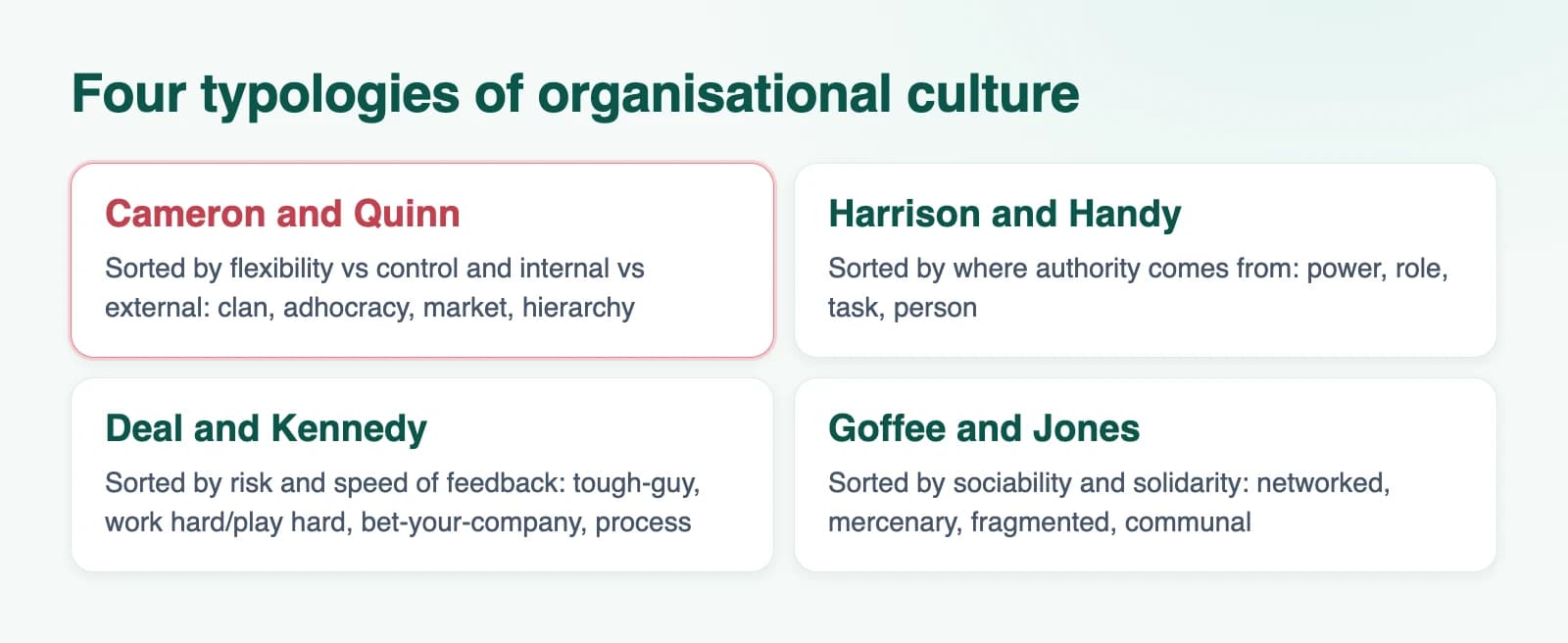
| Typology | What it sorts by | The four types | Where it comes from | Evidence base | Why it matters: use it when |
|---|---|---|---|---|---|
| Competing Values Framework (Cameron and Quinn) | Flexibility against control; internal against external focus | Clan, adhocracy, market, hierarchy | Quinn and Rohrbaugh's 1983 study of effectiveness criteria | Strongest of the four: a published instrument (OCAI) and a 2011 meta-analysis, with mixed support for its structure | You need to measure, compare units and plan a change |
| Power, role, task, person (Harrison; Handy) | Where authority comes from and what the organisation exists for | Power, role, task, person | Harrison's 1972 Harvard Business Review article, later developed by Handy | Conceptual; built from consulting experience | You are untangling a conflict about how decisions should be made |
| Deal and Kennedy | Size of business risk; speed of feedback on decisions | Tough-guy/macho, work hard/play hard, bet-your-company, process | Corporate Cultures (1982) | Conceptual; built from the authors' consulting and case material | You want to see how the market shapes behaviour |
| Double S cube (Goffee and Jones) | Sociability and solidarity | Networked, mercenary, fragmented, communal | Harvard Business Review (1996) | Conceptual, with a self-assessment questionnaire | You are diagnosing relationships, cliques and team cohesion |
Cameron and Quinn: clan, adhocracy, market, hierarchy
This is the typology most culture surveys use. Two tensions, flexibility against stability and control, and an internal against an external focus, give four types. Clan rewards teamwork and development. Adhocracy rewards initiative and experiment. Market rewards targets and winning. Hierarchy rewards process and reliability.
It is the only one of the four with a widely used measuring instrument, the OCAI, and a body of research behind it. A meta-analysis of 84 studies and 94 samples found clan, adhocracy and market cultures positively associated with employee attitudes, operational performance and financial performance, while the data did not support parts of the framework's internal structure (Hartnell, Ou and Kinicki, 2011). Our full guide to the Competing Values Framework covers the axes, the OCAI and how to read a profile.
Harrison and Handy: power, role, task and person
Roger Harrison published this model in 1972 as four "organization ideologies". In his later notes he records that it came out of a 1970 conversation with Charles Handy, who went on to write his own version.
- Power: the organisation tries to dominate its environment, and those at the top keep tight control. Harrison also describes a softer form in old, established firms, often family-owned: employees are cared for, until authority is challenged.
- Role: rational, orderly and rule-bound. Predictability is high, and in Harrison's words "the correct response tends to be more highly valued than the effective one".
- Task: the goal comes first. Authority rests on knowledge, not position, and structures change to fit the work, as in project teams.
- Person: the organisation exists to serve its members, as in some groups of professionals.
Harrison stresses that these are seldom found as pure types and that each has strengths. Power is fast under threat but poor at processing complex information. Role is stable but slow to adapt. Task copes best with complex change but struggles with internal cohesion.
Handy gave the four cultures Greek gods. In Gods of Management, Zeus stands for the power or "club" culture built around a central figure, Apollo for the role culture, Athena for the task culture and Dionysus for the person or "existential" culture.
The softer power form will be familiar to anyone who has worked in a founder-led or family group, a common structure in Egypt and the Gulf. The useful question is not whether power is centralised, but what happens when someone challenges it.
Deal and Kennedy: risk and speed of feedback
Terrence Deal and Allan Kennedy's Corporate Cultures (1982) argued that the business environment shapes culture through two forces: the degree of risk in a company's key activities, and how quickly people learn whether their decisions worked.
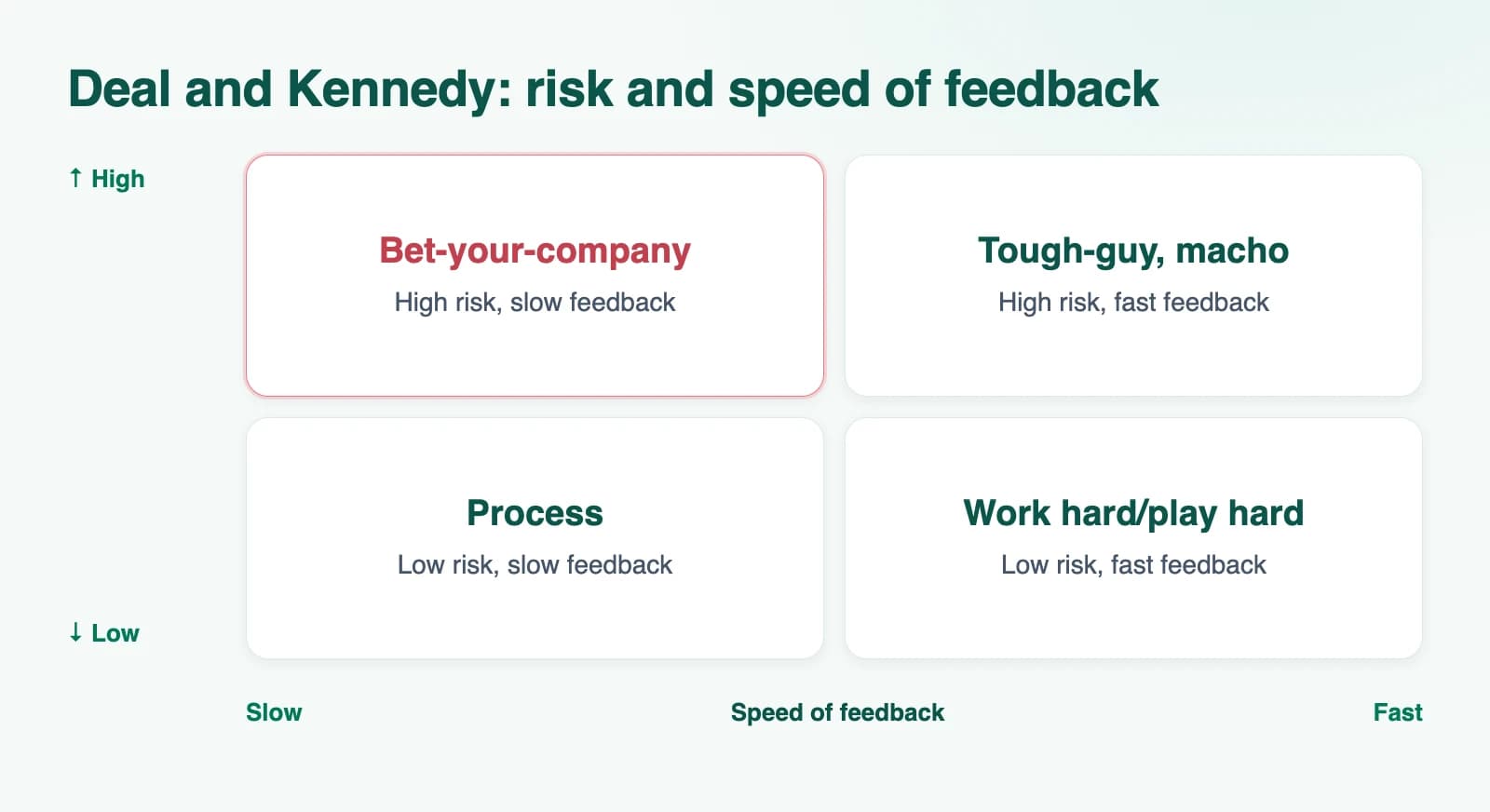
- Tough-guy, macho: high risk, fast feedback. Individualists who take big bets and learn quickly.
- Work hard/play hard: low risk per decision, fast feedback. Action is the norm, as in many sales organisations.
- Bet-your-company: high stakes, slow feedback; decisions take years to prove right or wrong.
- Process: low risk, slow or scarce feedback, so attention moves to how things are done rather than what they achieve, as in many banks and public bodies.
The model's value is the reminder that culture is partly a response to the work. A process culture in a regulated back office may be rational; the same culture in a fast-moving sales team is a problem.
Goffee and Jones: sociability and solidarity
In a 1996 Harvard Business Review article, Rob Goffee and Gareth Jones defined culture as community and measured it on two dimensions. Sociability is, in their words, "a measure of sincere friendliness" among members. Solidarity is the ability to pursue shared objectives quickly and effectively, regardless of personal ties.
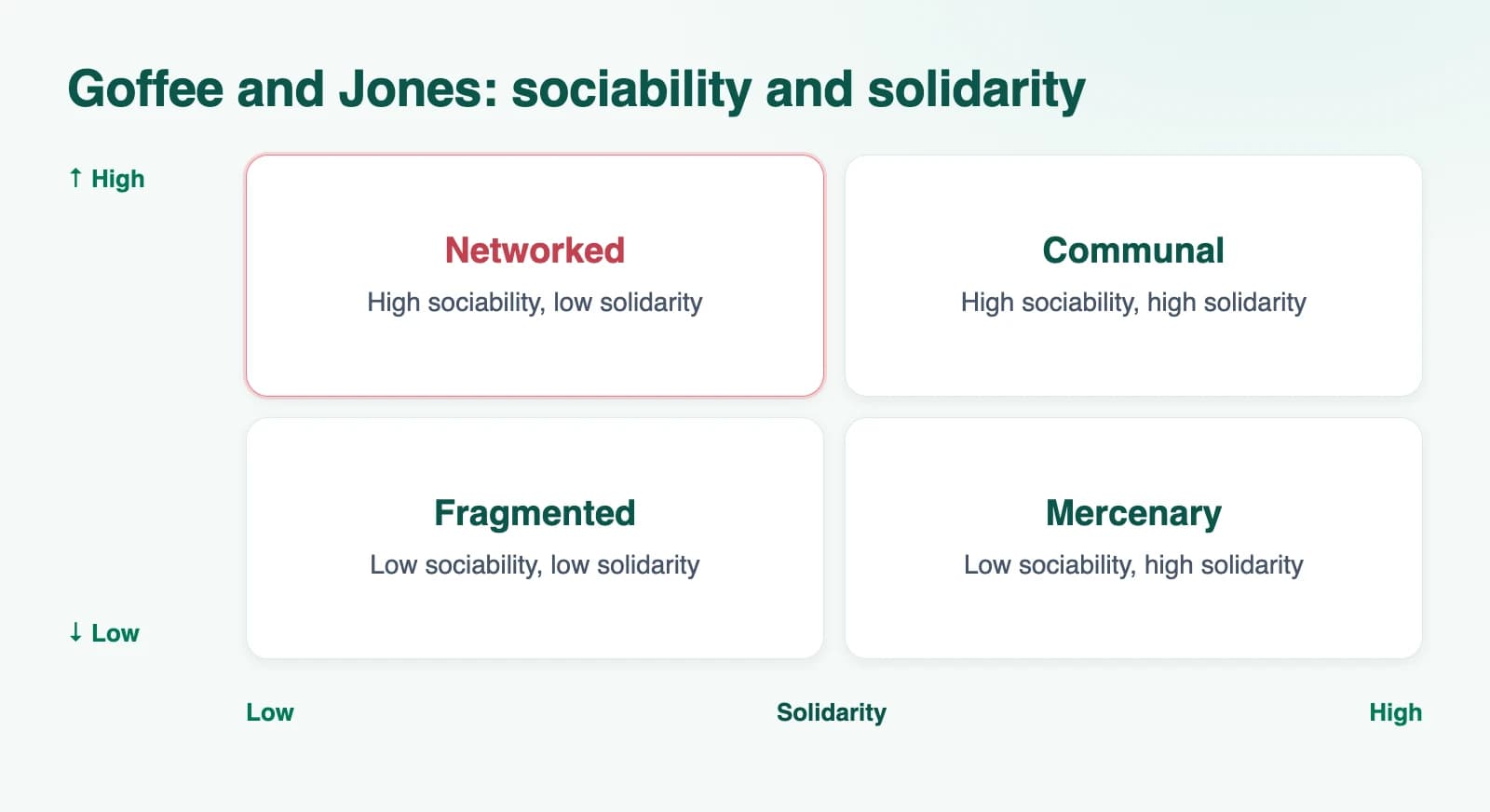
- Networked (high sociability, low solidarity): friendly, loyal, political; people get around the hierarchy through friendships.
- Mercenary (low sociability, high solidarity): focused on business, fast to respond to competitors, clear about performance, weak on loyalty.
- Fragmented (low on both): people work alone. It can suit some professional or outsourced work; it can also be a sign that politics or downsizing has torn the community apart.
- Communal (high on both): strong identity and shared goals, often seen in start-ups and in some mature firms.
They are blunt that "none of these cultures is 'the best'", and that units inside one company can differ sharply. Their warning about high sociability is worth printing for any manager: friendships make it hard to tackle poor performance.
The obvious answer, and why to test it
"Find out which type we are, then move towards the best one." It is what most people want from a culture typology.
Test it. The typologies are not rankings: the OCAI's own documentation calls the Competing Values Framework descriptive, Harrison sets out strengths and weaknesses for each ideology, Deal and Kennedy tie each culture to its market, and Goffee and Jones say no culture is best. Harrison and Goffee and Jones both describe real organisations as mixtures, and Goffee and Jones call the assumption that organisations are homogeneous one of the great errors of writing about culture.
There is a second trap. Labels such as "toxic", "people-first" or "innovative" describe a culture's health or emphasis, not a researched type. A toxic work culture can grow inside any of the sixteen boxes above.
So change the question from "which type are we?" to "which type does each part of the business need, and where is the gap biggest?"
How to tell which type of culture you have
Start from evidence of decisions, not opinions about values. These questions map to the typologies above.
| Question to ask | What the answers point to | Why it matters |
|---|---|---|
| When two managers disagree, who settles it, and on what grounds: rank, rule or expertise? | Power, role or task (Harrison) | Shows where authority really sits, whatever the organisation chart says |
| What gets someone promoted here: loyalty, ideas, results or reliability? | Clan, adhocracy, market or hierarchy (Cameron and Quinn) | Promotions teach everyone what the culture rewards |
| How long before people know whether a decision was right? | Fast or slow feedback (Deal and Kennedy) | Slow feedback pushes attention to process and politics |
| Would people help a colleague outside their job because they like them? | High or low sociability (Goffee and Jones) | Friendships drive cooperation, and also cliques |
| Would teams drop a pet project to hit a shared target? | High or low solidarity (Goffee and Jones) | Solidarity drives focus, and also turf battles |
| Do the answers differ between head office and the frontline? | Subcultures | One label for the whole company hides the gap |

Ask the questions in interviews and small groups at several levels, then compare. For scale, add one instrument chosen by the decision it must support; our comparison of culture assessment tools sets out the options.
A next step for this week
Pick the one question in the table that matters most to your current strategy, and ask it of ten people in two different parts of the business. Write the answers down word for word. If the two groups describe different cultures, you have found where to look first.
If you want that read across the whole organisation, our Persona Quest culture diagnostic applies the OCAI's four types through realistic workplace scenarios and shows current against desired culture by unit and role. Our organisational culture work starts from that measurement before any advice.
Frequently asked questions
What are the main types of organizational culture?
The most cited lists are Cameron and Quinn's clan, adhocracy, market and hierarchy; Harrison and Handy's power, role, task and person; Deal and Kennedy's tough-guy, work hard/play hard, bet-your-company and process; and Goffee and Jones' networked, mercenary, fragmented and communal. Each sorts culture on different dimensions.
What are the four types of culture in Cameron and Quinn's model?
Clan (flexible, internal), adhocracy (flexible, external), market (controlled, external) and hierarchy (controlled, internal). They come from the Competing Values Framework and are measured with the OCAI.
What is Charles Handy's model of organizational culture?
Four cultures, adapted from Roger Harrison's 1972 model: power (Zeus, the club culture), role (Apollo), task (Athena) and person (Dionysus, the existential culture). Handy set them out in Gods of Management.
Which type of organizational culture is best?
None in general. These typologies tie the right culture to the work, the market and the strategy, and each type has its own strengths and failure modes.
Can an organization have more than one type of culture?
Yes, and most do. Units, levels and sites often differ, and the differences are usually more useful to know than the company-wide label.
Sources
- Cameron, K.S. and Quinn, R.E. (2011), Diagnosing and Changing Organizational Culture: Based on the Competing Values Framework, 3rd edition, Jossey-Bass. oreilly.com
- Quinn, R.E. and Rohrbaugh, J. (1983), "A spatial model of effectiveness criteria: towards a competing values approach to organizational analysis", Management Science 29(3), 363–377. doi.org
- Hartnell, C.A., Ou, A.Y. and Kinicki, A. (2011), "Organizational culture and organizational effectiveness: a meta-analytic investigation of the competing values framework's theoretical suppositions", Journal of Applied Psychology 96(4), 677–694. doi.org
- Harrison, R. (1972), "Understanding your organization's character", Harvard Business Review, as reprinted with the author's introduction in Collected Papers of Roger Harrison, chapter 10. pepperdine.edu
- Handy, C., Gods of Management (1979 edition subtitled "How they work, and why they will fail"; later editions subtitled "The changing work of organisations"). archive.org
- Deal, T.E. and Kennedy, A.A. (1982), Corporate Cultures: The Rites and Rituals of Corporate Life, Addison-Wesley, as summarised in the Kirkus review. kirkusreviews.com
- Mind Tools (undated), "Deal and Kennedy's cultural model", for the two dimensions and the feedback speed of each type. mindtools.com
- Goffee, R. and Jones, G. (1996), "What holds the modern company together?", Harvard Business Review, November–December. hbr.org