
Organizational culture models: a field guide
Seven culture models, the one question each answers, and how to choose before you buy a survey: Schein, the Competing Values Framework, Denison, the cultural web, Hofstede and the classic typologies.
What is inside
- Seven models on one page: the question each answers, what you get, and where it is weak
- A table that starts from the decision you face, not from the model
- Each model in one paragraph, with its diagram
- The four mistakes that cost the most, and what to do instead
- What no model does, so you know what to add
- A first month, week by week
The proposal on your desk says "culture assessment". On page two it names a model. By page three the model has decided what your culture is allowed to look like: four types, twelve scores, or six circles on a wall.
The short answer: a culture model is a lens, and each lens answers one question well. Schein's levels explain why people do not do what the company says it values. The Competing Values Framework shows the culture people have and the one they would prefer. The Denison model compares you with other organisations in the language of performance. The cultural web shows what holds the present way of working in place. Hofstede's national dimensions give you hypotheses about a workforce from several countries, and his organisational model compares units. The classic typologies give everyone one word for the place. Write the question first. Then choose the lens.
This paper brings together seven articles on goldinkollar.com. Each article carries its own list of sources, and the main ones are named at the end. It is a guide to choosing, not a new study.
Seven models, and the question each answers
| Model | The question it answers | What you get | Where it is weak |
|---|---|---|---|
| Schein's three levels | Why do people not do what we say we value? | A written account of the assumptions behind behaviour, from observation, documents and interviews | No score, benchmark or trend line; findings depend on the interviewer |
| Competing Values Framework (OCAI) | Which culture do we have, and which do people prefer? | A current and a preferred profile across four types, and the gap between them | Scores depend on each other, so correlations and benchmarks need care; it reads what people report |
| Denison model | How does our culture compare, in terms a board accepts? | Percentile scores on four traits and twelve indexes, against the provider's database | The benchmark is proprietary; it does not explain why |
| Cultural web | What keeps the present way of working in place? | A workshop map of the paradigm and the six elements around it, today and as the strategy needs | No numbers; it shows the culture as the people in the room see it |
| Hofstede's national dimensions | How may people from different countries expect authority, rules and feedback to work? | Country scores on six scales, relative to other countries | Country averages: not a person, and not your organisation |
| Hofstede's organisational model | How do our units differ in everyday practice? | Each unit scored on six dimensions of practice | It rests on one 1990 study of 20 units in 10 organisations; today's versions are proprietary |
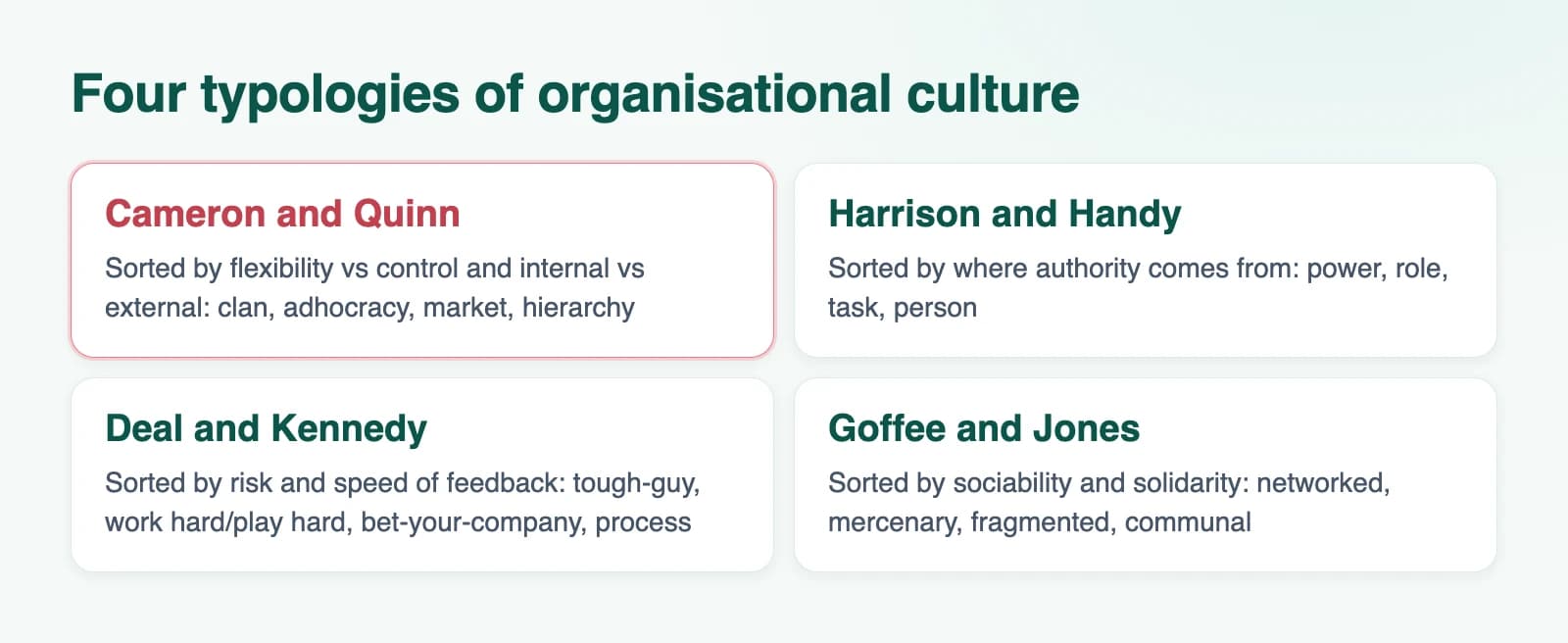
| The classic typologies | What kind of place is this, in a word? | A shared vocabulary: power, role, task, person and others | One label for the whole company hides its subcultures; none is a ranking |
Start from the decision, not from the model
Ask what you will decide with the result. The decision names the model.
| The decision you face | Start with | Why |
|---|---|---|
| A change has stalled, or a values launch is coming | Schein's three levels | It looks for the assumption that keeps the old behaviour in place |
| Leaders must agree the direction of a culture change | The Competing Values Framework and its questionnaire, the OCAI | It puts today's culture beside the one people prefer, and the gap becomes the agenda |
| The board asks whether the culture is normal | The Denison model | It answers with a comparison, in the language of performance |
| A sound strategy is not moving | The cultural web | It turns a vague culture problem into specific routines, symbols and controls |
| Managers move between countries, or one policy goes to several | Hofstede's national dimensions | They show where a practice may meet friction, as a hypothesis to test |
| Two companies merge, or sites differ | A model of everyday practice, such as Hofstede's organisational model | It compares units on what people do every day |
| A values programme is running and you must know whether behaviour is changing | Your own survey, with each value written as behaviour you can see | No ready-made model contains your values |
The seven models, one at a time
1. Schein's three levels
Every culture has three levels. Artifacts are what you can see and hear: structures, rituals, how meetings run. Espoused values are what the organisation says it stands for. Basic assumptions are beliefs so taken for granted that nobody discusses them, and they drive behaviour. When what you see contradicts what is said, the assumptions usually explain why. The model gives no number, which is why practitioners pair it with a survey. Read Schein's model of organizational culture.
2. The Competing Values Framework and the OCAI
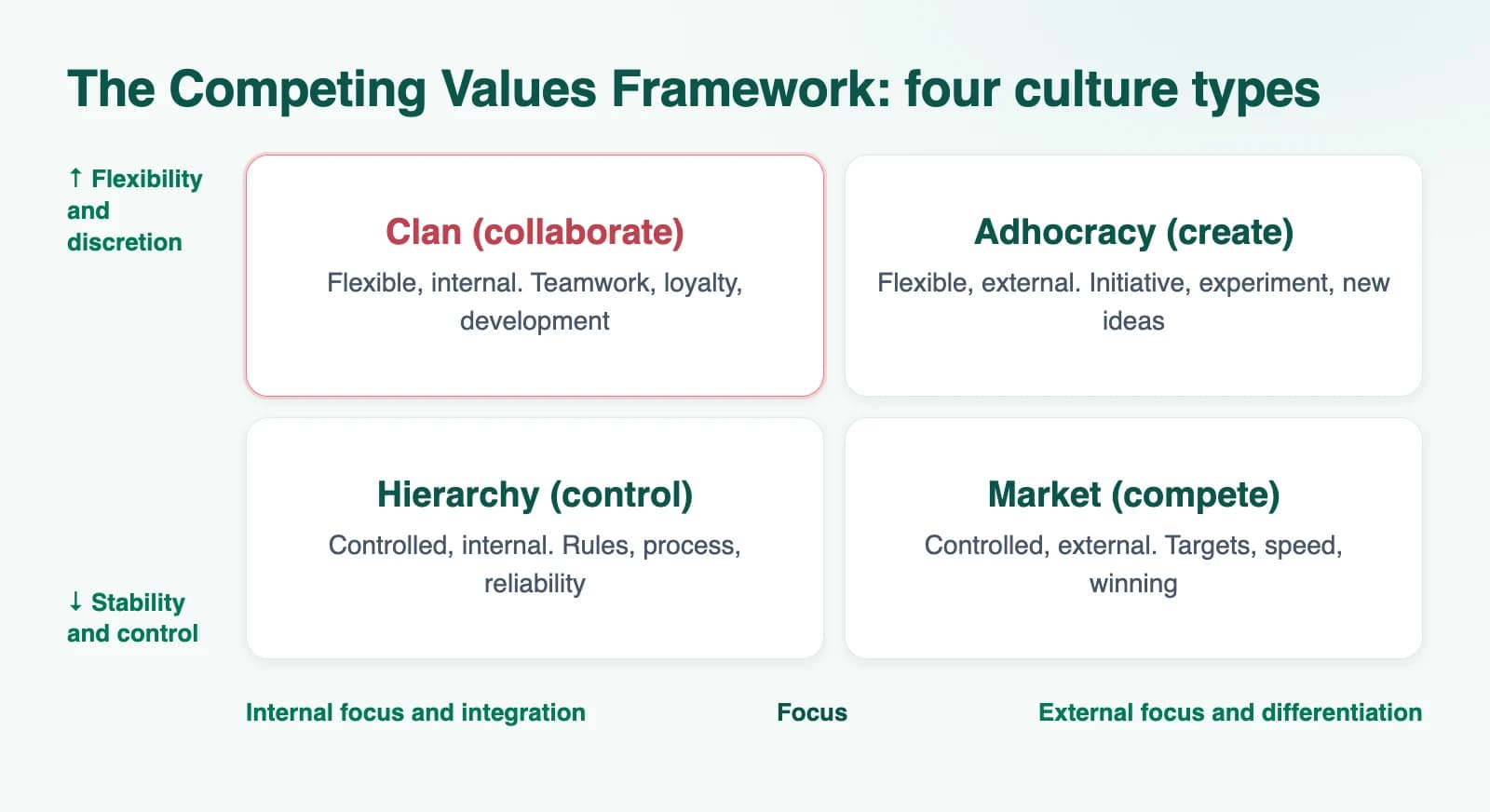
Two tensions: flexibility against stability and control, and an internal focus against an external one. The four combinations are four culture types: clan, adhocracy, market and hierarchy. The OCAI measures them by asking people to divide 100 points among four statements on six aspects of the organisation, once for today and once for the culture they would prefer. No type is good or bad in itself. Research supports the framework as a useful map, but not the claim that the four types are cleanly separate. Read the gaps, not the dominant type. Read the Competing Values Framework.
3. The Denison model
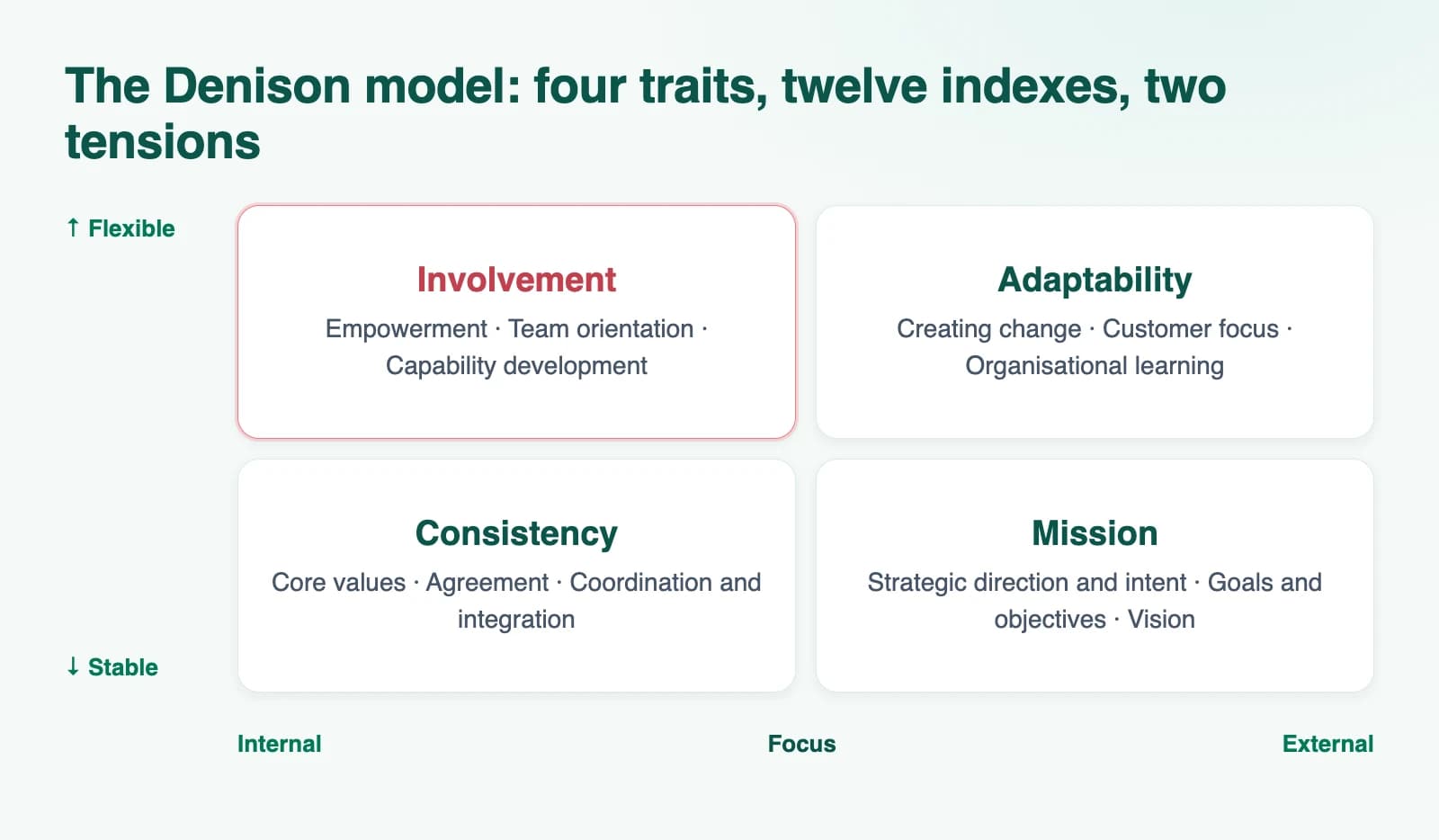
Four traits linked to performance: involvement, consistency, adaptability and mission. Each is measured through three indexes, twelve in all, and scores are reported as percentiles against the provider's database of other organisations. A percentile is a rank, not a mark out of 100. In a published analysis of 160 companies and 35,474 respondents, the company a person worked for explained only 6% to 10% of the differences in how individuals rated the culture. Most of the story sits between units, levels and locations. Read the Denison model.
4. The cultural web
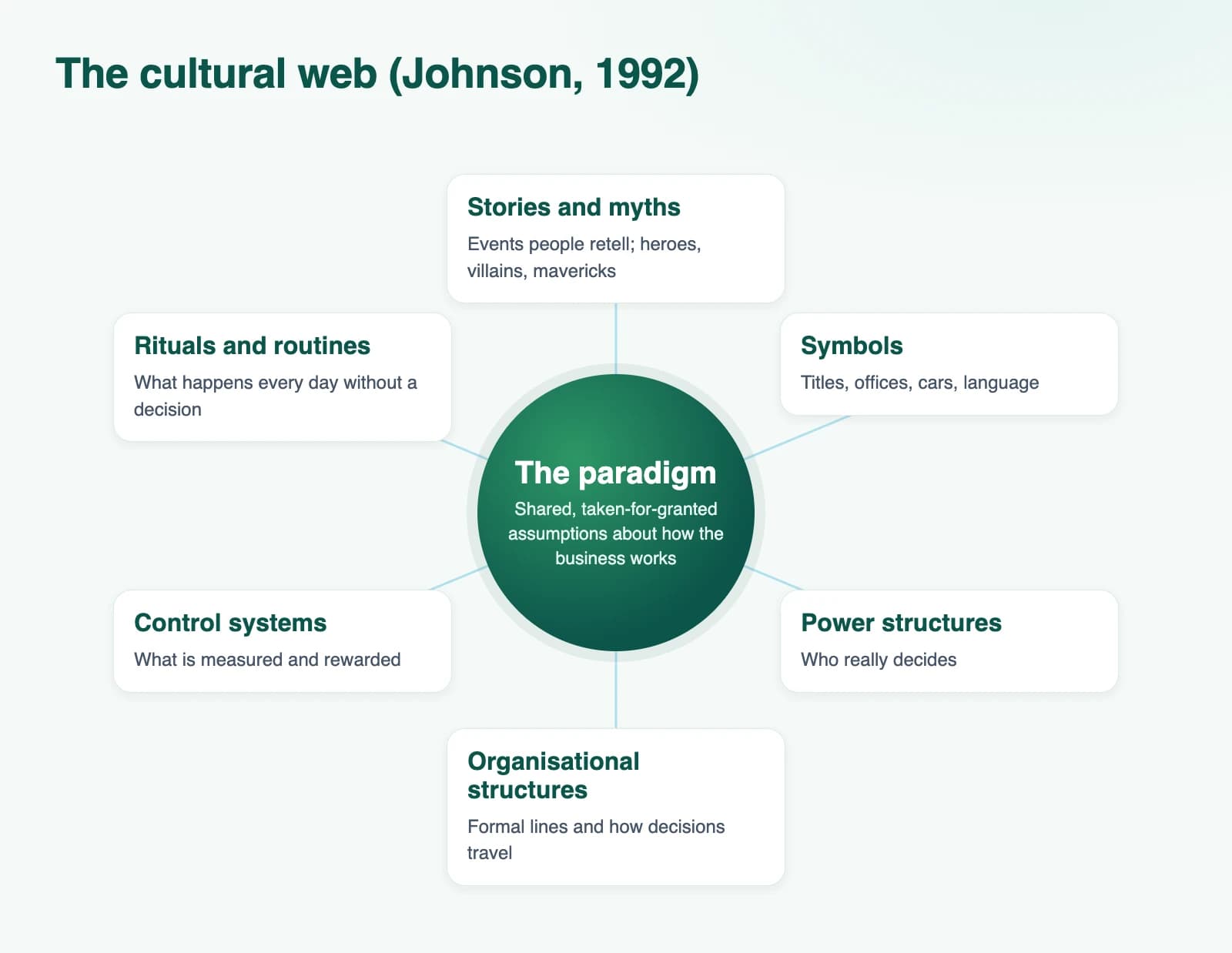
Developed by Gerry Johnson, and usually credited to Johnson and Kevan Scholes. At the centre is the paradigm: the shared, taken-for-granted assumptions about how the business works. Around it sit six elements that protect it: stories, rituals and routines, symbols, organisational structure, control systems and power structures. A team maps the culture it has, then the culture its strategy needs, then chooses what to change. Read the cultural web model.
5. Hofstede's national dimensions
Six scales for comparing national cultures: power distance, individualism versus collectivism, motivation towards achievement and success, uncertainty avoidance, long-term versus short-term orientation, and indulgence versus restraint. Each country's score is relative to other countries. Hofstede wrote that the scores "should not be used for stereotyping individuals". Use them to form hypotheses, then let your own employees' answers decide. Read Hofstede's cultural dimensions at work.
6. Hofstede's organisational model
Hofstede's research inside organisations produced six different dimensions, of everyday practice, such as process-oriented versus results-oriented, and open versus closed system. Each unit is scored on each dimension, which suits mergers and organisations with many sites. It rests on one 1990 study of 20 units in 10 organisations in Denmark and the Netherlands, and the versions sold today are proprietary, so ask who administers and interprets them. Read culture assessment tools compared.
7. The classic typologies
Roger Harrison and Charles Handy sort culture by where power and authority come from: power, role, task and person. Terrence Deal and Allan Kennedy sort it by business risk and the speed of feedback. Rob Goffee and Gareth Jones sort it by how friendly people are and how strongly they pursue shared goals. None of them is a ranking. Find your type from decisions and behaviour, not from the values poster. Read types of organizational culture.
Four mistakes that cost the most
| The mistake | What happens | What to do instead |
|---|---|---|
| Reading a percentile as a mark | A 34 is read as a failed exam, when it is a rank against other organisations | Compare the traits with each other, and your units with each other, before you read the rank |
| Reporting only the dominant type | "We are a hierarchy" ends the conversation | Report the gap between today and preferred, and the gap between units |
| Using a country score on a person | A manager is told not to ask the team for ideas, because of a national average | Treat the score as a hypothesis, design for it, and measure what people do |
| Changing the instrument every year | Every year becomes a new baseline | Choose one instrument and keep it |
What no model does
- No questionnaire reaches the deepest layer. A survey reads what people report. Stories, decisions and records explain it.
- No model is neutral about language. Most instruments were written in English, and a translated item can change its meaning. Read the Arabic before launch, as an employee would.
- No model sees one culture where there are several. Read the results by site, level and profession before you read the average.
- No model chooses for you. Each one ends with a profile or a map. Choosing the two or three behaviours to change is still a decision for leaders.
A first month
- Week one: write the decision. One sentence: what will we decide with the result, and who decides.
- Week two: choose one lens for numbers and one for reasons. A survey gives the profile. Interviews, focus groups and a look at records such as promotion decisions explain it.
- Week three: test the wording. Read every item in Arabic and in English with a few employees from the frontline and from head office.
- Week four: run it, and read the gaps before the averages. Then choose two or three behaviours, make them visible through leaders, recognition and decisions, and measure again in about twelve months.
At GoldinKollar we combine the two kinds of evidence. Persona Quest, our scenario-based diagnostic mapped to the OCAI, shows the current and the desired culture by unit and role. A culture audit explains the gaps through leadership interviews, focus groups in Arabic and English, and a review of the records that govern behaviour.
Sources
The seven articles carry the full reference lists. The main works behind them:
- Schein, E.H. with Schein, P. (2017), Organizational Culture and Leadership, 5th edition, Wiley.
- Cameron, K.S. and Quinn, R.E. (2011), Diagnosing and Changing Organizational Culture, 3rd edition, Jossey-Bass.
- Hartnell, C.A., Ou, A.Y. and Kinicki, A. (2011), "Organizational culture and organizational effectiveness", Journal of Applied Psychology 96(4), 677-694.
- Helfrich, C.D., Li, Y.-F., Mohr, D.C., Meterko, M. and Sales, A.E. (2007), "Assessing an organizational culture instrument based on the Competing Values Framework", Implementation Science 2, 13.
- Denison, D., Nieminen, L. and Kotrba, L. (2014), "Diagnosing organizational cultures", European Journal of Work and Organizational Psychology 23(1), 145-161.
- Johnson, G. (1992), "Managing strategic change: strategy, culture and action", Long Range Planning 25(1), 28-36.
- Hofstede, G. (2011), "Dimensionalizing cultures: the Hofstede model in context", Online Readings in Psychology and Culture 2(1).
- Hofstede, G., Neuijen, B., Ohayv, D.D. and Sanders, G. (1990), "Measuring organizational cultures", Administrative Science Quarterly 35(2), 286-316.
- Harrison, R. (1972), "Understanding your organization's character", Harvard Business Review.
- Deal, T.E. and Kennedy, A.A. (1982), Corporate Cultures: The Rites and Rituals of Corporate Life, Addison-Wesley.
- Goffee, R. and Jones, G. (1996), "What holds the modern company together?", Harvard Business Review, November-December.
Know someone who should read this?
Share it on LinkedIn with a post that is already written. You can change it before you publish.
Follow GoldinKollar on LinkedInTake this to your leadership with a plan, not an article.
Tell us what you are facing. In a 30-minute diagnosis call we tell you what we would measure first, which program fits and what it would take. We reply within one business day.
Messages and calls reach Islam Yousry, our Head of Research and Strategy, directly.