
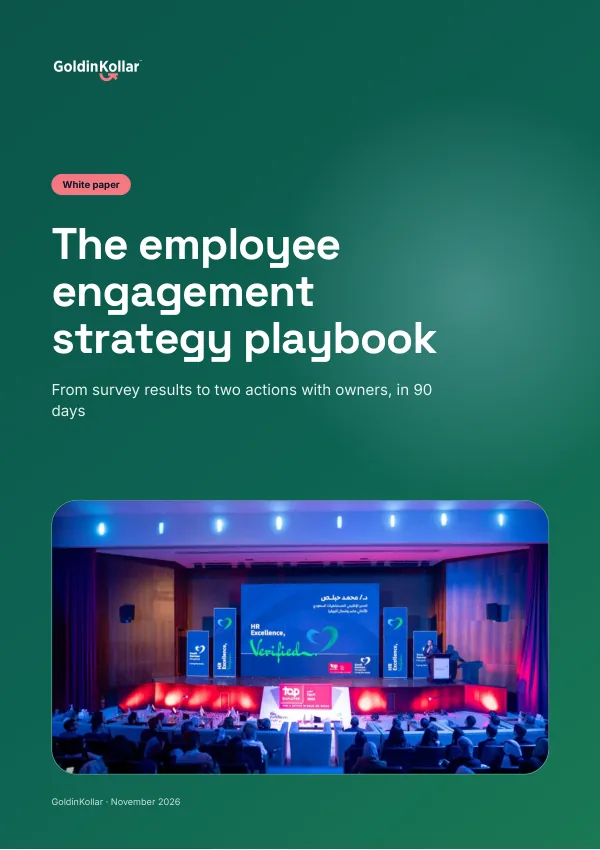
The employee engagement strategy playbook
From a set of results to two actions with owners, in 90 days: how to diagnose by group, name the fault, choose the kind of action the evidence supports, and check whether it worked.
What is inside
- What an engagement strategy can change, with the effect sizes from two reviews
- Three kinds of evidence, and the rule for when to act
- One sentence that names the fault
- Four kinds of action, and what the research found for each
- A scoring grid that takes many ideas down to two
- The plan on one page, the 90 days week by week, and a card for managers
From the work

A facilitator opens a session with colleagues seated at round tables.
The engagement results arrive in March. By April there is a plan with fourteen initiatives, a launch event and a logo. By the next survey the score has not moved, and nobody can say which of the fourteen was supposed to move it.
This playbook is the opposite of that plan. It takes one People and Culture team from a set of results to two actions with owners, in 90 days. It is a method, and where it leans on published research the study is named and listed at the end.
The short version
- Diagnose before you choose. Three kinds of evidence, read by group. Act only where two of them agree.
- Name the fault in one sentence. If you cannot, you are not ready to pick a strategy.
- Change the work before you add a programme. The evidence favours changing what people have to work with over adding activities.
- Keep two actions. Each with an owner, a group, a first move and a measure agreed in advance.
- Run it through managers, thirty minutes a month.
- Check at day 90, on the driver you aimed at. Then keep, change or stop.
What can an engagement strategy change, and what can it not?
Start with honest expectations. They decide what you promise your chief executive.
- Engagement can be raised, modestly. A meta-analysis of controlled engagement interventions found an overall effect that was small but positive (Hedges g = 0.29, from 14 studies), with a medium to large effect for interventions run with groups (Knight, Patterson and Dawson, 2017).
- About half of attempts show nothing. A later review of 40 intervention studies found that 20 had a significant positive effect, 18 had no effect and two had a negative one. Employee participation and manager support made a difference, and the bottom-up kind did best (Knight, Patterson and Dawson, 2019).
- Engagement is tied to results, with limits. A meta-analysis of 7,939 business units in 36 companies found relationships between employee satisfaction and engagement in a unit and its customer satisfaction, productivity, profit, turnover and accidents (Harter, Schmidt and Hayes, 2002). A synthesis of 214 studies found the evidence most robust for task performance, and warned that most studies cannot prove cause (Bailey and colleagues, 2017).
So promise direction and method. Do not promise points on an index by a date.
Step 1: what does the evidence say, group by group?
Weeks one to three. Collect three kinds of evidence for each group you can report safely: a site, a function, a grade band, a length of service.
| Evidence | What to pull | What it tells you |
|---|---|---|
| What people say in numbers | The lowest three drivers in the survey, for each group | Where it hurts, and for whom |
| What people do | Leavers in the first year, unplanned absence, internal moves, the survey response rate | Whether the score shows up in behaviour |
| What people say in words | Open comments, two focus groups, five stay interviews | Why |
The rule: act where two of the three agree. A low recognition score with no echo in behaviour or comments may be the mood of the survey month. A low score at one site, rising early turnover at that site and comments about favouritism are one problem seen three times.
If you have no survey, the free employee survey templates and the turnover calculator are enough to start. If scores fell everywhere in a hard year, read why engagement scores drop in a hard year before you diagnose anything.
Step 2: can you name the fault in one sentence?
Write it in this form, once for each problem you found:
In [group], [driver] is weak. We see it in [behaviour]. People say: "[their words]".
For example: In the night shift at the distribution centre, role clarity is weak. We see it in handover errors and first-year leavers. People say: "Every supervisor wants it done a different way."
A sentence like this limits the problem to a group you can reach, gives you the measure in advance, and stops the meeting from jumping to solutions. The next question becomes obvious: what would have to change for every supervisor to give the same instruction?
Step 3: which kind of action fits the fault?
Most menus of engagement ideas mix four different things. They do not have the same evidence behind them.
| Kind of action | What it changes | What the research found | Use it when the fault is about |
|---|---|---|---|
| Change what people have to work with | Clarity, feedback, say, support, tools, the manager's time | Engagement was predicted only by job resources in four samples (Schaufeli and Bakker, 2004). Training workers to improve their own jobs, or training with job redesign, may improve wellbeing and performance (Daniels and colleagues, 2017) | Roles, handovers, decisions, recognition, growth |
| Act on what people told you | Whether feedback leads to visible change | Groups that made action plans from survey feedback improved more on leadership and commitment than groups that only received feedback (Björklund and colleagues, 2007) | "Nothing changes here", falling response rates |
| Build managers' skill | How managers brief, listen and follow up | Only three of the 40 studies in the 2019 review tested leadership training: too few to rank it | One team far below the rest |
| Build people's own resources | Confidence, coping, job crafting | Bottom-up actions, job crafting among them, did best in the 2019 review | Capable people stuck in rigid jobs |
Events, gifts and campaigns are not in the table. They carry a message and mark a moment, and they are worth doing for that. They do not repair a fault in how work is organised.
Step 4: how do you get from many ideas to two?
List every action the team proposes. Score each from 0 to 3 on four questions.
| Question | 0 | 3 |
|---|---|---|
| Does it fit the fault we named? | It is a nice thing to do | It changes the condition in the sentence |
| Is it ours to change? | Needs a budget or a decision we do not have | Managers can start on Monday |
| Does one person own it? | A committee | A named person with time |
| Will people see it within 90 days? | A policy in a folder | Something that happens in their week |
Keep the two highest. Write the rest on a "not now" list and show that list to leaders, so that nobody adds a third in week five. With twelve actions running, nobody can tell which one worked.
The plan, on one page
| Line | What you write |
|---|---|
| The fault | The sentence from step 2 |
| The group | Who, where, how many |
| The action | What will be different in their week |
| The first move | What happens in the first ten working days |
| The owner | One name |
| What managers do | Thirty minutes a month: see below |
| The measure | The driver item, in this group, asked the same way as the baseline |
| The behaviour we expect | One figure that should follow: early leavers, absence, response rate |
| The check | Dates for day 45 and day 90 |
| Not now | What we chose not to do |
The 90 days, week by week
| When | What happens |
|---|---|
| Weeks 1 to 3 | Read the three kinds of evidence by group. Hold the focus groups |
| Week 4 | Write the fault sentences. Score the options. Leaders approve two actions and the "not now" list |
| Week 5 | Brief managers before anyone else: what we heard, what we will change, what we ask of you |
| Week 6 | Tell employees: what you said, the two things we will do, who owns each, when we report back |
| Weeks 6 to 12 | Run the actions. The owner reports on one page every two weeks |
| Week 9 | A short note to everyone: what has happened so far, with one example |
| Week 13 | Ask the targeted groups five questions on the drivers. Decide for each action: keep, change or stop |
The note in week nine matters. In Gallup's 2024 research only 8% of employees strongly agreed that their organisation takes action on surveys, and 38% did not know whether it takes any. Much of a strategy is making action visible.
What do managers do, in thirty minutes a month?
Strategies die between the head office and the team. Give every manager one card.
- Say what we heard, in the team's own results, in two minutes.
- Say the one thing that changes for this team, and when.
- Ask one question: "What is getting in the way of doing your best work this month?"
- Take one thing away with you, and report back on it next time.
A manager who does these four things each month is carrying the strategy. A manager who forwards the slides is not.
How do you tell whether it worked?
Check three things together at day 90, each in the group you aimed at:
- The driver: the same question, the same wording, the same group as the baseline. It should move before the overall index does.
- The behaviour: the figure you named in the plan.
- The words: what people say unprompted in a focus group or a stay interview.
Two of three moving in the right direction is a result. If nothing has moved after two checks, change the action instead of defending it. Then test the plan against the four enablers that David MacLeod and Nita Clarke's research found behind successful engagement: a strong story of where the organisation is going, managers who engage their people, a voice for employees throughout the organisation, and values that are reflected in daily behaviour.
What should you not promise?
- A number. The index also moves with pay rounds, restructures and the news.
- A return on investment in advance. The link between engagement and results is real across business units. It gives no figure for your company.
- One programme for everyone. The fault at the night shift is not the fault at head office.
- That activity is progress. Attendance at a launch is not engagement.
A checklist to keep
- Three kinds of evidence, read by group, and action only where two agree
- One sentence for each fault
- The work changed before a programme is added
- Two actions, one owner each, and a "not now" list
- Managers briefed before employees, and a note to everyone in week nine
- The same question at day 90 as at the start
- Keep, change or stop, decided on evidence
For the reasoning behind each strategy, see our article on employee engagement strategies. To find the weakest driver in each group, the GK Engagement Survey asks people to choose between the things they want.
Sources
- Knight, C., Patterson, M. and Dawson, J. (2017), "Building work engagement: a systematic review and meta-analysis investigating the effectiveness of work engagement interventions", Journal of Organizational Behavior 38(6), 792–812. doi.org
- Knight, C., Patterson, M. and Dawson, J. (2019), "Work engagement interventions can be effective: a systematic review", European Journal of Work and Organizational Psychology 28(3), 348–372. doi.org
- Harter, J. K., Schmidt, F. L. and Hayes, T. L. (2002), "Business-unit-level relationship between employee satisfaction, employee engagement, and business outcomes: a meta-analysis", Journal of Applied Psychology 87(2), 268–279. doi.org
- Bailey, C., Madden, A., Alfes, K. and Fletcher, L. (2017), "The meaning, antecedents and outcomes of employee engagement: a narrative synthesis", International Journal of Management Reviews 19(1), 31–53. doi.org
- Schaufeli, W. B. and Bakker, A. B. (2004), "Job demands, job resources, and their relationship with burnout and engagement: a multi-sample study", Journal of Organizational Behavior 25(3), 293–315. doi.org
- Daniels, K., Gedikli, C., Watson, D., Semkina, A. and Vaughn, O. (2017), "Job design, employment practices and well-being: a systematic review of intervention studies", Ergonomics 60(9), 1177–1196. doi.org
- Björklund, C., Grahn, A., Jensen, I. and Bergström, G. (2007), "Does survey feedback enhance the psychosocial work environment and decrease sick leave?", European Journal of Work and Organizational Psychology 16(1), 76–93. doi.org
- Gallup (2024), "How action plans propel engagement", 12 November 2024. gallup.com
- MacLeod, D. and Clarke, N., "The four enablers of engagement", Engage for Success. engageforsuccess.org
Know someone who should read this?
Share it on LinkedIn with a post that is already written. You can change it before you publish.
Follow GoldinKollar on LinkedInTake this to your leadership with a plan, not an article.
Tell us what you are facing. In a 30-minute diagnosis call we tell you what we would measure first, which program fits and what it would take. We reply within one business day.
Messages and calls reach Islam Yousry, our Head of Research and Strategy, directly.