
Pulse survey or annual engagement survey: pros, cons and a rhythm that works
The short answer: run a full engagement survey every year or two to find where the problems are. Use short pulse surveys in between only to check whether a specific action worked or to follow a change. A pulse is not a faster annual survey: in the one field test we found, pulse scores barely moved in eight months.
Pulse survey or annual survey: how do they compare?
| Option | Pros | Cons | Best when |
|---|---|---|---|
| Full engagement survey, once a year or every two years | Covers every driver. Enough questions and answers to compare teams, sites and grades. Gives a baseline | Slow from question to action. A heavy project. Results age | You need to know where the problems are and which groups have them |
| Pulse survey, a few questions, monthly or quarterly | Quick to answer and to read. Keeps one or two topics in view. Shows people their voice is still wanted | Too short to explain why. Weak at telling teams apart. Becomes noise if nothing follows | You are checking whether an action worked, or following a change month by month |
| Both, in a planned rhythm | The full survey finds the problem, the pulse checks the fix | Needs discipline: every round must lead to something people can see | Organisations that already act on results |
What does the research say?
Less than vendors suggest. One researcher who tested pulse surveys noted that, despite their popularity and marketing, there is little research on the practice (Brown, 2022).
A pulse can estimate the overall mood, and not much more. Brown ran a four-wave pulse survey in a health care organisation. The pulses gave reliable estimates of overall engagement, but scores stayed stable across eight months, and practically no differences between groups or trends could be found, even with about 50% participation. His conclusion: pulse surveys may be adequate for estimating overall sentiment, but not for detecting change over time or differences between groups.
Pulses depend on managers, and they raise ethical questions. An interview study of sixteen people in organisations that use pulse surveys found that success required sustained commitment from line managers. It also raised concerns about surveying groups with only a few employees and about managers who are "constantly under the magnifying glass". The authors conclude that pulse surveys can complement a comprehensive annual assessment (Berthelsen and Muhonen, 2026).
The follow-up matters more than the frequency. In Gallup's 2024 research, 8% of employees strongly agreed that their organisation takes action on surveys, and 38% did not know whether it takes any. In a three-year study of 1,236 employees, groups that made action plans from survey feedback reported greater improvements in leadership and commitment than groups that only received feedback (Björklund and colleagues, 2007).
We found no study that sets a safe number of surveys a year. What the evidence supports is narrower: ask as often as you can show people what their answers changed.
When should you choose a full survey?
- You do not have a baseline, or the last one is more than two years old.
- You need to compare groups: sites, functions, grades, length of service.
- You do not yet know which driver is weak. A pulse cannot find a problem it does not ask about.
- Leaders want one clear picture to decide the year's priorities.
When should you choose a pulse survey?
- You acted on the last survey and want to know whether it worked. Ask the same question, in the same words, of the same groups.
- A change is under way, a merger, a restructure or a new system, and you need to know month by month what people understand and what worries them.
- You have a team ready to read each round and respond within weeks.
Do not run a pulse because the annual survey felt slow. If the full survey produced no action, a shorter survey will produce no action faster.
What does a good rhythm look like?
| When | What you run | What follows |
|---|---|---|
| Month 0 | Full survey | Results to every manager, one action for each team |
| Month 3 | Pulse: five to ten questions on the drivers you acted on | Tell people what moved and what did not |
| Month 6 | Pulse, same questions | Adjust or stop the actions that are not working |
| Month 12 | Full survey again | Compare with the baseline, group by group |
Quarterly is enough for most organisations. Monthly fits a change programme with a team ready to act each month. Our guide to pulse survey questions has the questions, the length and how to read small movements without overreacting.
What does each option cost in effort?
We do not publish prices. The effort differs more than people expect.
- A full survey is a project: questions, translation, communication, about two weeks of fieldwork, analysis by group, a readout for every manager and an action step. Plan for it once, and do it properly.
- A pulse looks light and is not. Each round needs someone to read it, tell people what was heard and act. Four pulses a year are four small projects. If nobody owns the reading, drop the pulse.
The hidden cost of surveying too often is trust. Every survey that leads nowhere lowers the response to the next one.
Our view
We run employee surveys for clients, so weigh this page with that in mind.
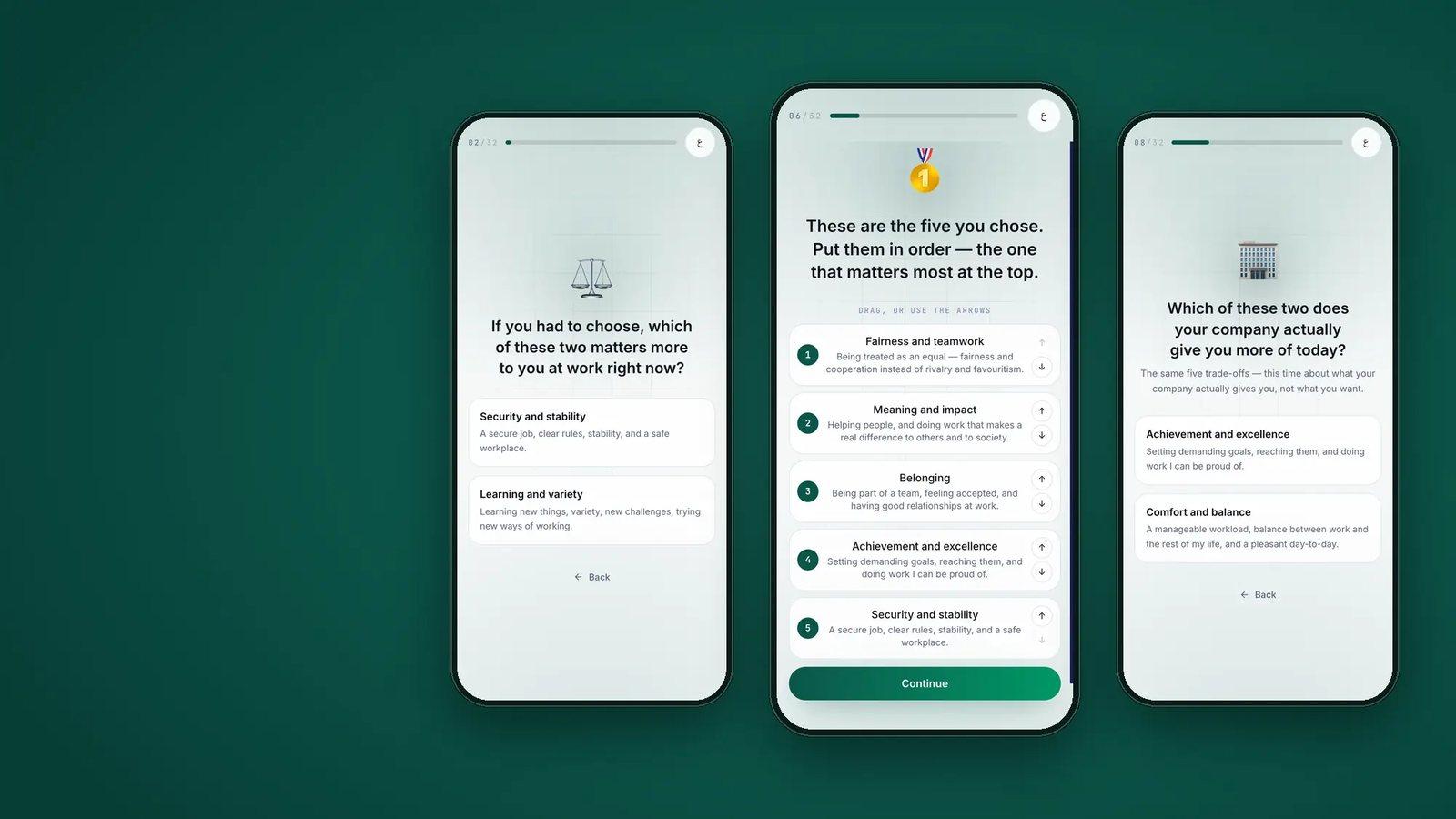
We start with one full survey, because nobody can fix what they have not found. Our GK Engagement Survey asks people to choose between things they want instead of rating their satisfaction, and it ends in one action for each group with an owner and a date. A pulse comes later, and only on the drivers that action was aimed at.
If you want to run it yourself, the employee survey templates are free, in Arabic and English. And if this year's scores fell and you are tempted to survey again to find out why, read why engagement scores drop in a hard year first.
Frequently asked questions
Can pulse surveys replace the annual engagement survey?
Rarely. A pulse has too few questions to show why a score is low, and in the one published field test we found it could not tell groups apart. Use the full survey to find the problem and pulses to follow the fix.
How often should you run a pulse survey?
Quarterly suits most organisations. Monthly works during a change, when someone is ready to act on each round. Weekly is hard to justify. The real limit is how often you can show people that their answers led to something.
How many questions should a pulse survey have?
Usually five to fifteen, and no more than about five minutes on a phone. Fewer than five rarely explains anything. Past fifteen it is a short annual survey, with the costs of both.
Is survey fatigue real?
People tire of surveys that disappear more than of surveys. In Gallup's 2024 research only 8% of employees strongly agreed that their organisation acts on surveys. The usual cure is fewer surveys, each followed by something people can see.
Should a pulse survey be anonymous?
Apply the same rules as the full survey: no results for groups below your minimum size, and no promise you cannot keep. Small teams surveyed often are the easiest to identify, so pulses need more care, not less. See are employee surveys anonymous?
What is the difference between a pulse survey and an engagement survey?
An engagement survey is a full baseline across many topics, run once a year or less. A pulse is a short repeat of a few questions. The first finds problems. The second checks progress.
Sources
- Brown, M. I. (2022), "Investigating the promise and pitfalls of pulse surveys", Industrial and Organizational Psychology 15(1), 137–149. doi.org
- Berthelsen, H. and Muhonen, T. (2026), "Taking the pulse: a qualitative study on pulse survey implementation", Frontiers in Organizational Psychology 3, 1696769. doi.org
- Gallup (2024), "How action plans propel engagement", 12 November 2024. gallup.com
- Björklund, C., Grahn, A., Jensen, I. and Bergström, G. (2007), "Does survey feedback enhance the psychosocial work environment and decrease sick leave?", European Journal of Work and Organizational Psychology 16(1), 76–93. doi.org
Know someone who should read this?
Share it on LinkedIn with a post that is already written. You can change it before you publish.
Follow GoldinKollar on LinkedIn