
In-house or agency for employee events and team days: pros, cons and how to choose
The short answer: organise a team day in-house when it is small, simple and meant to be social. Use an agency when the day has to change how people work together, involves a large crowd, or must carry a message. The research points one way: what the day is designed to do matters more than who runs it.
In-house, a ready-made package or an agency: how do they compare?
Most companies choose between three options, not two.
| Option | Pros | Cons | Best when |
|---|---|---|---|
| In-house: HR or an office team plans it | Knows the people and the inside jokes. No brief to write. Full control | Takes weeks from people who have other jobs. Little experience of crowds, safety and suppliers. The organisers cannot take part | One team or one floor, a simple format, a social goal |
| A ready-made package from a venue or an activity provider | Quick to book. Predictable. Someone else runs the games | The same day they sold last week. Not tied to your goal. Nothing happens afterwards | You need a pleasant day soon and expect nothing more from it |
| An agency that designs and runs the day | Built around what your teams need to do better. One party answers for the crew, the kit and the safety. Film and photos you can use | Needs a brief, a decision-maker and lead time. A poor brief still gives a poor day | A large group, a message to land (an anniversary, values, a merger), or a problem between teams |
When should you run it in-house?
Run it yourself when most of these are true:
- Fewer people than one person can keep an eye on, in a place you already know.
- The goal is honest and simple: thank people, let them meet, mark the end of a hard quarter.
- Someone on the team enjoys organising and has the hours.
- Nothing about the day is risky: no water, no heights, no long travel.
You do not need an outsider for a lunch and a football match.
When should you use an agency?
Use an agency when most of these are true:
- The day has a job to do: two departments that do not cooperate, a new structure, values that exist only on a wall.
- The crowd is large or spread over several sites and shifts.
- Leaders will speak, and what they say has to fit the rest of the day.
- You want the organisers to take part instead of holding a clipboard.
- You need the record: a film, photographs, something to show the people who were on shift.
What does the research say?
We found no study that compares team days run in-house with team days run by an agency. The research is about design, and it is useful.
Team building works, moderately, when it has a purpose. A meta-analysis of team-building studies, based on 60 correlations, found a positive, moderate effect across team outcomes, strongest for how members feel about the team and how they work together. It examined four components: goal setting, interpersonal relations, problem solving and role clarification (Klein and colleagues, 2009). An afternoon of games with none of those is entertainment.
The talk afterwards does much of the work. A meta-analysis of 46 samples (2,136 people) found that structured debriefs improved performance by about 25% on average compared with a control group, and its results pointed to the value of facilitation and structure (Tannenbaum and Cerasoli, 2013). Most company days end with a group photo. The ones that change something end with a talk about what the team will do differently.
Team building is one of four tools. A review in American Psychologist describes four evidence-based ways to develop teams: team training, leadership training, team building and team debriefing (Lacerenza and colleagues, 2018). If your problem is skill or leadership, a team day is the wrong tool whoever runs it.
So the test is the same for every option: a goal the activities serve, and a debrief that turns the day into something people do on Monday. An in-house team can meet that test. Many agencies fail it. Our article on whether team building works covers the evidence in full.
What does each option cost in effort?
We do not publish prices. Here is where the effort goes.
- In-house: the venue, transport, catering, permits, suppliers, a run-of-show, a host, first aid and photography. In our planning template a comfortable schedule is eight weeks. Those are weeks taken from someone's real job, and on the day the risk sits with HR.
- A ready-made package: a booking and a headcount. Little effort, and little that is yours.
- An agency: one brief, one person who can approve, a site visit, and two or three review points. You should not be chasing suppliers.
The budget is driven by the same five things in every option: the number of people, the venue, travel, what has to be built, and whether you film it. Ask for those lines priced separately.
What should you ask an agency before you sign?
- What will our teams do better afterwards, and how is each activity tied to that?
- Who writes the challenges, and can we see a full day you ran, not a highlights reel?
- Who is on site, in what numbers, and who is responsible for safety?
- Do you facilitate in Arabic and in English?
- What happens in the week after the day?
- What do we keep: films, photos, templates, the kit?
Our view
We design and run team days, so weigh this page with that in mind.
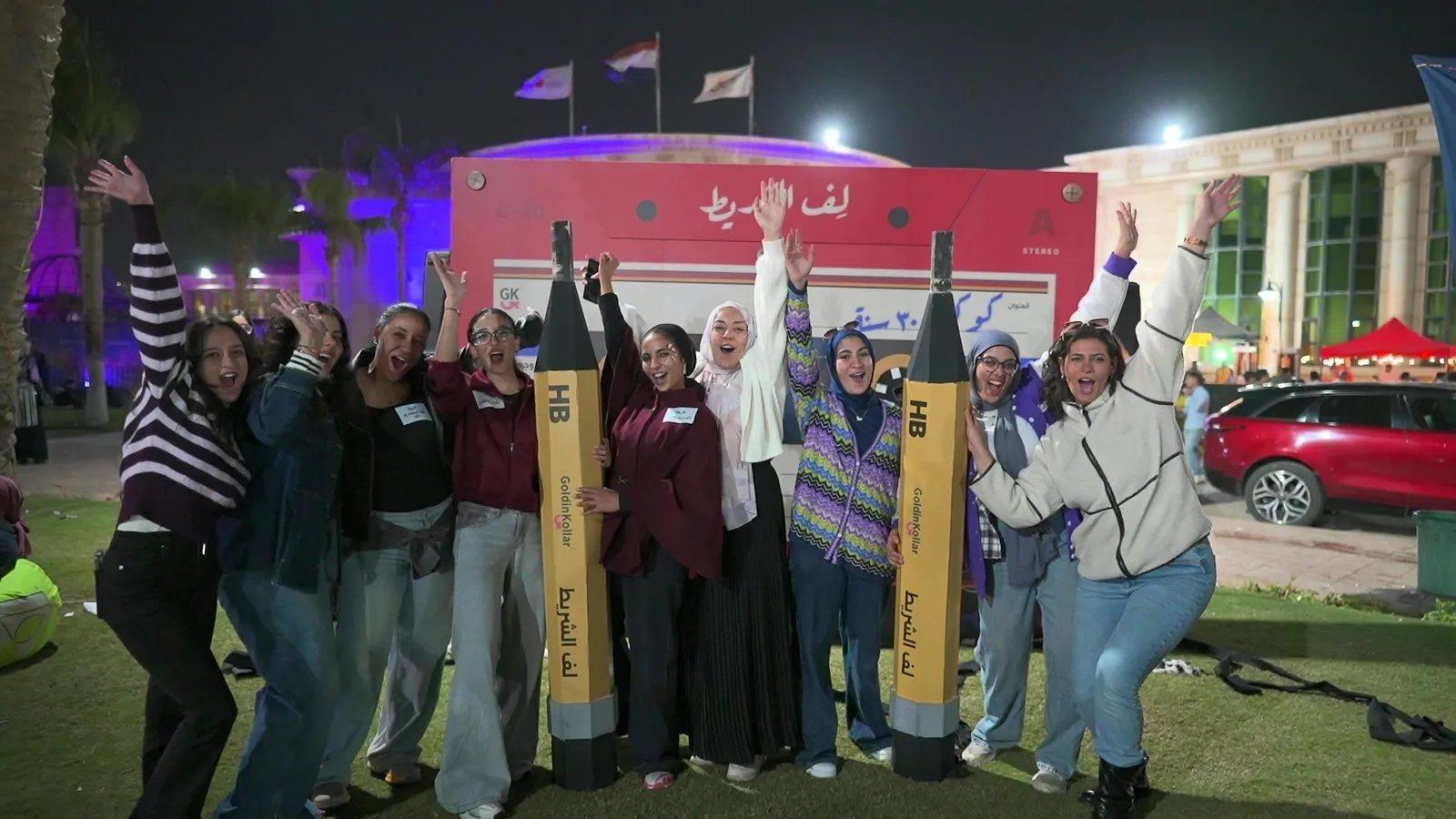
Every challenge we build starts from what the teams need to do better together, then we make the games, stands, kits and team identities, bring the facilitators and film the day. Two published examples: MSA University's 30th anniversary team day, played as five games, and, for an anniversary brought to the office floor, etisalat Egypt's 18th anniversary. Our team building page describes the work.
If your day is small and social, run it yourself. Our team day and activation templates and the employee activation playbook are free and were written for that: a brief, a week-by-week plan, station sheets, a safety walk and five questions for the morning after.
Frequently asked questions
How much does a team building day cost?
It depends on the number of people, the venue, travel, what has to be built and whether the day is filmed. A day for fifty people at your own site and a day for a thousand at a resort are not the same product.
How far ahead should you plan a team day?
Eight weeks is comfortable, and four is possible for a simple idea at your own site. Large days with travel, permits or custom-built sets need longer. The step most often left too late is briefing managers.
Should a team day be indoors or outdoors?
Decide from the goal, then the season. In Egypt and the Gulf, summer heat rules out most outdoor formats during the day. Indoor days are easier to control and to film. Outdoor days give space and energy but need a weather plan, shade, water and a stricter safety walk.
What is the difference between a team day and an activation?
A team day takes people out of their work for a day. An activation comes to them: a stand, a game or a set on the office floor that people join for a few minutes. Activations reach shift workers and busy teams that a full day cannot. Our team day and activation templates cover both.
Sources
- Klein, C., DiazGranados, D., Salas, E., Le, H., Burke, C. S., Lyons, R. and Goodwin, G. F. (2009), "Does team building work?", Small Group Research 40(2), 181–222. doi.org
- Tannenbaum, S. I. and Cerasoli, C. P. (2013), "Do team and individual debriefs enhance performance? A meta-analysis", Human Factors 55(1), 231–245. doi.org
- Lacerenza, C. N., Marlow, S. L., Tannenbaum, S. I. and Salas, E. (2018), "Team development interventions: evidence-based approaches for improving teamwork", American Psychologist 73(4), 517–531. doi.org
Know someone who should read this?
Share it on LinkedIn with a post that is already written. You can change it before you publish.
Follow GoldinKollar on LinkedIn